Rajya Sabha Polls: BJP Wins MP Seats as Rival Nomination Rejected
Source:The Hindu ↗
Why It Matters
This development highlights the constitutional and legal frameworks of Rajya Sabha elections, the authority of Returning Officers, the mandate of full disclosures in affidavits, and Rajya Sabha representation from Madhya Pradesh.
Summary
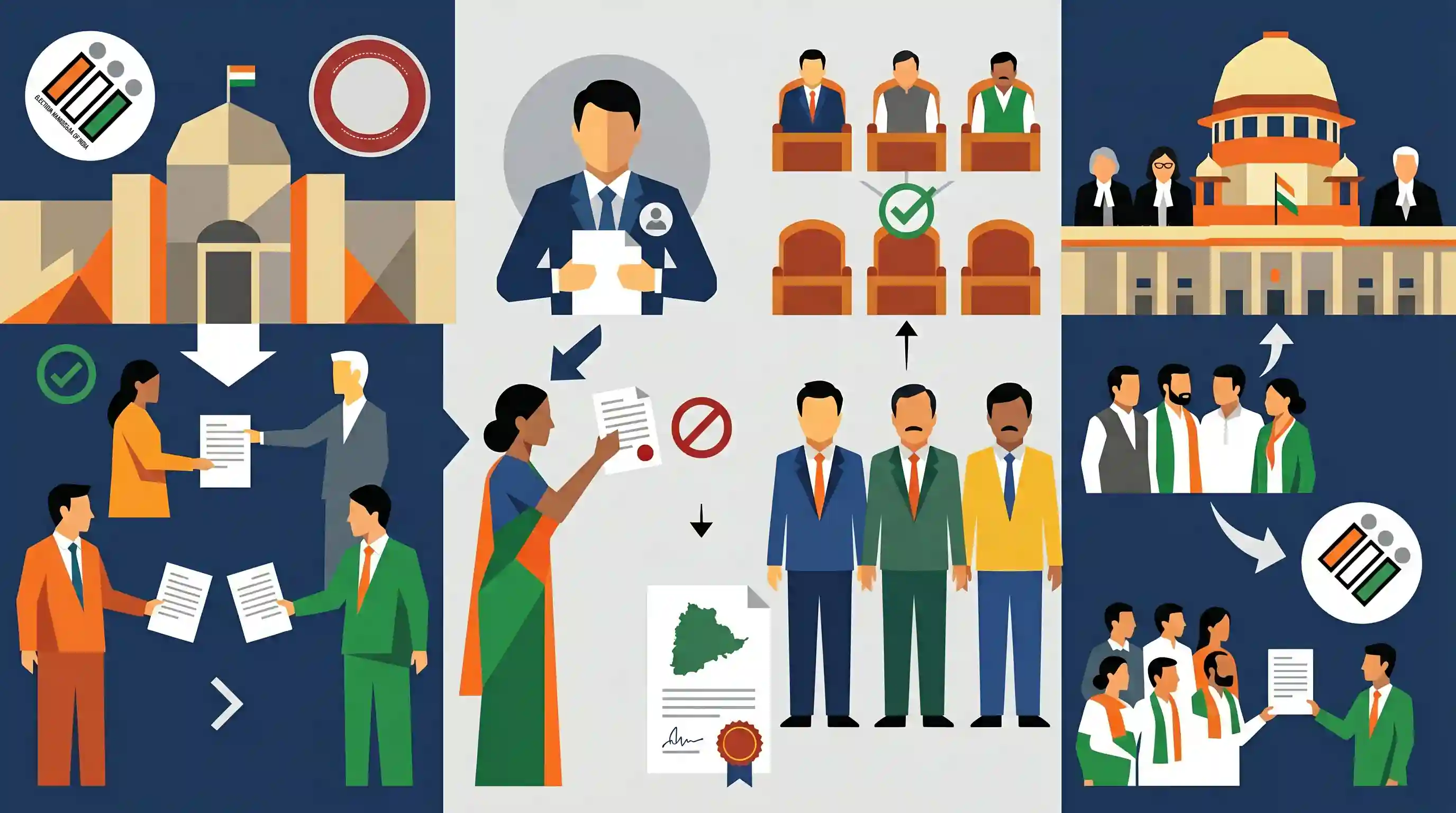
On June 11, 2026, three BJP candidates—Tarun Chug, Rajneesh Agrawal, and Mahesh Kewat—were elected unopposed to the Rajya Sabha from Madhya Pradesh after the nomination of Congress candidate Meenakshi Natarajan was rejected. Returning Officer Arvind Sharma rejected her nomination due to the non-disclosure of a Telangana legal notice in her poll affidavit, leading Congress to approach the Supreme Court and the Election Commission of India to challenge the decision.
Key Points
- Three BJP candidates—Tarun Chug, Rajneesh Agrawal, and Mahesh Kewat—were declared elected unopposed to the Rajya Sabha from Madhya Pradesh.
- The elections were prompted by three seats falling vacant due to the terms of Digvijaya Singh (Congress), Union Minister George Kurien (BJP), and Sumer Singh Solanki (BJP) coming to an end.
- Returning Officer Arvind Sharma (Principal Secretary of the MP Legislative Assembly) rejected the nomination of Congress candidate Meenakshi Natarajan on the grounds of non-disclosure of a legal notice in a Hyderabad-based case in her election affidavit.
- The Congress party challenged the rejection of Meenakshi Natarajan's nomination in the Supreme Court, petitioning the Election Commission of India and accusing the BJP and the returning officer of unconstitutional bias and 'seat theft'.
- Madhya Pradesh has 11 seats in the Rajya Sabha (Council of States), and its representatives are elected by the 230 members of the MP Legislative Assembly.
Important Terms
Representation of the People Act, 1951

A landmark legislation enacted by Parliament to regulate the conduct of elections, outline candidate qualifications and disqualifications, address corrupt practices, and resolve electoral disputes in India.
UPSC context
GS Paper II (Polity): Salient features of the RPA 1951, legislative disqualifications, and electoral reforms.
Election Commission of India (ECI)
An autonomous constitutional body established under Article 324 of the Constitution of India, responsible for administering and overseeing free, fair, and transparent national and state-level elections.
UPSC context
GS Paper II (Polity): Powers, structure, and functions of constitutional bodies overseeing democratic processes.
Supreme Court of India
The apex judicial body in India, established under Article 124, serving as the ultimate court of appeal, protector of fundamental rights, and final interpreter of the Constitution.
UPSC context
GS Paper II (Polity & Judiciary): Judicial review, landmark cases, and the balance of powers.
Constitution of India
The supreme legal document of India that establishes the political code, structure, powers, and duties of government institutions while guaranteeing fundamental rights and directive principles to citizens.
UPSC context
GS Paper II (Polity): Core principles, basic structure, federalism, and fundamental rights.
Prelims Trap
The Supreme Court can immediately strike down a Returning Officer's arbitrary rejection of a nomination paper during an ongoing election process.
Under Article 329(b) and the Ponnuswami precedent, judicial review of intermediate electoral steps is strictly barred until the election concludes, leaving an Election Petition as the sole remedy.
Static Concepts Connected
What constitutional restrictions govern judicial interference in the ongoing election process?
- Article 329(b): Strictly debars courts from entertaining challenges to any stage of an election except through an election petition filed after results.
- High Court Jurisdiction: Election petitions must be presented directly to the High Court of the respective state within 45 days of the declaration of results.
- Ponnuswami Case Precedent: The SC established that 'election' is a single continuous process; intermediate disputes cannot be used to stall or derail democratic exercises.
What legal norms govern Rajya Sabha elections regarding domicile, voting, and defection?
- Open Ballot System: MLAs must show their marked ballot to their party’s authorized agent; voting is not secret, unlike general Lok Sabha elections.
- Anti-Defection Exemption: The Tenth Schedule does not apply to Rajya Sabha elections; cross-voting MLAs cannot be disqualified, though parties can take disciplinary action.
- No Domicile Requirement: A candidate does not need to reside in the state they represent; they must only be a registered voter anywhere in India.
Cross-Topic Patterns
Electoral Integrity vs Judicial Restraint
Analyzes the balance between Article 324 (ECI's plenary authority) and Article 329(b), which strictly limits court intervention to ensure elections proceed without judicial stalling.
Voter Information and Article 19
Connects Returning Officers rejecting nominations for non-disclosure to the landmark ADR (2002) ruling, which established candidate transparency as part of the voter’s right to know.

Expect a multi-statement question testing Article 329(b)'s judicial bar alongside Rajya Sabha's open ballot and Tenth Schedule exemption.
Linked PYQs · 2
Linked PYQs · 2
- 2018MPPSC_PRELIMSGS1
Who among the following women won the by-edition in 2017 for the one Rajya Sabha seat from Madhya Pradesh?
- 2014MPPSC_PRELIMSGS1
In which article of Indian constitution provision of election commission is mentioned?
