Electoral mechanics and majority requirements in upper house elections
Source:Indian Express ↗
Why It Matters
Understanding the electoral mechanics, majority requirements, and anti-defection provisions related to the Rajya Sabha is fundamental for the UPSC Polity syllabus. It directly links to parliamentary functioning, federalism, and legislative processes.
Summary
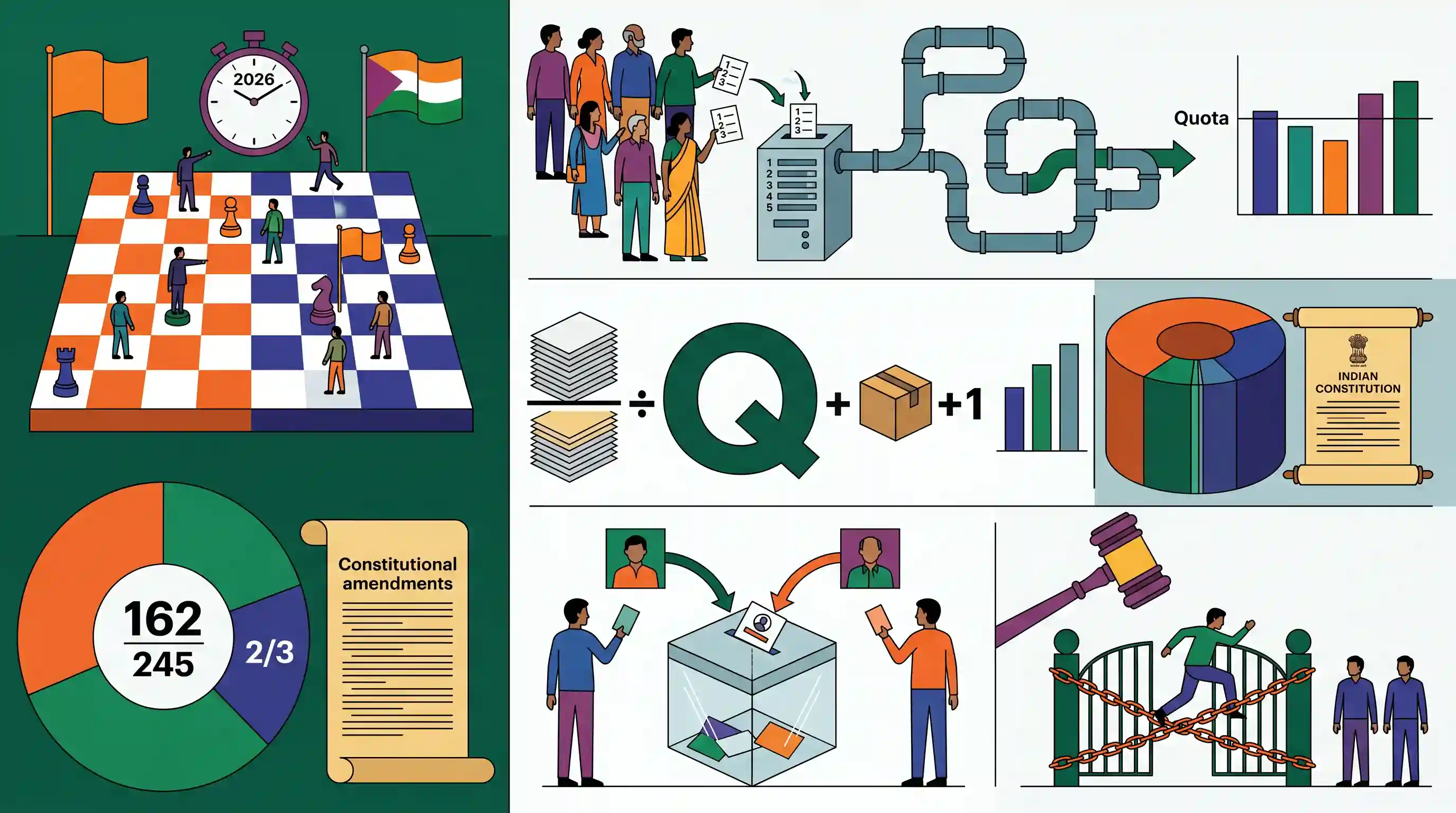
The article analyzes the political arithmetic and strategic importance of the upcoming 2026 Rajya Sabha elections for the National Democratic Alliance (NDA). It explains the complex voting mechanics—proportional representation by means of a single transferable vote—and the formula used to calculate the winning quota. Furthermore, it highlights the necessity of a two-thirds majority (162 seats) in the Upper House for passing Constitutional Amendment Bills. The piece also delves into the nuances of the open ballot system and how cross-voting occurs despite the anti-defection provisions of the Tenth Schedule, shaping the legislative balance of power in India's Parliament.
Key Points
- The ruling NDA coalition is aiming to secure 162 seats (a two-thirds majority) in the Rajya Sabha by the 2026 elections to independently pass Constitutional Amendment Bills.
- Rajya Sabha members are elected by MLAs using proportional representation by a single transferable vote, with a specific quota formula determining the winning threshold.
- Unlike the secret ballot used in general elections, Rajya Sabha elections employ an open ballot system where MLAs must show their vote to a party agent to enforce party discipline.
- Despite the open ballot and Tenth Schedule (anti-defection law), cross-voting remains a significant factor as dissenting MLAs often calculate the political costs of disqualification against other gains.
Important Terms
Rajya Sabha

The Upper House of Parliament ('Council of States'), a permanent body representing States and Union Territories. Members are elected indirectly for six-year terms, with one-third retiring every two years.
UPSC context
GS Paper II (Parliament). Vital for understanding federalism and the legislative role of the 'continuing chamber.'
Tenth Schedule
The 'Anti-Defection Law' added by the 52nd Amendment (1985). It disqualifies legislators for voluntarily quitting their party or voting against the party 'whip' without permission.
UPSC context
GS Paper II (Governance). Tests knowledge of political stability and the Presiding Officer's quasi-judicial powers.
Constitution Amendment Bill
Legislation under Article 368 to modify the Constitution. It requires a special majority in both Houses and cannot infringe upon the 'Basic Structure' of the Constitution.
UPSC context
GS Paper II (Constitution). Tests Article 368 procedures and the balance between constitutional flexibility and rigidity.
Single Transferable Vote (STV)
A voting system used in Rajya Sabha elections where voters rank candidates by preference. It ensures proportional representation by transferring surplus votes from winning or trailing candidates.
UPSC context
GS Paper II (Elections). Tests technical understanding of indirect election mechanics and minority representation.
Special Majority
The requirement for passing Constitutional Amendment Bills: a majority of the House's total membership AND at least two-thirds of those present and voting.
UPSC context
GS Paper II (Parliamentary Procedure). Tests precision in identifying thresholds for constitutional vs. ordinary lawmaking.
NDA (National Democratic Alliance)
A political coalition led by the Bharatiya Janata Party (BJP). In a UPSC context, it serves as an example of coalition governance and executive-legislative dynamics.
UPSC context
GS Paper II (Polity). Relevant for discussions on multiparty systems and coalition politics in India.
Prelims Trap
An MLA who cross-votes in a Rajya Sabha election is disqualified under the Anti-Defection Law (Tenth Schedule).
Cross-voting in a Rajya Sabha election does not attract disqualification under the Tenth Schedule. Parties cannot issue mandatory whips for these indirect elections.
Static Concepts Connected
How does the voting process for Rajya Sabha elections work?
- Indirect Election: Members are elected indirectly by the elected MLAs of the state using proportional representation by means of a single transferable vote (PR-STV).
- Open Ballot: An amendment to the RPA, 1951 introduced an open ballot system in 2003. MLAs must show their vote to an authorized party agent to prevent invalidation.
- Judicial Backing: The Supreme Court upheld the open ballot system in the Kuldip Nayar v. Union of India (2006) case, noting it prevents corruption.
What are the rules for passing a Constitutional Amendment Bill?
- Equal Powers: Under Article 368, the Rajya Sabha has equal powers with the Lok Sabha. The bill must be passed by a special majority in each house separately.
- Special Majority: A special majority requires a majority of the total membership of the House and a majority of not less than two-thirds of the members present and voting.
- No Joint Sitting: Unlike ordinary bills, the Constitution does not permit a joint sitting (under Article 108) to resolve a deadlock between the two Houses on amendment bills.
Cross-Topic Patterns
Open Ballot vs. Secret Electoral Funding
The Kuldip Nayar judgment upheld the 'open ballot' in RS elections to enforce political transparency, a stark contrast to the 'voter anonymity' arguments recently struck down in the Electoral Bonds case.
Tenth Schedule limits in indirect elections
The Anti-Defection law strictly applies to legislative voting within the House (trust votes, money bills), but does not apply to indirect elections like those for the President, Vice-President, or Rajya Sabha.

Expect a multi-statement Prelims question in 2026 contrasting the open ballot in RS elections with the 10th Schedule's non-applicability.
Linked PYQs · 5
Linked PYQs · 5
- 2020PrelimsGS1
Rajya Sabha has equal powers with Lok Sabha in
- 2022PrelimsGS1
Consider the following statements: 1. A bill amending the Constitution requires a prior recommendation of the President of India. 2. When a Constitution Amendment Bill is presented to the President of India, it is obligatory for the President of India to give his/her assent. 3. A Constitution Amendment Bill must be passed by both the Lok Sabha and the Rajya Sabha by a special majority and there is no provision for joint sitting. Which of the statements given above are correct?
- 2014PrelimsGS1
Which one of the following Schedules of the Constitution of India contains provisions regarding anti-defection?
- 2025MainsGS2
Indian Constitution has conferred the amending power on the ordinary legislative institutions with a few procedural hurdles. In view of this statement, examine the procedural and substantive limitations on the amending power of the Parliament to change the Constitution.
- 2022MainsGS2
Discuss the role of the Vice-President of India as the Chairman of the Rajya Sabha.
