Parliament Passes Modernized Indian Ports Legislation
Source:Indian Express ↗
Why It Matters
Modernising India's port laws is critical for enhancing maritime trade competitiveness, attracting private investment through improved ease of doing business, and aligning domestic regulations with international environmental and safety standards.
Summary
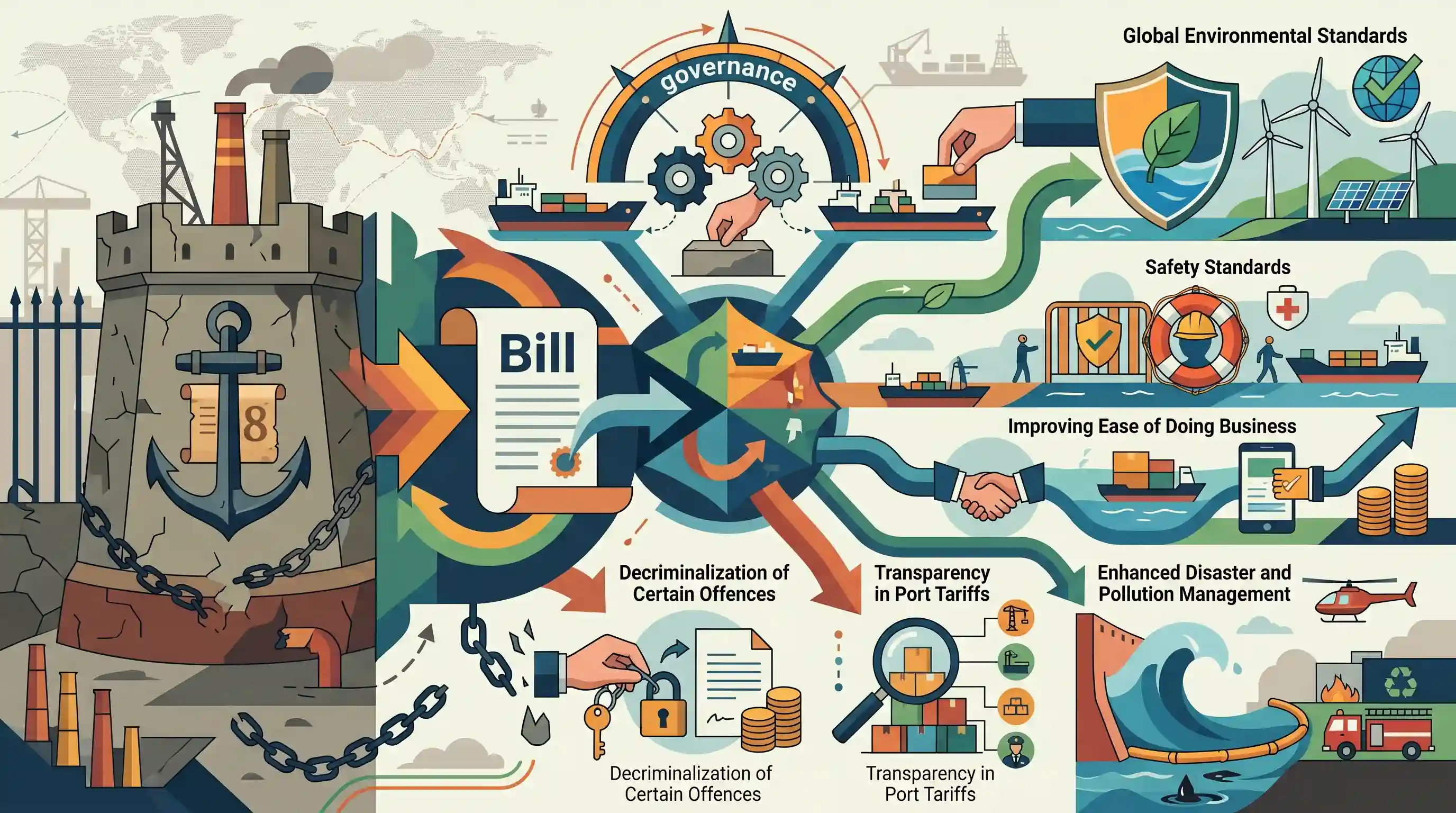
The Rajya Sabha has cleared the Indian Ports Bill, 2025, a significant legislative reform intended to replace the colonial-era Indian Ports Act of 1908. The bill focuses on modernising maritime governance by promoting integrated port development, ensuring compliance with global environmental and safety standards, and improving the ease of doing business. Key provisions include the decriminalisation of certain offences, bringing transparency to port tariffs, and enhancing disaster and pollution management at Indian ports.
Key Points
- The Rajya Sabha passed the Indian Ports Bill, 2025 to repeal and replace the 117-year-old Indian Ports Act of 1908.
- The legislation aims to foster integrated port development and ensure optimal utilization of India's expansive coastline.
- It seeks to ensure global compliance with international maritime conventions regarding pollution, safety, and security at ports.
- To improve ease of doing business, the bill decriminalises certain minor offences and mandates transparency in port tariffs.
Important Terms
Indian Ports Bill, 2025

A 2025 legislation (now Act) replacing the 1908 Act to modernize port governance, ensure environmental compliance, and promote integrated development across India's coastline.
UPSC context
GS Paper III: Infrastructure (Ports). Essential for questions on maritime reforms, ease of doing business, and legislative modernization.
Indian Ports Act, 1908
Colonial-era legislation that governed Indian ports for over a century; it focused on basic administration and safety but lacked modern environmental and digitalization frameworks.
UPSC context
GS Paper III: Infrastructure. Important for understanding the historical legal evolution and "archaic law" replacement themes.
Maritime State Development Council (MSDC)
A statutory body (under the 2025 Act) chaired by the Union Minister for Ports, facilitating coordination between the Centre and coastal states for national port planning.
UPSC context
GS Paper II: Federalism. Tests understanding of Centre-State relations and cooperative federalism in infrastructure development.
State Maritime Boards
Statutory bodies established by coastal states to administer, regulate, and develop non-major ports within their respective jurisdictions under the 2025 framework.
UPSC context
GS Paper III: Economy/Infrastructure. Relevant for decentralization of port management and state-level governance of concurrent list subjects.
Major and Non-Major Ports
Major ports are under Union jurisdiction (Major Port Authorities Act, 2021); non-major (minor) ports are under State jurisdiction but governed by the Indian Ports Act.
UPSC context
GS Paper III: Infrastructure. Fundamental distinction for questions on maritime jurisdiction and the Constitutional division of powers (List I vs. List III).
MARPOL Convention
The International Convention for the Prevention of Pollution from Ships; the 2025 Act mandates port compliance with these global environmental standards.
UPSC context
GS Paper III: Environment. Important for international environmental agreements and their domestic legislative implementation.
Dispute Resolution Committee (DRC)
State-level bodies mandated by the 2025 Act to adjudicate disputes between non-major ports, concessionaires, and users, aimed at faster grievance redressal.
UPSC context
GS Paper III: Ease of Doing Business. Relevant for institutional mechanisms reducing judicial pendency in commercial sectors.
Prelims Trap
"The Indian Ports Bill 2025 brings all non-major ports under the direct administrative control of the Union Government."
The Bill gives statutory recognition to State Maritime Boards to administer non-major ports, reinforcing concurrent jurisdiction rather than centralising power.
Static Concepts Connected
What is the constitutional jurisdiction over Major vs. Non-Major Ports in India?
- Major Ports: Major ports fall under the Union List (List I) and are administered by the Central Government via individual port authorities.
- Non-Major Ports: Non-major ports fall under the Concurrent List (List III) and are administered by the respective State Governments, typically through State Maritime Boards.
- Cooperative Federalism: The new Act mandates the Maritime State Development Council (MSDC) to facilitate Centre-State coordination for integrated port development.
What are the MARPOL and Ballast Water Management (BWM) Conventions?
- MARPOL Convention: The International Convention for the Prevention of Pollution from Ships (MARPOL) prevents marine environment pollution by ships from operational or accidental causes.
- BWM Convention: The BWM Convention mandates ships to manage their ballast water and sediments to prevent the spread of harmful aquatic organisms and pathogens (invasive species).
- IMO Role: The International Maritime Organization (IMO), a specialized agency of the UN, is responsible for administering both conventions globally.
Cross-Topic Patterns
Decriminalisation for Ease of Doing Business
The decriminalisation of minor offences in the Ports Bill mirrors the recent Jan Vishwas Act and Companies Act amendments, highlighting a systemic shift from imprisonment to civil penalties to boost EoDB.
Marine Biodiversity & Invasive Species
Enforcing the Ballast Water Management Convention links maritime infrastructure directly to GS3 biodiversity, as untreated ballast water is a primary vector for introducing invasive alien species into coastal ecosystems.
Cooperative Federalism in Infrastructure
Granting statutory status to the MSDC aligns with the trend of utilizing joint Centre-State councils (like the GST Council) to manage concurrent subjects and draft integrated national perspective plans.

Expect a 2026 Prelims question pairing the Ballast Water Convention and invasive alien species with India's newly passed Ports Act.
Linked PYQs · 3
Linked PYQs · 3
- 2023PrelimsGS1
Consider the following pairs: Port Well known as 1. Kamarajar Port: First major port in India registered as a company 2. Mundra Port: Largest privately owned port in India 3. Visakhapatnam Port: Largest container port in India How many of the above pairs are correctly matched?
- 2009PrelimsGS1
In India, the ports are categorized as major and non-major ports. Which one of the following is a non-major port?
- 2025MainsGS3
Why is maritime security vital to protect India's sea trade? Discuss maritime and coastal security challenges and the way forward.
