Parliament Presiding Officers Reject CEC Removal Notice
Source:The Hindu ↗
Why It Matters
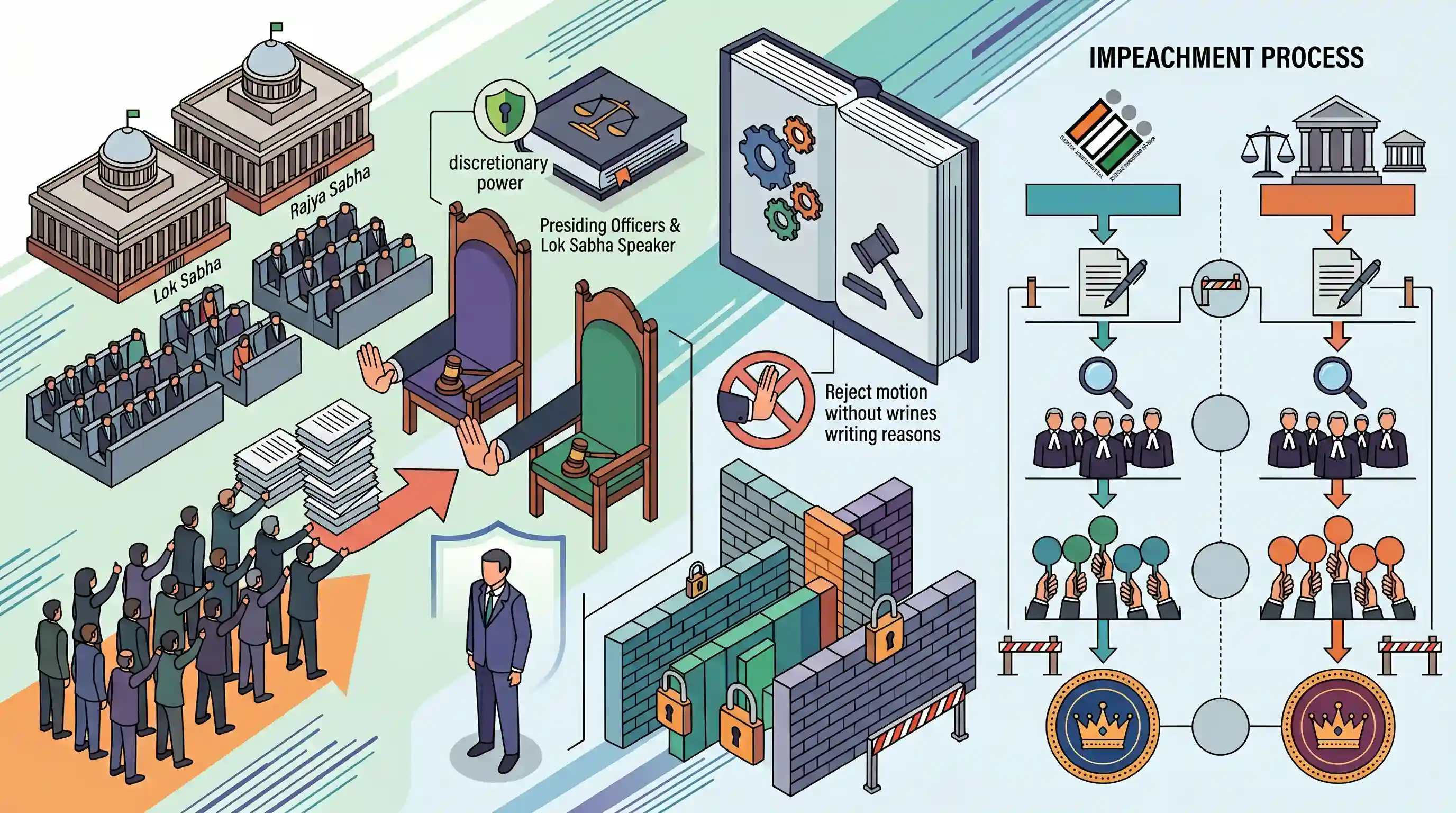
This event is critical for understanding the constitutional protections ensuring the independence of the Election Commission of India. It practically demonstrates the intersection of Article 324 (CEC removal mechanism) and the statutory procedures under the Judges (Inquiry) Act, 1968, particularly highlighting the significant discretionary powers held by the Speaker and Rajya Sabha Chairman in admitting removal motions.
Summary
The Rajya Sabha Chairman and Lok Sabha Speaker rejected a formal notice moved by 193 Opposition MPs seeking the removal of Chief Election Commissioner Gyanesh Kumar. The presiding officers exercised their discretionary power under Section 3 of the Judges (Inquiry) Act, 1968, to refuse the motion without specifying reasons. The incident highlights the procedural safeguards governing the removal of constitutional functionaries like the CEC, whose dismissal process mirrors the impeachment of a Supreme Court judge.
Key Points
- A removal notice against Chief Election Commissioner Gyanesh Kumar, signed by 193 Opposition MPs across both Houses, was rejected by the Rajya Sabha Chairman and Lok Sabha Speaker.
- The presiding officers cited Section 3 of the Judges (Inquiry) Act, 1968, which grants them discretionary power to either admit or refuse a removal motion after due consultation.
- The Constitution mandates that the CEC can only be removed in the same manner and on similar grounds as a Supreme Court judge, which is why the Judges (Inquiry) Act applies to the process.
- The Opposition's notice accused the CEC of being subservient to the executive and deliberately abusing his constitutional position.
- Opposition leaders criticized the lack of definitive reasons for the rejection, contrasting it with a July 2025 incident where a removal motion against a High Court judge was formally admitted.
Important Terms
Judges (Inquiry) Act, 1968

A law regulating the procedure for investigating and removing Supreme Court/High Court judges. It also governs the removal process for the Chief Election Commissioner (CEC).
UPSC context
GS Paper II (Polity). Tests knowledge of the procedural safeguards for constitutional functionaries and the legislature's role in judicial/administrative accountability.
Election Commission of India (ECI)
A permanent constitutional body established under Article 324 to conduct free and fair elections for Parliament, State Legislatures, and the President/Vice-President offices.
UPSC context
GS Paper II (Constitutional Bodies). Central to topics on electoral reforms, democratic integrity, and institutional independence.
Chief Election Commissioner (CEC)
The head of the Election Commission who enjoys constitutional security of tenure. Removal is only possible through a parliamentary process identical to a Supreme Court judge.
UPSC context
GS Paper II (Polity). Tests understanding of tenure security and the distinction between the CEC and other Election Commissioners.
Presiding Officers
The Speaker (Lok Sabha) and Chairman (Rajya Sabha). Under the Judges (Inquiry) Act, they have discretionary power to admit or reject a removal motion.
UPSC context
GS Paper II (Parliament). Focuses on their quasi-judicial roles and discretionary powers in managing parliamentary motions.
Article 324(5)
The specific clause providing the CEC protection from arbitrary removal. It mandates removal only for 'proved misbehaviour or incapacity' via a special majority in Parliament.
UPSC context
GS Paper II (Constitutional Provisions). Key for questions on the independence of constitutional authorities and the separation of powers.
Proved Misbehaviour or Incapacity
The only two constitutional grounds on which a Supreme Court judge or the Chief Election Commissioner can be removed from office.
UPSC context
GS Paper II (Polity). Important for understanding the high threshold required for the removal of high-ranking constitutional officials.
Prelims Trap
The Presiding Officer is bound to admit a CEC removal motion if signed by 100 Lok Sabha or 50 Rajya Sabha MPs.
Section 3 of the Judges (Inquiry) Act, 1968 grants the Presiding Officer discretionary power to either admit or refuse the motion. The numerical threshold merely allows introduction.
Static Concepts Connected
What is the procedure to remove the Chief Election Commissioner (CEC)?
- Constitutional Basis: Article 324(5) limits removal to the same grounds and manner as a Supreme Court Judge (proved misbehaviour or incapacity).
- Statutory Procedure: Governed by the Judges (Inquiry) Act, 1968. Requires a motion signed by 100 LS or 50 RS members.
- Investigation Committee: If admitted, the Presiding Officer forms a 3-member panel (SC Judge, HC Chief Justice, distinguished jurist) to probe charges.
- Parliamentary Approval: Requires a special majority in both Houses of Parliament, followed by Presidential assent in the same session.
How does removal protection differ between the CEC and other Election Commissioners?
- CEC Protection: Enjoys constitutional security of tenure and requires a rigorous impeachment-like process mirroring a Supreme Court Judge.
- Other ECs: Cannot be removed from office except on the explicit recommendation of the Chief Election Commissioner.
Cross-Topic Patterns
ECI Appointments vs Removals
The 2023 Act altered how the CEC is appointed. UPSC often tests new statutory appointment rules alongside standing constitutional removal protections to check conceptual clarity.
Speaker's Discretionary Authority
Links the Speaker's refusal power under the Judges (Inquiry) Act with other exclusive discretionary powers like certifying Money Bills and adjudicating Tenth Schedule disqualifications.

Expect a 2026 Prelims question on Article 324 vs Judges (Inquiry) Act, emphasizing the Speaker's discretionary power to reject motions.
Linked PYQs · 4
Linked PYQs · 4
- 2019PrelimsGS1
Consider the following statements: 1. The motion to impeach a Judge of the Supreme Court of India cannot be rejected by the Speaker of the Lok Sabha as per the Judges (Inquiry) Act, 1968. 2. The Constitution of India defines and gives details of what constitutes 'incapacity and proved misbehaviour' of the Judges of the Supreme Court of India. 3. The details of the process of impeachment of the Judges of the Supreme Court of India are given in the Judges (Inquiry) Act, 1968. 4. If the motion for the impeachment of a Judge is taken up for voting, the law requires the motion to be backed by each House of the Parliament and supported by a majority of total membership of that House and by not less than two-thirds of total members of that House present and voting. Which of the statements given above is/are correct?
- 2023MainsGS2
Discuss the role of Presiding Officers of state legislatures in maintaining order and impartiality in conducting legislative work and in facilitating best democratic practices.
- 2022MainsGS2
Discuss the role of the Election Commission of India in the light of the evolution of the Model Code of Conduct.
- 2017PrelimsGS1
Consider the following statements: 1. The Election Commission of India is a five-member body. 2. Union Ministry of Home Affairs decides the election schedule for the conduct of both general elections and bye-elections. 3. Election Commission resolves the disputes relating to splits/mergers of recognised political parties. Which of the statements given above is/are correct?
