Rajya Sabha Merger and Anti Defection Law Application
Source:The Hindu ↗
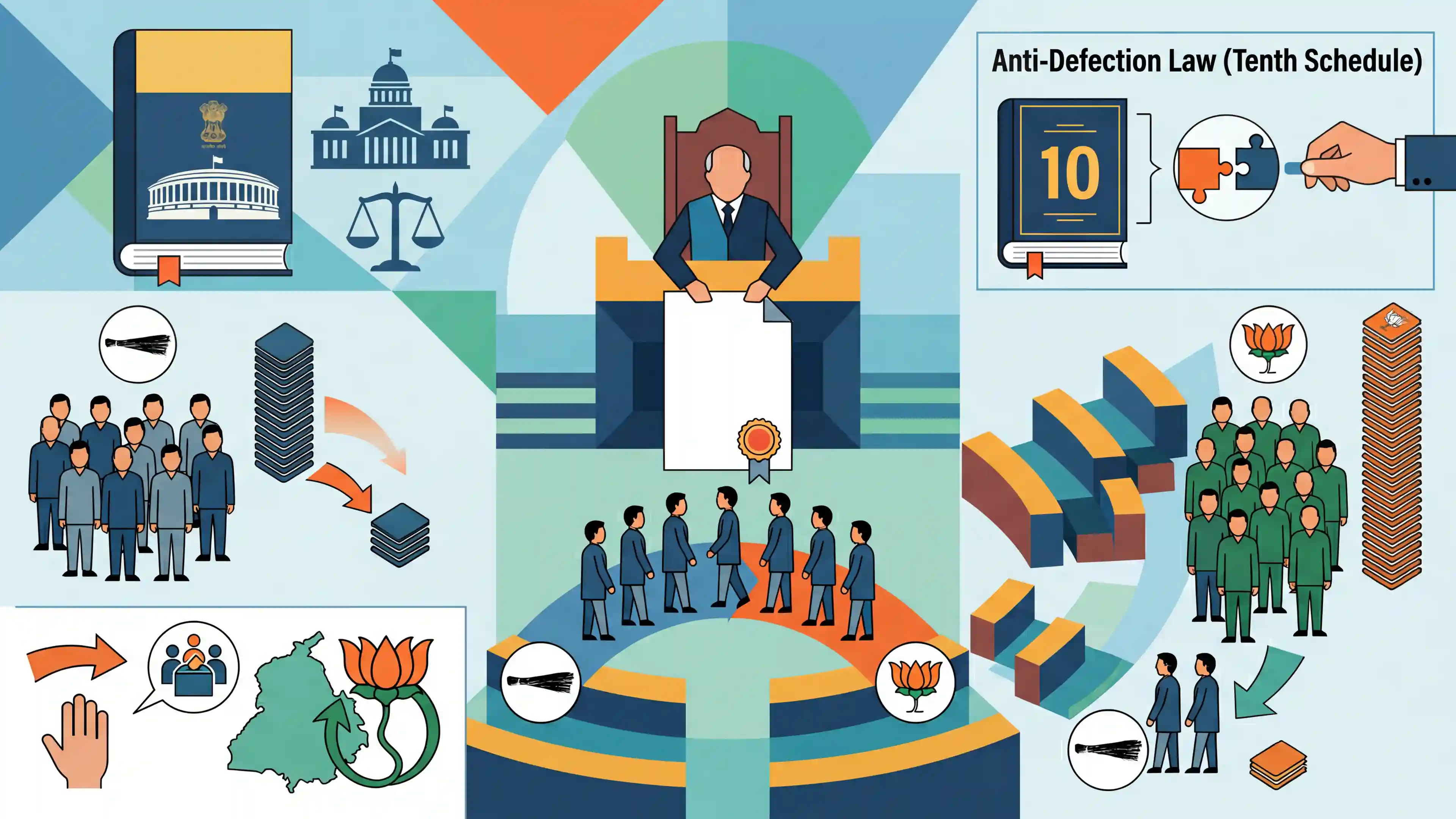
Why It Matters
Understanding the mechanics of the Tenth Schedule (Anti-Defection Law) is crucial for UPSC aspirants, specifically the conditions under which a merger avoids disqualification (requiring two-thirds of the legislative party). It also highlights the discretionary powers of the Rajya Sabha Chairman in accepting such realignments, directly tying into GS Paper 2 topics on the functioning of Parliament and constitutional bodies.
Summary
Rajya Sabha Chairman C.P. Radhakrishnan has accepted the merger of seven Aam Aadmi Party (AAP) MPs with the Bharatiya Janata Party (BJP). This significant political shift increases the BJP's strength in the Upper House to 113, while AAP's representation falls to three. AAP leaders, including national convener Arvind Kejriwal, heavily criticized the move, labeling it 'Operation Lotus' and accusing the BJP of undermining their mandate in Punjab. The development highlights the application of the Anti-Defection Law (Tenth Schedule) regarding the merger of legislative parties and the crucial role of the presiding officer in recognizing such shifts.
Key Points
- Seven AAP Rajya Sabha MPs have merged with the BJP, reducing AAP's strength in the Upper House to three.
- The merger increases the BJP's tally in the Rajya Sabha to 113 members.
- Rajya Sabha Chairman C.P. Radhakrishnan officially accepted the merger, marking a significant political realignment.
- The event brings into focus the Tenth Schedule (Anti-Defection Law), specifically the clause that exempts members from disqualification if two-thirds of the legislative party merges with another party.
- AAP leadership condemned the move as part of 'Operation Lotus', accusing the BJP of attempting to destabilize its government and mandate in Punjab.
Important Terms
Tenth Schedule

A constitutional schedule added in 1985 containing the Anti-Defection Law, outlining grounds for disqualifying legislators who switch parties or defy party whips.
UPSC context
GS Paper II (Polity). Tests understanding of constitutional amendments, legislative stability, and parliamentary procedures.
Anti-Defection Law
Legislation designed to prevent political instability by disqualifying elected representatives who defect, except in cases of valid mergers supported by two-thirds of members.
UPSC context
GS Paper II. Evaluates knowledge of political ethics, floor-crossing, and the 52nd and 91st Amendments.
Merger Clause
A provision under the Tenth Schedule allowing legislators to join another party without disqualification if at least two-thirds of the legislative party agrees.
UPSC context
GS Paper II. Tests the distinction between individual defection and collective realignment under constitutional law.
Presiding Officer
The Speaker or Chairman of a House who serves as the sole arbiter for deciding disqualification questions under the Tenth Schedule.
UPSC context
GS Paper II. Tests authority, neutrality, and the scope of judicial review (Kihoto Hollohan case).
Rajya Sabha
The Upper House of Parliament representing States and UTs, whose members are indirectly elected by State Legislative Assemblies for six-year terms.
UPSC context
GS Paper II. Vital for understanding federalism, bicameralism, and the indirect election system.
Aam Aadmi Party (AAP)
A national political party in India, founded in 2012, currently governing Delhi and Punjab; granted national status in 2023.
UPSC context
GS Paper II (Elections). Tests criteria for national party status and regional political dynamics.
Bharatiya Janata Party (BJP)
India's largest political party and leader of the NDA coalition, currently holding a significant majority in the Lok Sabha.
UPSC context
GS Paper II. Relevant for coalition politics and parliamentary party strength.
Prelims Trap
"A merger is valid if two-thirds of the Legislature Party agree to defect, regardless of the Original Political Party."
Paragraph 4 of the Tenth Schedule requires the Original Political Party to merge with another party, and two-thirds of the Legislature Party to agree. A pure 2/3rds legislature party split without an original party merger is not protected.
Static Concepts Connected
What are the exceptions to disqualification under the Tenth Schedule?
- Merger Exception: Disqualification does not apply if a member's original political party merges with another, and at least two-thirds of the legislature party members agree.
- Presiding Officer Exemption: A member elected as a Presiding Officer can voluntarily give up party membership without disqualification, provided they do not rejoin while holding office.
- Split (Repealed): The earlier provision protecting a one-third 'split' in a legislature party was omitted by the 91st Constitutional Amendment Act (2003).
What is the scope of judicial review on 10th Schedule decisions?
- Tribunal Status: The Presiding Officer acts as a quasi-judicial tribunal when deciding defection cases, making their decisions subject to judicial review (Kihoto Hollohan case, 1992).
- Timing of Review: Courts generally cannot intervene before the Presiding Officer makes a final decision (no interlocutory intervention), except in extremely rare cases of imminent, irreversible consequences.
- Grounds for Review: The final decision can be struck down by constitutional courts on grounds of mala fides, perversity, or violation of constitutional mandates.
Cross-Topic Patterns
Anti-Defection + Presiding Officer Discretion
Mergers under the 10th Schedule often highlight the discretionary powers of Presiding Officers, linking directly to constitutional deadlocks involving Governors and Speakers previously tested in Mains (e.g., Maharashtra and Arunachal Pradesh crises).
Tenth Schedule + Inner Party Democracy
The rigidity of the Anti-Defection Law is heavily debated for stifling intra-party dissent, connecting constitutional defection rules to broader Ethics and Governance topics regarding internal party democracy and electoral reforms.

Expect a highly specific 2026 Prelims question differentiating "Legislature Party" from "Original Political Party" in 10th Schedule mergers.
Linked PYQs · 3
Linked PYQs · 3
- 2025PrelimsGS1
Consider the following statements : I. If any question arises as to whether a Member of the House of the People has become subject to disqualification under the 10th Schedule, the President's decision in accordance with the opinion of the Council of Union Ministers shall be final. II. There is no mention of the word 'political party' in the Constitution of India. Which of the statements given above is/are correct?
- 2014PrelimsGS1
Which one of the following Schedules of the Constitution of India contains provisions regarding anti-defection?
- 2022MainsGS2
Discuss the role of the Vice-President of India as the Chairman of the Rajya Sabha.
