Parliamentary motion of thanks and bilateral trade deal deliberations
Source:The Hindu ↗
Why It Matters
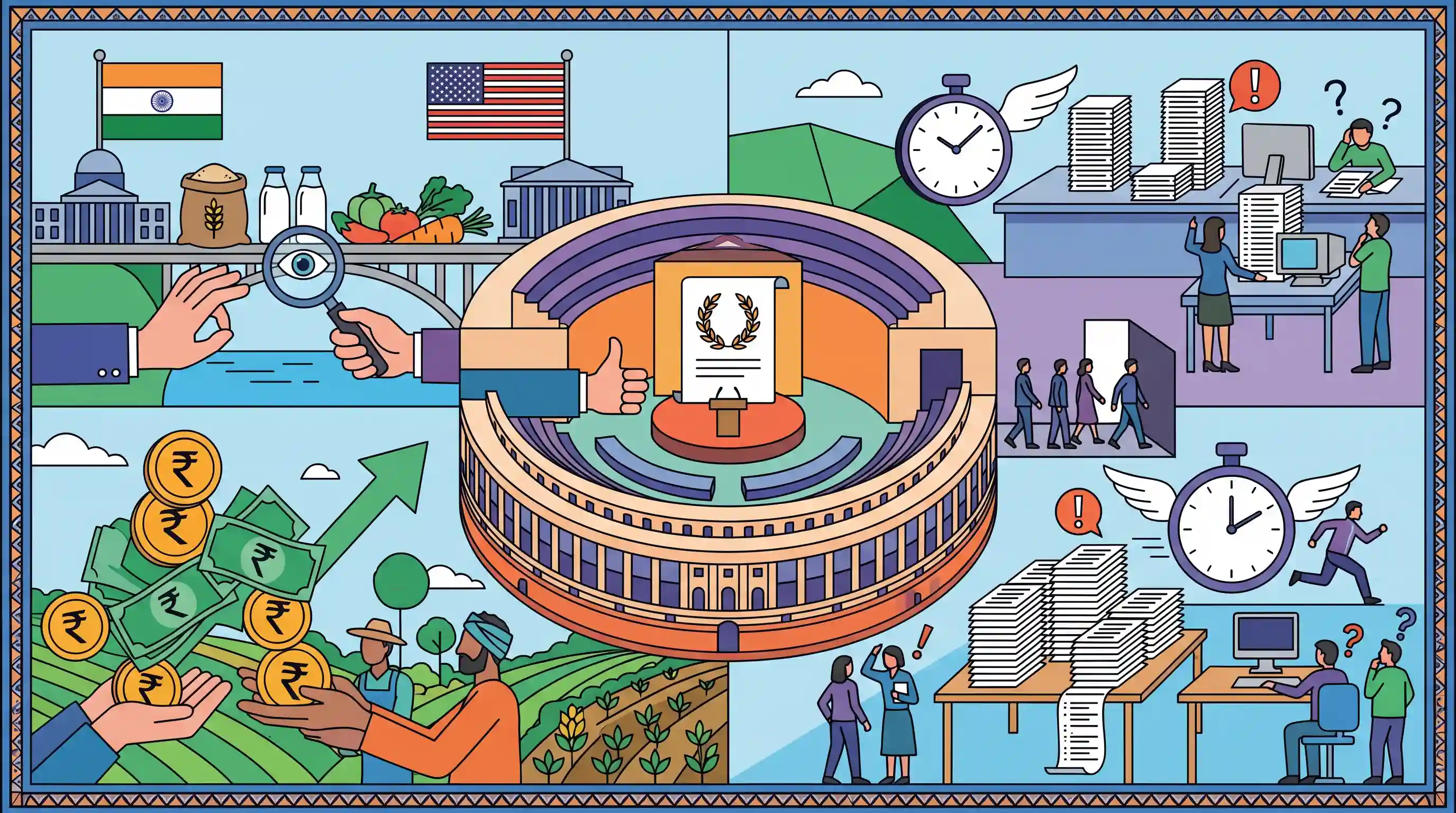
The article highlights parliamentary mechanisms like the Motion of Thanks, the domestic sensitivities (agriculture and dairy) involved in international trade negotiations, the role of direct benefit transfers in farming, and the administrative challenges of updating electoral rolls.
Summary
The Rajya Sabha adopted the Motion of Thanks to the President's address amid a walkout by the Opposition. The debate highlighted significant policy contentions, notably the Opposition's apprehension regarding the potential inclusion of sensitive agriculture and dairy products in the newly negotiated India-U.S. bilateral trade deal. In defense of the government's agricultural record, BJP members underscored the distribution of ₹4 lakh crore to farmers under the PM-Kisan Samman Nidhi scheme to boost rural incomes. Additionally, concerns were raised regarding electoral administration, with members criticizing the purportedly rushed nature of the special intensive revision of the electoral rolls.
Key Points
- The Rajya Sabha adopted the Motion of Thanks to the President's address, defeating Opposition amendments in their absence following a walkout.
- Opposition members expressed concerns over the India-U.S. trade deal, questioning the potential inclusion of sensitive agriculture and dairy products.
- BJP MPs defended the government's agricultural policies, citing the distribution of ₹4 lakh crore to farmers under the PM-Kisan Samman Nidhi scheme.
- AAP MP Sandeep Kumar Pathak criticized the expedited timeline for the special intensive revision of the voters list, calling the three-month deadline impractical.
Important Terms
Motion of Thanks

A parliamentary procedure following the President's special address (Article 87). It allows members to debate government policies. If defeated in the Lok Sabha, the government must resign.
UPSC context
GS Paper 2 (Polity); tests understanding of parliamentary motions and executive accountability.
Pradhan Mantri Kisan Samman Nidhi (PM-Kisan)
A Central Sector Scheme providing ₹6,000 annually to landholding farmer families in three equal installments via Direct Benefit Transfer (DBT) to supplement agricultural and domestic needs.
UPSC context
GS Paper 3 (Agriculture/Economy); crucial for topics on farmer welfare and digital governance.
India-U.S. Bilateral Trade Deal
A negotiated trade agreement between India and the United States, currently facing scrutiny over market access for American dairy and agricultural products and Indian tariff protections.
UPSC context
GS Paper 2 (International Relations); tests knowledge of bilateral groupings and impact of policies on India's interests.
Rajya Sabha
The 'Council of States' or Upper House of India's Parliament. It is a permanent body representing states and union territories, ensuring federal equilibrium and legislative review.
UPSC context
GS Paper 2 (Polity); central to the study of the legislature and federalism.
Special Intensive Revision of Electoral Rolls
A comprehensive, time-bound house-to-house verification by the Election Commission of India (ECI) to update voter lists, remove duplicates, and ensure electoral roll accuracy before elections.
UPSC context
GS Paper 2 (Polity/Elections); important for electoral reforms and the role of the ECI.
Prelims Trap
"Defeat of the Motion of Thanks in either House of Parliament necessitates the resignation of the Council of Ministers."
Only defeat in the Lok Sabha brings down the government, as the Council of Ministers is collectively responsible solely to the Lower House (Article 75).
Static Concepts Connected
What are the constitutional rules governing the Motion of Thanks?
- Article 87: Mandates the President's special address to both Houses at the start of the first session each year and after each general election.
- Amendments: MPs can move amendments to highlight omissions in the address. The original or amended motion must then be put to vote.
- Government Survival: Defeat of the motion in the Lok Sabha amounts to a loss of confidence, requiring the government to resign. Defeat in Rajya Sabha does not.
What are the core features of the PM-KISAN scheme?
- Central Sector: It is a 100% Central Sector scheme, meaning the Union government bears the entire financial burden directly.
- Universal Landholding: Initially for small/marginal farmers, it now covers all landholding farmer families, transferring ₹6,000 annually in three equal installments via Direct Benefit Transfer.
- Exclusion Criteria: Institutional landholders, income tax payees, and constitutional post holders are explicitly excluded from receiving the benefits.
Cross-Topic Patterns
Agri protectionism & WTO AoA
The US-India bilateral friction over dairy/agriculture imports echoes India's multilateral fight at the WTO over the Agreement on Agriculture and the Peace Clause for public stockholding.
RPA 1950 vs 1951 divide
Debates on 'special intensive revision of electoral rolls' invoke RPA 1950, a frequent Prelims trick where aspirants confuse its provisions with RPA 1951 (which governs the actual conduct of elections).

Expect a mixed-statement Prelims question merging Article 87 (Motion of Thanks) rules with RPA 1950 provisions on electoral rolls.
Linked PYQs · 4
Linked PYQs · 4
- 2017MainsGS3
How do subsidies affect the cropping pattern, crop diversity and economy of farmers? What is the significance of crop insurance, minimum support price and food processing for small and marginal farmers?
- 2020MainsGS2
What is the significance of Indo-US defence deals over Indo-Russian defence deals? Discuss with reference to stability in the Indo-Pacific region.
- 2023MainsGS2
Discuss the role of Presiding Officers of state legislatures in maintaining order and impartiality in conducting legislative work and in facilitating best democratic practices.
- 2024MainsGS2
Examine the need for electoral reforms as suggested by various committees with particular reference to "one nation one election" principle.
