Special Intensive Revision and Parliamentary Disruptions
Source:The Hindu ↗
Why It Matters
This article highlights the recurring issues of parliamentary disruptions, the frequent invocation and rejection of Rule 267, and critical concerns surrounding electoral roll revisions and potential voter disenfranchisement, which are direct syllabus components in Polity and Governance.
Summary
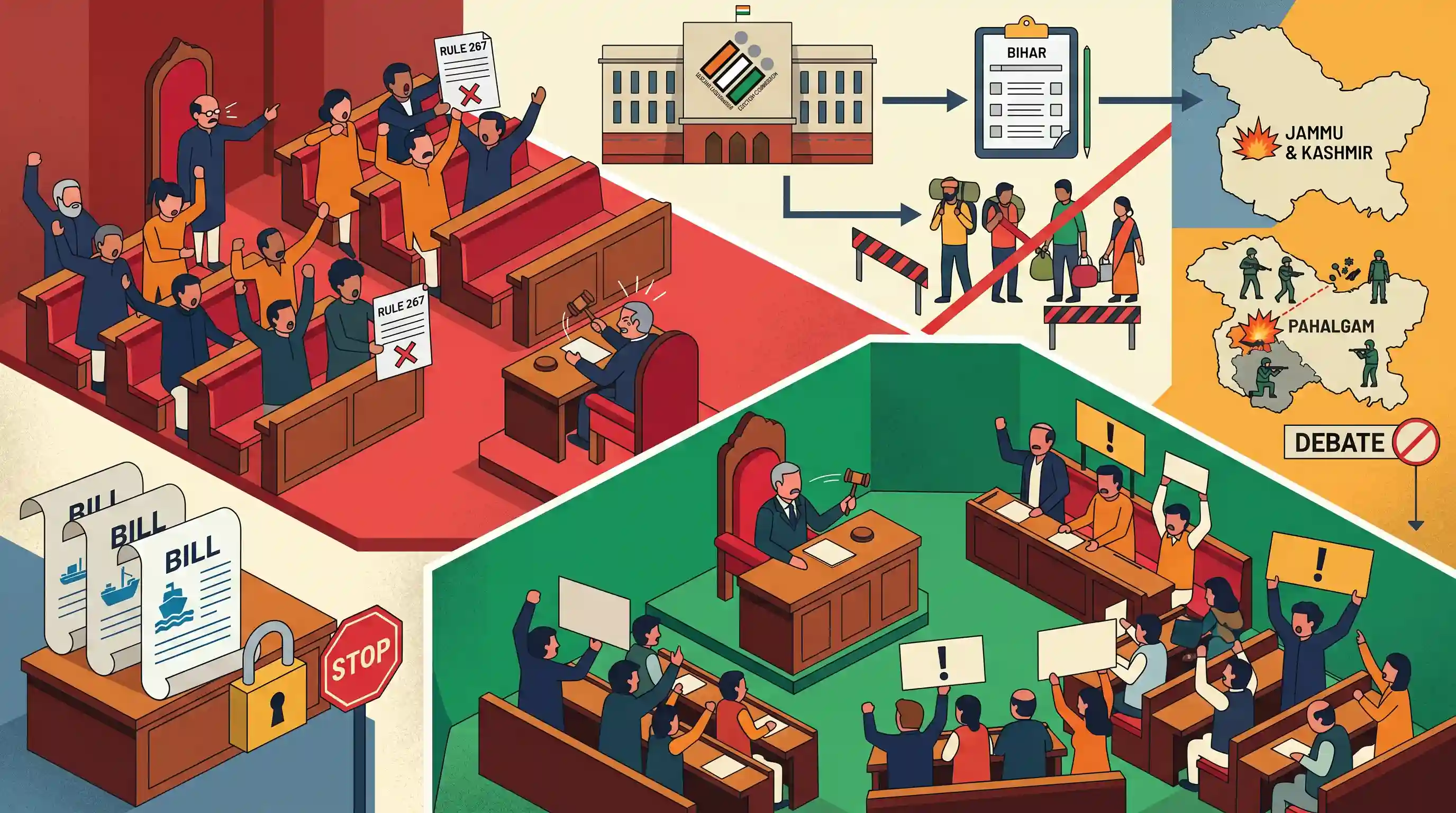
Both the Rajya Sabha and Lok Sabha experienced significant disruptions and repeated adjournments as Opposition MPs fiercely protested the Election Commission's 'Special Intensive Revision' (SIR) of electoral rolls in Bihar. Opposition leaders, moving notices under Rule 267, demanded a discussion on the exercise, alleging it could disenfranchise migrant workers who lack necessary documents. The deadlock prevented the introduction of key legislation, including 'The Carriage of Goods by Sea Bill 2025', and delayed debates on internal security matters like the Pahalgam terror incidents.
Key Points
- Both Houses of Parliament faced repeated adjournments for the sixth consecutive sitting due to Opposition protests over the Election Commission's Special Intensive Revision (SIR) in Bihar.
- The INDIA bloc raised concerns that the SIR could disenfranchise migrant workers, citing a survey indicating that over one-third of them lack the required documentation.
- The Opposition submitted 26 notices under Rule 267 to suspend regular business for a debate on the issue, which were rejected by the presiding officers.
- Legislative business was disrupted, delaying the introduction of 'The Carriage of Goods by Sea Bill 2025' and a planned debate on 'Operation Sindoor and Pahalgam terror' in the Lok Sabha.
Important Terms
Special Intensive Revision (SIR)

A 2025 house-to-house verification of electoral rolls in Bihar aimed at weeding out bogus entries and illegal migrants. Critics allege it risks disenfranchising migrant workers lacking specific documents.
UPSC context
GS II: Representation of People Act; tests knowledge of electoral reforms and the Election Commission's constitutional mandate.
Rule 267
A Rajya Sabha rule allowing members to seek the suspension of pre-scheduled business to discuss a matter of urgent public importance, requiring the Chairman's consent.
UPSC context
GS II: Parliament and State Legislatures; tests understanding of parliamentary procedures and executive-legislative relations.
The Carriage of Goods by Sea Bill 2025
2025 legislation that modernizes India’s maritime legal framework by repealing the colonial-era 1925 Act, aligning with global Hague-Visby standards and promoting electronic documentation.
UPSC context
GS III: Infrastructure and Economy; relevant for laws governing international trade and ease of doing business.
Operation Sindoor
A 2025 military response to terror attacks in Pahalgam, J&K, which became a central political issue during the Bihar Assembly elections regarding national security.
UPSC context
GS III: Internal Security; tests awareness of security operations and their intersection with political discourse.
Election Commission of India (ECI)
The constitutional body (Article 324) responsible for conducting elections. Recently scrutinized for its SIR exercise and voter list management in Bihar.
UPSC context
GS II: Constitutional Bodies; covers the structure, powers, and functioning of the ECI.
Rajya Sabha
The Upper House of Parliament representing States and UTs. It serves as a permanent house where members are indirectly elected for six-year terms.
UPSC context
GS II: Parliament Structure; focuses on the federal role and legislative powers of the Upper House.
Prelims Trap
Preparation of electoral rolls and the 'ordinarily resident' criterion fall under the Representation of the People Act, 1951.
Voter registration, delimitation, and the preparation of electoral rolls (including the SIR) are governed by the RPA 1950, not the RPA 1951, which strictly deals with the actual conduct of elections.
Static Concepts Connected
How do Rule 267 and Rule 176 differ in the Rajya Sabha?
- Rule 267: Suspends all listed business to discuss a matter of urgent public importance; strictly requires the Chairman's consent.
- Rule 176: Allows a short-duration discussion (max 2.5 hours) on urgent matters without suspending regular business or requiring a vote.
Which statutory provisions govern voter registration and the Special Intensive Revision (SIR)?
- RPA 1950: Governs the allocation of seats, delimitation, and the preparation or special revision (SIR) of electoral rolls under Section 21(3).
- Ordinarily Resident: Under Section 19 of RPA 1950, a voter must be ordinarily resident in a constituency, which often structurally excludes undocumented internal migrants.
Cross-Topic Patterns
Migrant Voting + Remote EVMs
The disenfranchisement of internal migrants links demographic shifts to electoral laws and the Election Commission's proposed Remote Voting Machines (RVMs) to solve 'ordinarily resident' hurdles.
Parliamentary Rules + Internal Security
Political deadlocks over state electoral rolls stalling national security debates (like Operation Sindoor) repeatedly highlight the friction between regional politics and national legislative priorities.

Expect a tricky prelims statement contrasting RPA 1950 (rolls/SIR) with RPA 1951 (election conduct), paired with migrant voting rights.
Linked PYQs · 5
Linked PYQs · 5
- 2025MainsGS2
Indian Constitution has conferred the amending power on the ordinary legislative institutions with a few procedural hurdles. In view of this statement, examine the procedural and substantive limitations on the amending power of the Parliament to change the Constitution.
- 2022MainsGS2
Discuss the procedures to decide the disputes arising out of the election of a Member of the Parliament or State Legislature under The Representation of the People Act, 1951. What are the grounds on which the election of any returned candidate may be declared void ? What remedy is available to the aggrieved party against the decision ? Refer to the case laws.
- 2017MainsGS2
The Indian Constitution has provisions for holding joint session of the two Houses of the Parliament. Enumerate the occasions when this would normally happen and also the occasions when it cannot, with reason thereof.
- 2025MainsGS3
Terrorism is a global scourge. How has it manifested in India? Elaborate with contemporary examples. What are the counter measures adopted by the State? Explain.
- 2023MainsGS3
Winning of 'Hearts and Minds' in terrorism-affected areas is an essential step in restoring the trust of the population. Discuss the measures adopted by the Government in this respect as part of the conflict resolution in Jammu and Kashmir.
