Cross Border Terrorism Financing and India Counter Terrorism Strategy
Source:The Hindu ↗
Why It Matters
Demonstrates India's assertive strategic posture regarding cross-border terrorism (e.g., Operation Sindoor) and its official diplomatic critique of global multilateral bodies like the UNSC when they appoint state-sponsors of terror to counter-terrorism bodies. Important for GS-3 Security and GS-2 International Relations.
Summary
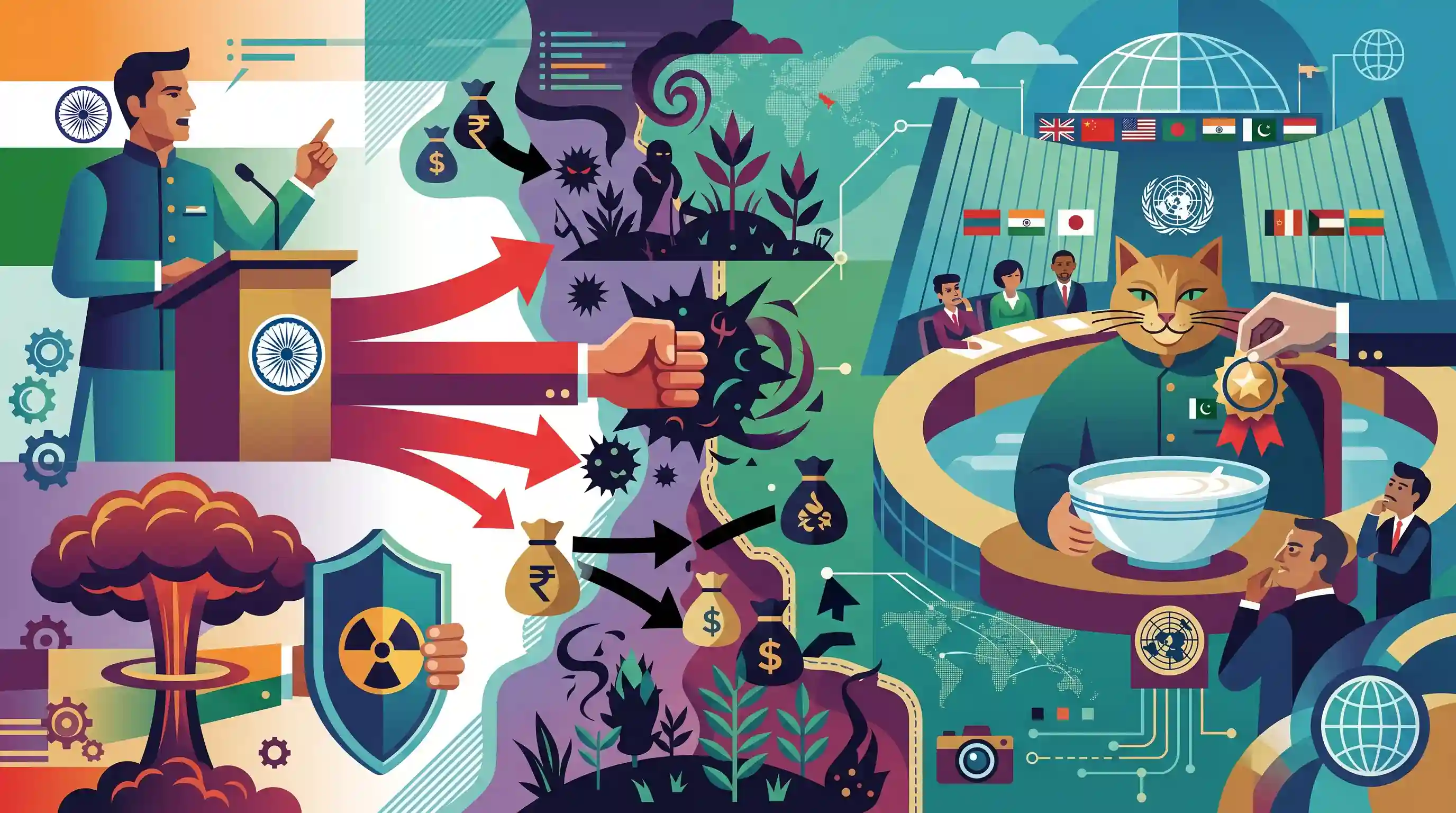
In an address to the Rajya Sabha, Defence Minister Rajnath Singh termed Pakistan a "nursery of terrorism" and called on the international community to cut off foreign funding to terror networks. Referencing 'Operation Sindoor,' Singh highlighted India's robust military resolve and a proactive national security strategy, asserting that the Indian Armed Forces are fully capable of acting against terrorists on both sides of the border without bowing to nuclear blackmail. He also strongly criticized the United Nations Security Council (UNSC) for appointing Pakistan as the Vice-Chair of the Counter-Terrorism Committee, comparing it to asking a cat to guard milk.
Key Points
- Defence Minister Rajnath Singh labeled Pakistan a 'nursery of terrorism' and urged the global community to curb foreign funding directed at terrorists there.
- He heavily criticized the UNSC for appointing Pakistan as the Vice-Chair of the Counter-Terrorism Committee, likening it to 'making the cat guard the milk.'
- Asserted that India will not succumb to 'nuclear blackmailing' and retains the capability and intent to strike at terror roots on either side of the border.
- Cited 'Operation Sindoor' as a prime example of India's evolving national security strategy and the military's firm resolve.
Important Terms
Operation Sindoor

A 2025 Indian military operation launched in response to the Pahalgam terror attack, involving precision strikes on terror launchpads in Pakistan and PoK.
UPSC context
GS Paper III: Internal Security. Tests understanding of India’s evolving counter-terrorism doctrines and proactive defense strategies.
UNSC Counter-Terrorism Committee
A subsidiary body of the UN Security Council established post-9/11 to monitor member states' implementation of measures to enhance legal and institutional counter-terrorism ability.
UPSC context
GS Paper II: International Relations. Relevant for discussions on global governance, terror funding, and India's advocacy for international organizational reform.
United Nations Security Council (UNSC)
One of the six principal organs of the United Nations, responsible for maintaining international peace and security through resolutions, sanctions, and military action.
UPSC context
GS Paper II: Important International institutions. Focuses on the mandate of global bodies and India’s quest for permanent membership.
Rajya Sabha
The Upper House of India's bicameral Parliament, representing states and Union Territories, and acting as a permanent chamber for legislative oversight.
UPSC context
GS Paper II: Indian Polity. Tests knowledge of parliamentary proceedings, the role of the Upper House, and executive accountability.
Indian Armed Forces
The military forces of India, including the Army, Navy, and Air Force, tasked with protecting national sovereignty and conducting counter-insurgency operations.
UPSC context
GS Paper III: Security Challenges and their Management. Relates to military modernization, theaterisation, and cross-border strategic capabilities.
Prelims Trap
"The UNSC Counter-Terrorism Committee imposes direct financial sanctions on UN-designated terrorists."
The CTC (Resolution 1373) monitors state compliance with counter-terror measures but does NOT impose sanctions. The 1267 Sanctions Committee handles listing individuals and entities.
Static Concepts Connected
What is the mandate of the UNSC Counter-Terrorism Committee (CTC)?
- Origin: Established by UN Security Council Resolution 1373 in the immediate aftermath of the 9/11 attacks in 2001.
- Core Function: Monitors the implementation of state measures to criminalize terror financing, freeze terrorist assets, and enhance cross-border cooperation.
- No Direct Sanctions: Unlike the 1267 ISIL/Al-Qaida Sanctions Committee, the CTC does not maintain a sanctions list or directly sanction individuals.
How does the Financial Action Task Force (FATF) combat terror financing?
- Global Mandate: Acts as the global money laundering and terrorist financing watchdog, setting international standards to prevent illegal activities.
- Grey List: Places jurisdictions under increased monitoring, heavily restricting their access to international financial lifelines like the IMF and World Bank.
- Black List: Identifies High-Risk Jurisdictions subject to a Call for Action, requiring member states to apply enhanced due diligence and countermeasures.
Cross-Topic Patterns
Nuclear overhang & proxy warfare
Links India's shift from strategic restraint to proactive strikes (Op Sindoor) under a nuclear overhang, critical for GS-3 security doctrines and analyzing sub-conventional conflicts.
UNSC structural paradoxes & reforms
Pakistan's CTC Vice-Chair role perfectly exemplifies the institutional paralysis of the UN, serving as an ideal case study for GS-2 Mains answers demanding urgent multilateral reform.

Expect a multi-statement Prelims question distinguishing the mandates of UNSC CTC (Res 1373) and the 1267 Sanctions Committee in 2026.
Linked PYQs · 4
Linked PYQs · 4
- 2023MainsGS3
Give out the major sources of terror funding in India and the efforts being made to curtail these sources. In the light of this, also discuss the aim and objective of the 'No Money for Terror (NMFT)' Conference recently held at New Delhi in November 2022.
- 2020MainsGS3
Analyze internal security threats and transborder crimes along Myanmar, Bangladesh and Pakistan borders including Line of Control (LoC). Also discuss the role played by various security forces in this regard.
- 2024MainsGS2
‘Terrorism has become a significant threat to global peace and security.’ Evaluate the effectiveness of the United Nations Security Council's Counter Terrorism Committee (CTC) and its associated bodies in addressing and mitigating this threat at the international level.
- 2016MainsGS3
The terms 'Hot Pursuit' and 'Surgical Strikes' are often used in connection with armed action against terrorist attacks. Discuss the strategic impact of such actions.
