Defence Minister Reviews West Asia Crisis and Indigenization Roadmap
Source:The Hindu ↗
Why It Matters
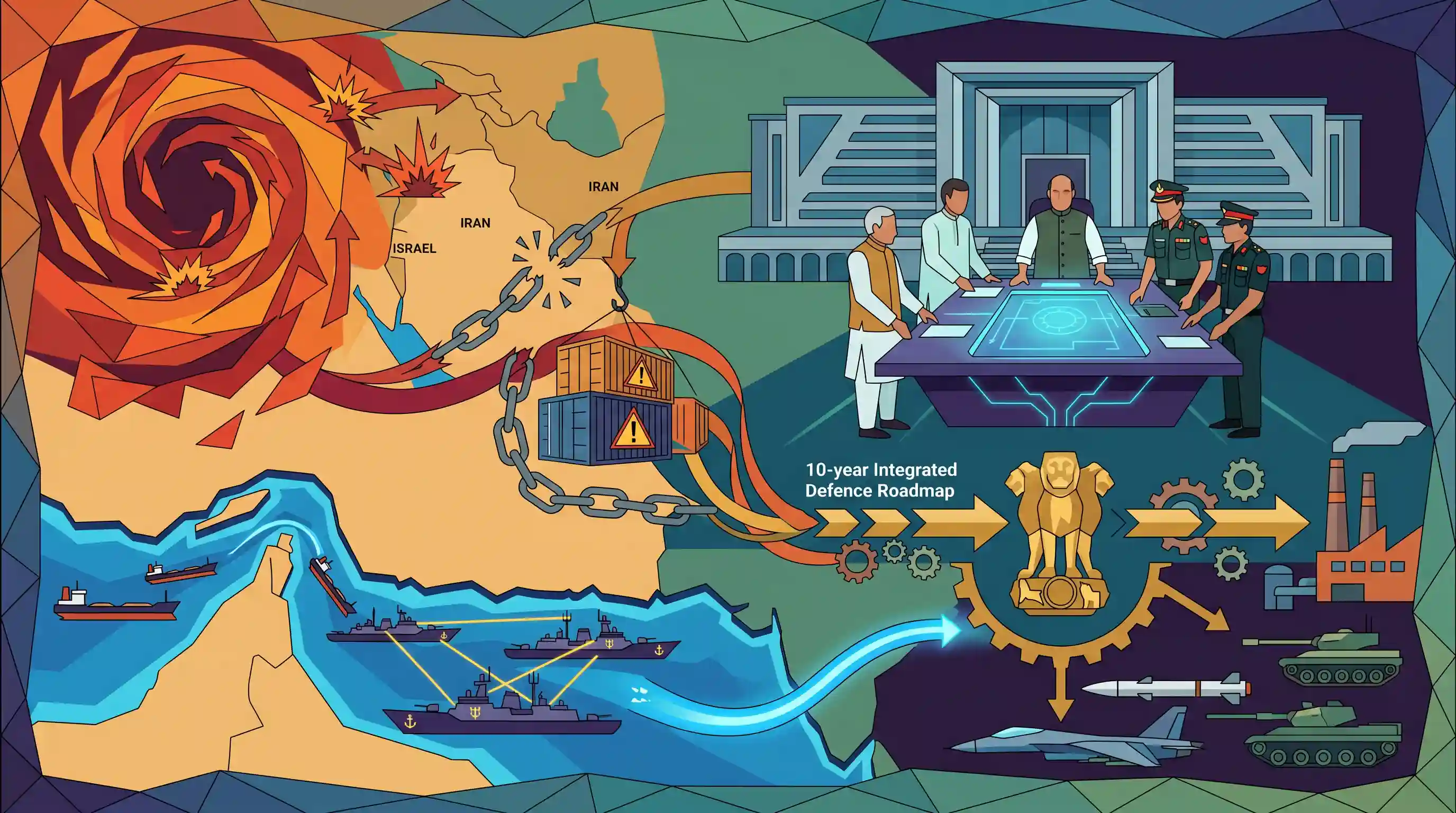
Demonstrates the direct impact of West Asian geopolitical instability on India's energy and maritime security, and validates the strategic push for defence indigenization (Aatmanirbhar Bharat) to insulate national security from global supply chain disruptions.
Summary
Defence Minister Rajnath Singh led a strategic review of India's operational readiness in response to the volatile security situation in West Asia involving Israel, Iran, and the US. Recognizing the vulnerability of global defence supply chains and critical maritime choke points like the Strait of Hormuz, the Minister emphasized the need for a 10-year integrated defence roadmap rooted in self-reliance (Aatmanirbhar Bharat). The meeting also underscored the critical role of the Indian Navy's mission-based deployments in escorting merchant vessels and securing vital energy transit routes in the Gulf of Oman, linking regional geopolitical turbulence directly to India's energy and maritime security paradigms.
Key Points
- Defence Minister Rajnath Singh held a high-level review of India's defence preparedness and supply chain resilience in light of escalating conflicts in West Asia.
- The meeting emphasized the strategic importance of the Strait of Hormuz and the Gulf of Oman, as disruptions there directly threaten India's energy security and economic stability.
- The Indian Navy's proactive 'mission-based deployments' were commended for securing sea lines of communication and successfully escorting merchant vessels carrying essential oil and LPG.
- A key outcome was the call to draft a comprehensive 10-year integrated defence roadmap, heavily prioritizing indigenous defence production (Aatmanirbhar Bharat) to buffer against global supply chain shocks.
Important Terms
Cabinet Committee on Security (CCS)

India's highest decision-making body for national security, defence expenditure, and strategic affairs. It is chaired by the Prime Minister and includes senior ministers of Defence, Home, External Affairs, and Finance.
UPSC context
GS Paper II: Executive and Ministries. Tests knowledge of the highest-level security governance and crisis management architecture in India.
Strait of Hormuz
A critical maritime chokepoint connecting the Persian Gulf to the Gulf of Oman. It is the world's most vital energy transit route, carrying roughly one-fifth of global oil supply.
UPSC context
GS Paper II: IR/Geography. Tests understanding of strategic maritime bottlenecks and their direct impact on India's energy security.
Aatmanirbhar Bharat
A government vision for a 'Self-Reliant India' built on five pillars—Economy, Infrastructure, Systems, Demography, and Demand—aiming to reduce import dependency, particularly in the strategic defence sector.
UPSC context
GS Paper III: Indian Economy/Defence. Tests understanding of indigenization, strategic autonomy, and domestic manufacturing in the context of global supply chain volatility.
Gulf of Oman
A strategic maritime arm of the Arabian Sea that serves as the entry point to the Persian Gulf. It is a vital transit route for India's oil and natural gas imports.
UPSC context
GS Paper II: International Relations. Tests awareness of regional geopolitics, maritime security, and India's strategic operational presence in West Asia.
Indian Navy
The maritime branch of the Indian Armed Forces tasked with safeguarding territorial integrity and securing vital Sea Lanes of Communication (SLoCs) through mission-based deployments and anti-piracy operations.
UPSC context
GS Paper III: Internal Security/Defence. Tests knowledge of blue-water naval roles, regional stability (SAGAR initiative), and protection of maritime trade.
Ministry of Defence (MoD)
The administrative body of the Government of India responsible for coordinating and supervising all agencies relating directly to national security and the Indian Armed Forces.
UPSC context
GS Paper II: Governance/Ministries. Tests understanding of the executive structure that formulates defence policies and manages the armed forces.
Prelims Trap
The Strait of Hormuz connects the Red Sea to the Gulf of Aden.
Hormuz connects the Persian Gulf to the Gulf of Oman (bordered by Iran/Oman/UAE). Bab-el-Mandeb connects the Red Sea to the Gulf of Aden. UPSC often swaps these critical chokepoints.
Static Concepts Connected
Which key maritime chokepoints dictate India's energy and trade security in the IOR?
- Strait of Hormuz: Connects the Persian Gulf to the Gulf of Oman. Over 40% of India's crude oil imports pass through here.
- Bab-el-Mandeb: Connects the Red Sea to the Gulf of Aden. Vital for India's trade with Europe via the Suez Canal.
- Strait of Malacca: Connects the Andaman Sea to the South China Sea. The primary chokepoint for India's Act East trade.
What is the framework of the Indian Navy's 'Mission-Based Deployments' (MBD)?
- Origin & Objective: Adopted in 2017 to ensure a continuous, proactive naval presence across critical chokepoints in the Indian Ocean Region (IOR).
- Operational Utility: Facilitates rapid response to emerging crises, anti-piracy operations, disaster relief, and the securing of crucial Sea Lines of Communication (SLOCs).
- Execution: Deploying mission-ready ships and aircraft at sensitive maritime transit routes like the Gulf of Oman to escort merchant vessels.
Cross-Topic Patterns
Energy Security + West Asian Geopolitics
Disruptions in the Strait of Hormuz directly test the adequacy of India's Strategic Petroleum Reserves (SPRs) and reinforce the macroeconomic need to accelerate the transition to renewables.
Defence Indigenization + Supply Chain Shocks
External conflicts expose vulnerabilities in military imports, linking GS-2 geopolitical turbulence directly to GS-3 industrial policies like the Defence Acquisition Procedure and Aatmanirbhar Bharat.

Expect a multi-statement Prelims question merging the geographic mapping of West Asian straits with the Navy's Mission-Based Deployments.
Linked PYQs · 4
Linked PYQs · 4
- 2017MainsGS2
The question of India's Energy Security constitutes the most important part of India's economic progress. Analyze India's energy policy cooperation with West Asian countries.
- 2025MainsGS2
"Energy security constitutes the dominant kingpin of India's foreign policy, and is linked with India's overarching influence in Middle Eastern countries.” How would you integrate energy security with India's foreign policy trajectories in the coming years?
- 2025MainsGS3
Why is maritime security vital to protect India's sea trade? Discuss maritime and coastal security challenges and the way forward.
- 2022MainsGS3
What are the maritime security challenges in India ? Discuss the organisational, technical and procedural initiatives taken to improve the maritime security.
