Defence Minister Reviews West Asia Crisis and Defence Preparedness
Source:The Hindu ↗
Why It Matters
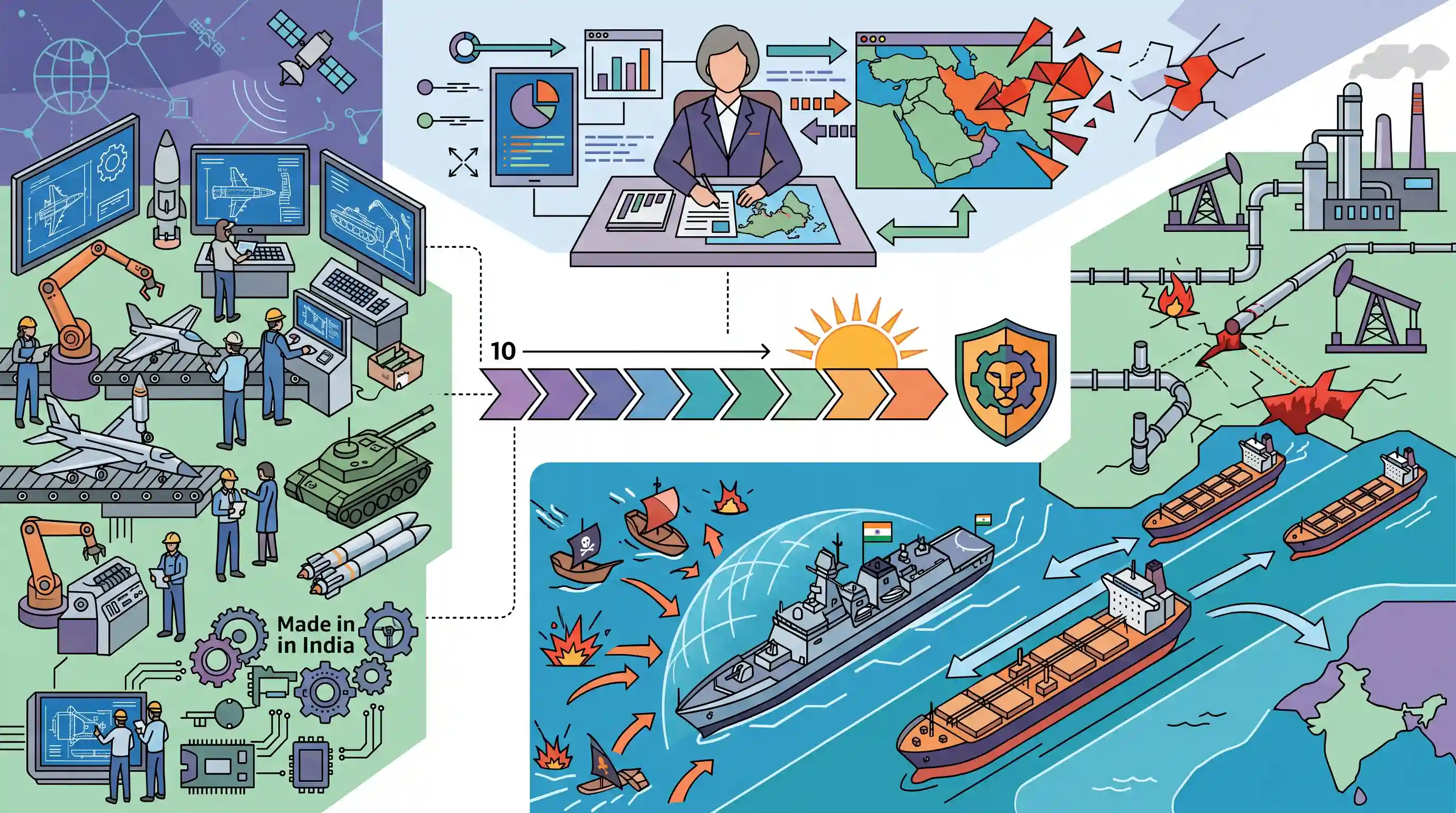
The article connects geopolitical instability in West Asia to tangible impacts on India's defense preparedness and energy security, demonstrating the critical need for self-reliance in defense (Make in India) and active naval deployments to secure maritime trade routes.
Summary
Defense Minister Rajnath Singh chaired a high-level review assessing the impact of the West Asian conflict on India's strategic interests. Highlighting vulnerabilities in defense supply chains and energy security, he called for an integrated 10-year defense roadmap aligned with 'Aatmanirbhar Bharat'. The Indian Navy is actively escorting energy shipments in the Gulf of Oman to counter disruptions near the Strait of Hormuz.
Key Points
- Defense Minister Rajnath Singh called for a 10-year integrated defense roadmap to ensure self-reliance and secure supply chains amid ongoing conflicts in West Asia.
- The conflict involving the US, Israel, and Iran poses significant risks to India's defense procurement, as well as the maintenance and serviceability of existing military equipment.
- The Indian Navy has deployed warships in the Gulf of Oman on a mission-based deployment to safely escort merchant vessels carrying vital energy supplies like LPG and oil.
- The strategic importance of the Strait of Hormuz was highlighted, with US President-elect Donald Trump discussing the necessity of keeping the maritime chokepoint open in a recent call with PM Modi.
Important Terms
Aatmanirbhar Bharat

A flagship government initiative aiming to make India self-reliant. In defense, it focuses on 'Positive Indigenization Lists' to ban imports and promote domestic manufacturing and R&D.
UPSC context
GS Paper 3: Science & Technology/Security. Crucial for understanding defense indigenization and 'Make in India' in the security sector.
Strait of Hormuz
A critical maritime chokepoint between the Persian Gulf and Gulf of Oman. It handles roughly 20% of global oil trade and nearly half of India’s crude imports.
UPSC context
GS Paper 1 (Geography) & GS Paper 2 (IR). Tests knowledge of maritime trade routes and geopolitical vulnerabilities.
Operation Urja Suraksha
A 2026 maritime security mission where the Indian Navy provides close-protection escorts to India-bound tankers (LPG, LNG, crude) through high-risk zones near the Strait of Hormuz.
UPSC context
GS Paper 3: Security. Demonstrates India's role as a 'Net Security Provider' and its proactive maritime energy security strategy.
Strategic Autonomy
The capability of a state to pursue its own national interests and foreign policy without being constrained by other states or dependent on foreign defense supplies.
UPSC context
GS Paper 2: International Relations. A key pillar of Indian foreign policy, especially during global conflicts or supply chain disruptions.
Indigenization of Technology
The process of developing and producing defense equipment within India using local resources and expertise to reduce import dependence and boost domestic industries.
UPSC context
GS Paper 3: Security/Technology. Focuses on the role of DRDO, DPSUs, and the private sector in achieving defense self-reliance.
Energy Security
The uninterrupted availability of energy sources at an affordable price. For India, it involves securing maritime routes like Hormuz and diversifying crude oil suppliers.
UPSC context
GS Paper 3: Economy/Security. Vital for understanding the impact of West Asian volatility on India’s fiscal health and inflation.
Prelims Trap
"The Strait of Hormuz connects the Red Sea to the Gulf of Aden."
Hormuz connects the Persian Gulf to the Gulf of Oman. Bab-el-Mandeb connects the Red Sea to the Gulf of Aden. UPSC frequently swaps these defining water bodies.
Static Concepts Connected
What are the critical maritime chokepoints in the Western Indian Ocean?
- Strait of Hormuz: Connects the Persian Gulf to the Gulf of Oman and the Arabian Sea. It handles approximately 20% of global oil consumption.
- Bab-el-Mandeb: Connects the Red Sea to the Gulf of Aden, serving as the gateway to the Suez Canal for Asia-Europe maritime trade.
What is the Indian Navy's Mission-Based Deployment (MBD) strategy?
- Continuous Naval Presence: Adopted in 2017, it involves deploying mission-ready ships and aircraft along critical sea lanes and chokepoints across the Indian Ocean Region (IOR).
- Core Objective: Aims to secure Sea Lines of Communication (SLOCs), prevent piracy, and provide rapid response capabilities during regional crises or natural disasters.
- Geographic Focus: The operational footprint spans from the Strait of Hormuz and Gulf of Aden in the west to the Malacca Strait in the east.
Cross-Topic Patterns
Defense indigenization + West Asia imports
The West Asia conflict highlights a dual vulnerability: India relies heavily on Israel for critical defense technologies (UAVs, missiles) while simultaneously depending on the broader region for crude oil imports.
Net Security Provider + Energy SLOCs
Naval escort missions in the Gulf of Oman demonstrate India's operational shift toward securing global energy Sea Lines of Communication, reinforcing its role as a net security provider in the IOR.

Expect a multi-statement Prelims question merging IOR chokepoint mapping (Hormuz/Oman) with the Indian Navy's Mission-Based Deployments.
Linked PYQs · 3
Linked PYQs · 3
- 2025MainsGS2
"Energy security constitutes the dominant kingpin of India's foreign policy, and is linked with India's overarching influence in Middle Eastern countries.” How would you integrate energy security with India's foreign policy trajectories in the coming years?
- 2014MainsGS3
Foreign Direct Investment (FDI) in the defence sector is now set to be liberalized. What influence this is expected to have on Indian defence and economy in the short and long run?
- 2024PrelimsGS1
Consider the following statements : Statement-I : Sumed pipeline is a strategic route for Persian Gulf oil and natural gas shipments to Europe. Statement-II : Sumed pipeline connects the Red Sea with the Mediterranean Sea. Which one of the following is correct in respect of the above statements?
