India and Japan Discuss Roadmap for Bilateral Defense Partnership
Source:The Hindu ↗
हे का महत्त्वाचे आहे
India-Japan relations are a cornerstone of India's Act East Policy and Indo-Pacific strategy. Bilateral defence collaborations, specifically technology transfer and maritime security, are recurring themes in UPSC GS2 (International Relations) and GS3 (Defence Manufacturing & Security). Understanding this dynamic is crucial for questions on regional stability and strategic partnerships.
सारांश
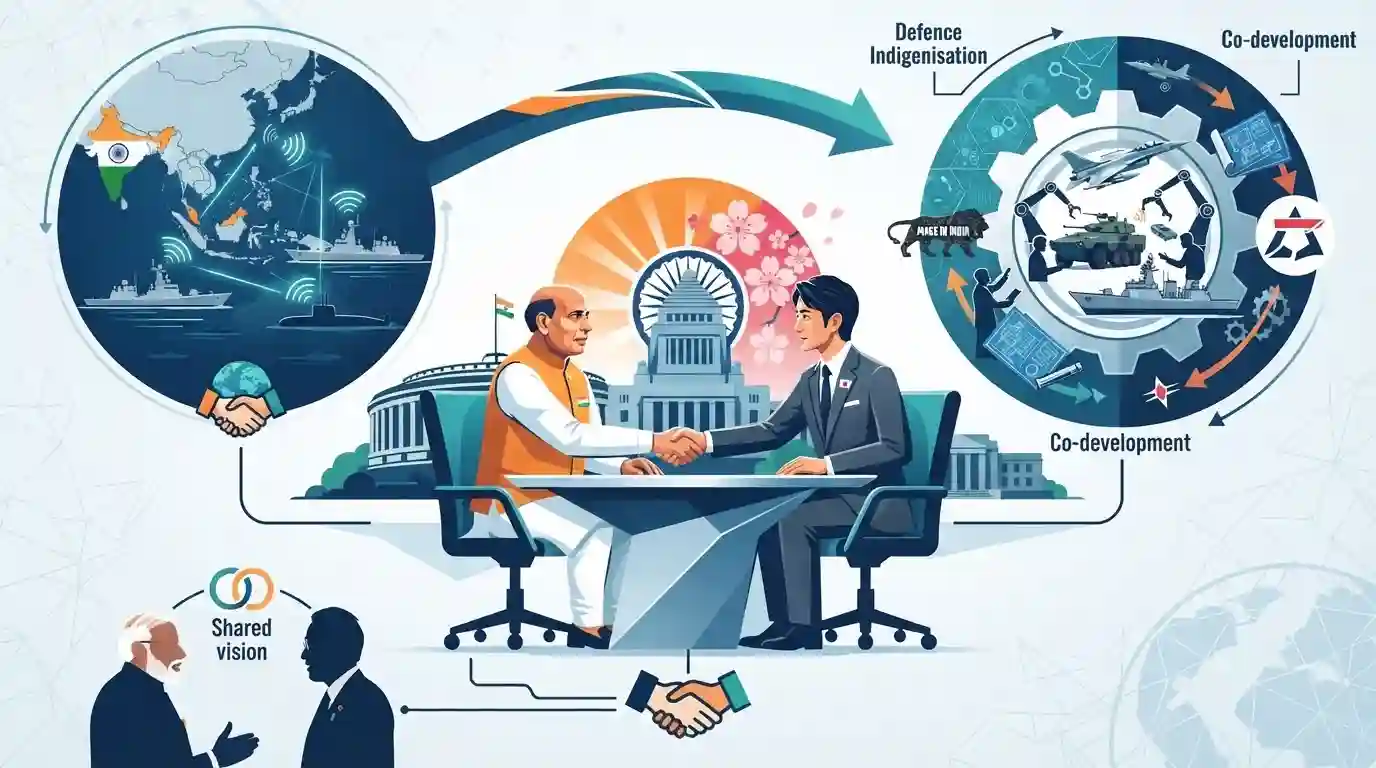
India and Japan are set to deepen their defence and security partnership as Indian Defence Minister Rajnath Singh holds bilateral talks with his Japanese counterpart Shinjiro Koizumi. The discussions will prioritize maritime security cooperation in the Indo-Pacific and the co-development of defence equipment and technology, supported by the 'Make in India' framework and Japan's relaxed defence export principles. This meeting follows the recent strategic dialogues between the Prime Ministers of both nations, reaffirming their shared vision for regional stability.
मुख्य मुद्दे
- Defence Ministers of India and Japan, Rajnath Singh and Shinjiro Koizumi, are scheduled to discuss a roadmap for bolstering bilateral defence and security cooperation.
- A central focus will be on co-development and co-production of defence technology under the 'Make in India' initiative, leveraging Japan's revised Three Principles on Transfer of Defence Equipment and Technology.
- The leaders are expected to deliberate on enhancing maritime security cooperation to ensure a free, open, resilient, and prosperous Indo-Pacific region.
- The defence talks build upon the recent bilateral engagement between Prime Minister Narendra Modi and Japanese Prime Minister Sanae Takaichi in New Delhi.
महत्त्वाच्या संज्ञा
Make in India

A 2014 Indian government initiative to encourage domestic manufacturing. In the defence sector, it aims to reduce import dependence, promote self-reliance, and foster local design and development of military hardware.
UPSC context
GS Paper 3 (Indigenisation of Technology). Essential for evaluating India's push towards strategic autonomy and self-reliance in defence.
Three Principles on Transfer of Defence Equipment and Technology
Japan's 2014 framework replacing its strict arms export ban. It permits defence transfers that promote peace, international cooperation, and Japan's security, subject to strict transparency and end-use controls.
UPSC context
GS Paper 2 (International Relations). Crucial for understanding Japan's evolving security posture and its implications for India-Japan defence ties.
Defence Indigenisation
The capability to develop and produce defence equipment domestically to achieve self-reliance. It reduces import burdens, enhances strategic autonomy, and ensures preparedness during military crises or supply chain disruptions.
UPSC context
GS Paper 3 (Internal Security). Tests understanding of India's defence modernisation and initiatives addressing dependency on foreign hardware.
पूर्वपरीक्षा सापळा
Japan's defense transfer principles limit its bilateral technology co-development with India to non-lethal, non-combat hardware.
The April 2026 revisions abolished the restrictive 'Five Categories' bottleneck, allowing co-development of combat-relevant technology like the UNICORN stealth communication mast.
संबंधित स्थिर संकल्पना
What is India's '2+2' Ministerial Dialogue mechanism?
- Definition: A high-level strategic format involving the Foreign and Defence Ministers to align security, defence, and diplomatic policies.
- Key Partners: India holds this dialogue with key partners including the US, Japan, Australia, Russia, and the UK to institutionalise strategic cooperation.
How does the Acquisition and Cross-Servicing Agreement (ACSA) function?
- Core Function: A bilateral military agreement enabling reciprocal access to food, fuel, spare parts, and military bases during exercises or UN missions.
- Strategic Value: Vastly extends the operational reach of the Indian Navy in the Western Pacific and the Japanese MSDF in the Indian Ocean.
आंतर-विषय नमुने
Defense Indigenisation + Foreign Technology Transfer
The UNICORN project aligns Japan's stealth design with India's BEL, demonstrating how strategic technology transfers bypass domestic R&D bottlenecks to accelerate 'Make in India' initiatives.
Indo-Pacific Security + Constitutional Pacifism
Japan's removal of export bottlenecks marks a historic shift from post-war pacifism, converting the Quad from a diplomatic group into an active defense-industrial partnership.

ACSA logistics and joint stealth projects like UNICORN are prime for multi-statement questions on India-Japan maritime architecture.
संबंधित PYQ · 3
संबंधित PYQ · 3
- 2019MainsGS2
‘The time has come for India and Japan to build a strong contemporary relationship, one involving global and strategic partnership that will have a great significance for Asia and the world as a whole.’ Comment.
- 2020MainsGS2
What is the significance of Indo-US defence deals over Indo-Russian defence deals? Discuss with reference to stability in the Indo-Pacific region.
- 2014MainsGS3
Foreign Direct Investment (FDI) in the defence sector is now set to be liberalized. What influence this is expected to have on Indian defence and economy in the short and long run?
