Hyderabad State Integration and Counter Terrorism Doctrine in India
Source:The Hindu ↗
Why It Matters
The article bridges GS-I (Post-Independence Consolidation) and GS-III (Internal Security). It provides a concrete example of state integration (Operation Polo, Hyderabad) often tested in Mains, and links it to India's evolving counter-terrorism doctrine (Operation Sindoor), illustrating the state's hard-power approach to cross-border terrorism.
Summary
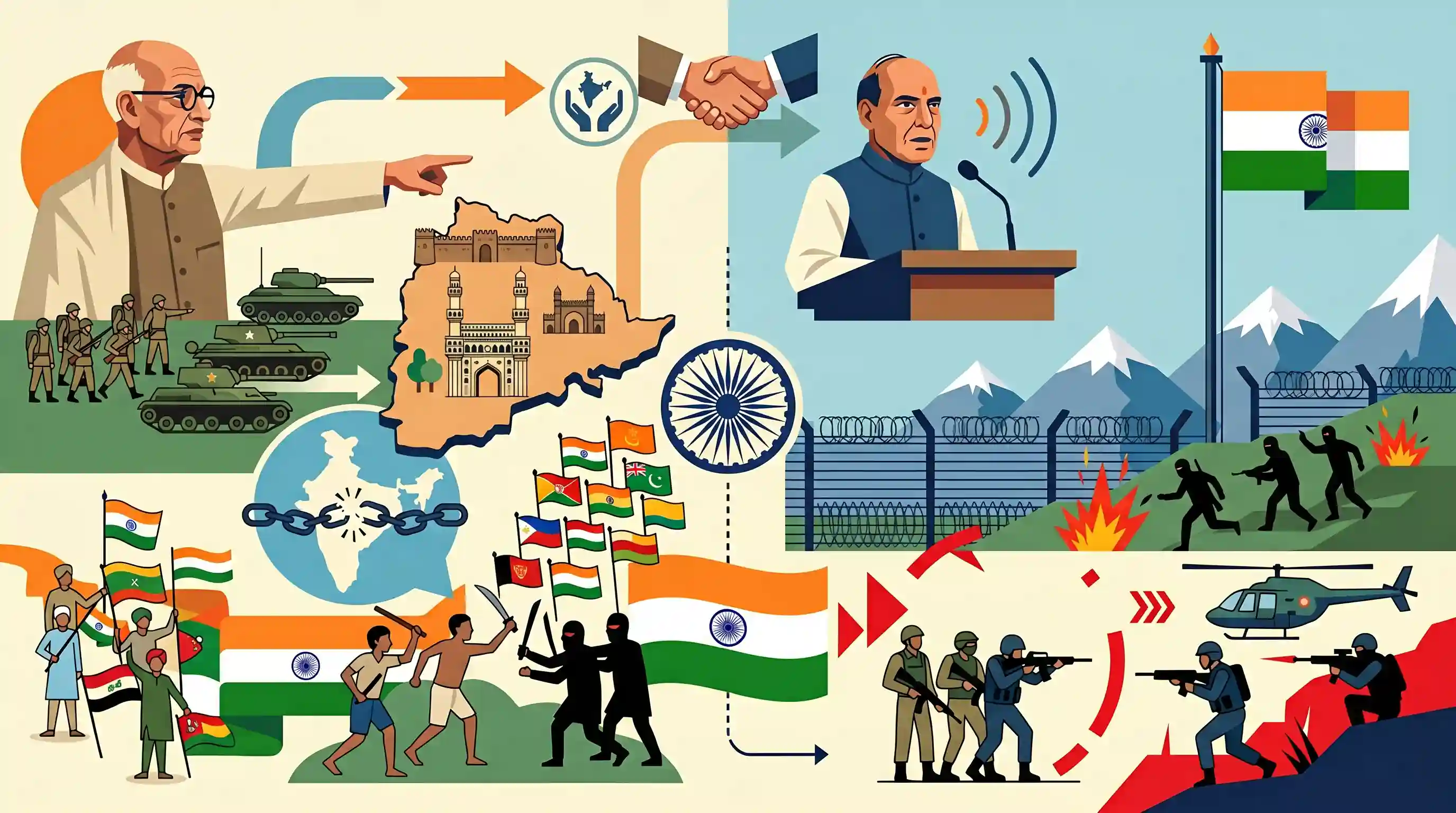
During the Telangana Liberation Day celebrations in Secunderabad, Defence Minister Rajnath Singh commemorated the 1948 integration of Hyderabad into India via Operation Polo, led by Sardar Vallabhbhai Patel. He drew a historical parallel between the people's armed struggle against the oppressive Razakars (the Nizam's militia) and India's contemporary resolve against cross-border terrorism. Specifically referencing 'Operation Sindoor'—launched in retaliation to a terror attack in Pahalgam—Singh asserted India's uncompromising stance on national security and sovereignty, stating that the nation will not bow to external aggression.
Key Points
- Defence Minister Rajnath Singh led the 'Telangana Liberation Day' celebrations, marking the integration of Hyderabad into the Indian Union in 1948 through Operation Polo.
- Singh drew a parallel between the historical Telangana armed struggle against the Nizam's brutal Razakar militia and India's recent assertive counter-terrorism actions.
- He specifically highlighted 'Operation Sindoor', India's military response to Pakistan following a terrorist attack in Pahalgam, demonstrating a firm stance on national security.
- The speech emphasized Sardar Vallabhbhai Patel's pivotal role in national consolidation and criticized previous state governments for ignoring the Liberation Day due to appeasement politics.
Important Terms
Operation Polo

The September 1948 military 'police action' led by the Indian government to integrate the princely state of Hyderabad into the Indian Union after the Nizam's refusal to accede.
UPSC context
GS Paper I: Post-Independence Consolidation. Tests knowledge of national integration and Sardar Patel’s role in unifying India.
Operation Sindoor
A 2025 Indian military campaign involving precise strikes against cross-border terror infrastructure in response to a major terrorist attack in Pahalgam, Jammu & Kashmir.
UPSC context
GS Paper III: Internal Security. Evaluates understanding of India’s contemporary counter-terrorism strategies and strategic deterrence.
Razakars
A private paramilitary militia in the Hyderabad state, led by Qasim Razvi, that violently opposed the state's integration with India and supported the Nizam’s autocratic rule.
UPSC context
GS Paper I: Modern Indian History. Tests knowledge of the communal and political challenges during the integration of princely states.
Telangana Armed Struggle
A communist-led peasant uprising (1946–1951) in Hyderabad state against the oppressive feudal landlordism (Jagirdari system) and the autocratic rule of the Nizam.
UPSC context
GS Paper I: Modern Indian History. Tests understanding of agrarian movements and socio-political resistance in princely states.
Hyderabad Liberation Day
Observed on September 17 to commemorate the 1948 integration of Hyderabad State into the Indian Union following the surrender of the Nizam’s forces.
UPSC context
GS Paper I: Post-Independence India. Important for understanding the historical timeline of the consolidation of the Indian Union.
Prelims Trap
Hyderabad signed the Instrument of Accession prior to Operation Polo.
Hyderabad only signed a Standstill Agreement (Nov 1947). The formal Instrument of Accession was signed by the Nizam later, after his military surrender following Operation Polo (Sept 1948).
Static Concepts Connected
What factors led to the launch of Operation Polo in Hyderabad?
- Standstill Agreement violation: The Nizam breached the November 1947 status quo agreement by covertly negotiating with Pakistan, banning Indian currency, and importing arms.
- Razakar violence: Kasim Razvi's extremist paramilitary militia committed widespread atrocities against the majority rural population, aggressively advocating for an independent Islamic state.
- Geographical threat: An independent or hostile Hyderabad in the heart of the Deccan plateau posed an unacceptable balkanization risk to the newly formed Indian Union.
What were the key drivers of the Telangana Armed Struggle (1946-1951)?
- Vetti system: The agrarian struggle was primarily a revolt against 'vetti' (forced bonded labor) exacted by powerful landlords and state officials.
- Communist leadership: Organized by the Communist Party of India (CPI), it successfully mobilized peasants against the feudal exploitation by powerful Jagirdars and Deshmukhs.
- Dual resistance: The massive rebellion fought simultaneously against oppressive agrarian socio-economic structures and the autocratic political regime of the Nizam of Hyderabad.
Cross-Topic Patterns
Integration history meets GS3 Internal Security
Linking 1948 police action to modern pre-emptive strikes (Operation Sindoor) showcases the evolution of India's coercive statecraft and non-contact military doctrine.
Peasant movements shaping post-independence reforms
The communist-led Telangana armed struggle against the Vetti system heavily influenced independent India's early land reform legislation and catalyzed the Bhoodan movement.

Expect a chronological Prelims question matching Indian military operations (Polo, Vijay, Meghdoot, Cactus, Sindoor) with their contexts.
Linked PYQs · 3
Linked PYQs · 3
- 2025MainsGS1
Trace India's consolidation process during early phase of independence in terms of polity, economy, education and international relations.
- 2021MainsGS1
Assess the main administrative issues and socio-cultural problems in the integration process of Indian Princely States.
- 2025MainsGS3
Terrorism is a global scourge. How has it manifested in India? Elaborate with contemporary examples. What are the counter measures adopted by the State? Explain.
