India South Korea Defence Partnership and KIND X Ecosystem Roadmap
Source:The Hindu ↗
Why It Matters
The development showcases India's evolving foreign policy strategy, moving beyond traditional trade ties with East Asian nations to forge robust defence and technology partnerships. It highlights the practical application of the 'Act East Policy' in securing the Indo-Pacific and demonstrates progress in the 'Aatmanirbhar Bharat' push by securing foreign collaboration for domestic high-tech arms manufacturing.
Summary
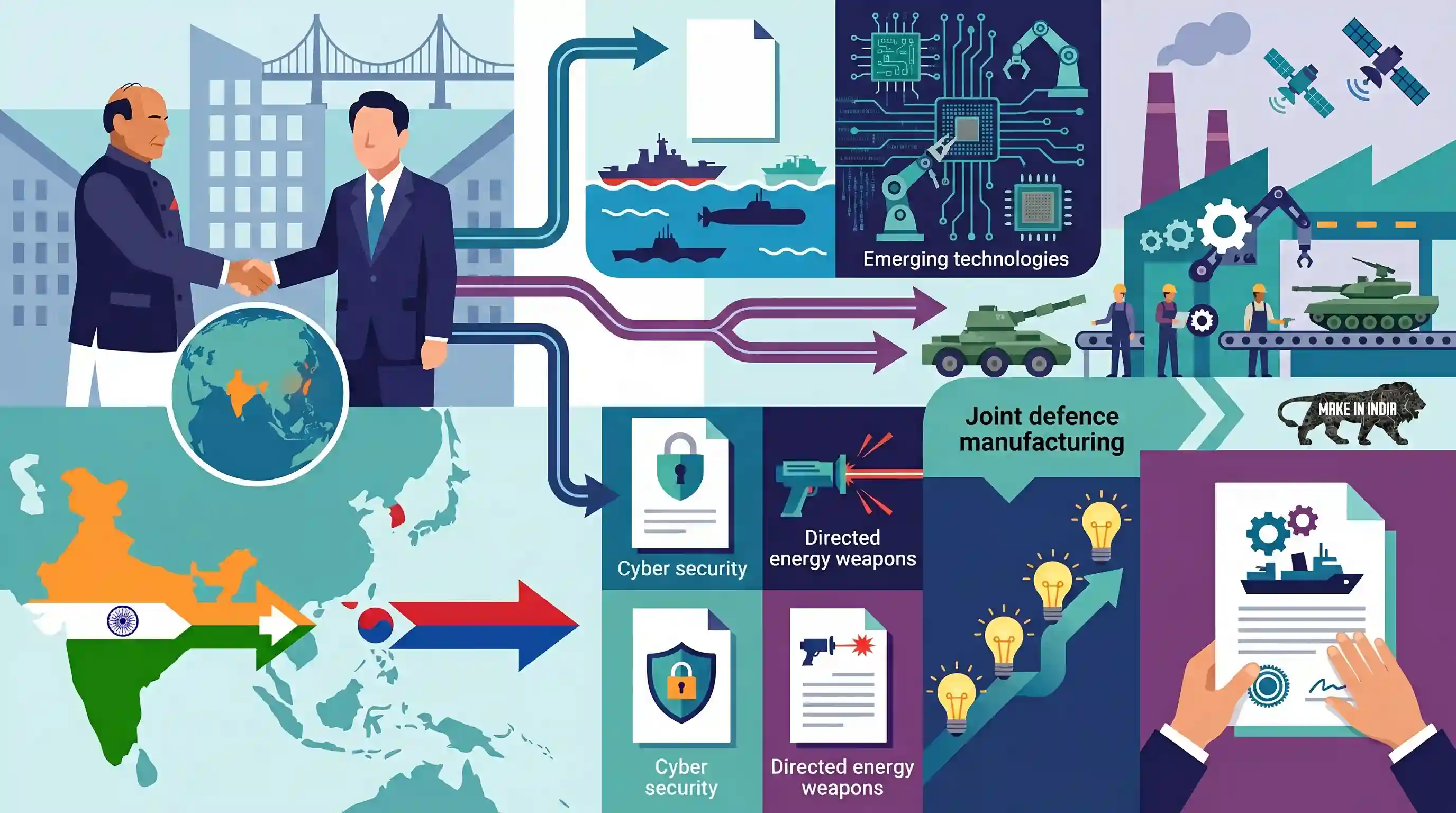
Defence Minister Rajnath Singh held extensive bilateral talks with South Korean Defence Minister Ahn Gyu-back in Seoul, aimed at deepening strategic and defence ties. The discussions focused on expanding cooperation in maritime security, emerging technologies, and joint defence manufacturing under India's 'Make in India' initiative. Key outcomes included MoUs on cyber security and future-oriented projects like directed energy weapons, the launch of the KIND-X innovation ecosystem roadmap, and a manufacturing pact between L&T and Hanwha. Both nations emphasized the alignment of India's Act East Policy with South Korea's Indo-Pacific vision to ensure regional stability.
Key Points
- Defence Minister Rajnath Singh held bilateral talks in Seoul with his South Korean counterpart to expand cooperation in maritime security, cyber tech, emerging technologies, and military exchanges.
- Multiple MoUs were signed covering defence, cyber security, training exchanges, and UN peacekeeping operations.
- Emphasis was placed on co-development of future-oriented projects, including self-propelled air defence systems and directed energy weapons, aligning with the 'Make in India' and 'Aatmanirbhar Bharat' initiatives.
- A roadmap for the India-Korea Defence Innovation Accelerator Ecosystem (KIND-X) was established to foster R&D in AI, autonomous systems, semiconductors, and quantum technology.
- The leaders noted a strong convergence between India’s Act East Policy and South Korea’s regional strategic vision for a free, open, and rules-based Indo-Pacific.
- A manufacturing agreement was finalized between Larsen & Toubro and South Korea’s Hanwha, boosting indigenous defence production.
- Singh reiterated India's commitment to its 'No First Use' nuclear policy, zero tolerance for terrorism, and highlighted 'Operation Sindoor' as a symbol of India's strategic confidence.
Important Terms
Act East Policy

India's proactive diplomatic initiative to strengthen economic, strategic, and cultural ties with the Indo-Pacific region, evolving from the earlier "Look East Policy."
UPSC context
GS Paper II: International Relations. Tests India's regional foreign policy and its strategic alignment with Indo-Pacific partners.
KIND-X (India-Korea Defence Innovation Accelerator Ecosystem)
A bilateral "innovation bridge" launched in 2026 to synergize the defence startups, R&D, and industrial ecosystems of India (iDEX) and South Korea (DAPA).
UPSC context
GS Paper III: Security/Technology. Relevant for defence technology co-development and achieving self-reliance in advanced military hardware.
Operation Sindoor
A 2025 Indian military operation targeting terrorist infrastructure in Pakistan following an attack in Pahalgam, reflecting India's "zero-tolerance" and proactive counter-terrorism doctrine.
UPSC context
GS Paper III: Internal Security. Tests understanding of India’s evolving military response to state-sponsored terrorism.
Aatmanirbhar Bharat (Defence)
A national vision aiming for self-reliance in strategic sectors, particularly defence, by promoting indigenous design, development, and manufacturing to reduce import dependency.
UPSC context
GS Paper III: Security/Economy. Crucial for questions on defence indigenisation and strategic autonomy.
No First Use (NFU) Policy
India's nuclear doctrine component specifying that nuclear weapons will only be used in retaliation against a nuclear attack on Indian territory or forces.
UPSC context
GS Paper III: Security. Tests knowledge of India’s nuclear posture and regional deterrence dynamics.
K9 Vajra-T
A 155mm self-propelled howitzer produced by L&T in India using South Korean technology; it is a landmark project for defence indigenisation.
UPSC context
GS Paper III: Security. Cited as a successful case study of technology transfer and "Make in India" in defence.
Make in India
A flagship program launched in 2014 to transform India into a global manufacturing hub, focusing on 25 sectors including defence.
UPSC context
GS Paper III: Economy/Security. Tests industrial policy and its role in strategic sector growth.
Prelims Trap
Operation Sindoor is a joint naval military exercise conducted by India and South Korea.
It is actually an Indian national security operation demonstrating a doctrinal shift toward 'punitive deterrence' against state-sponsored terrorism, not a bilateral exercise.
Static Concepts Connected
What are Directed Energy Weapons (DEWs)?
- Mechanism: Weapons that use highly focused energy (lasers, high-power microwaves, particle beams) to damage targets without physical projectiles.
- Key Advantages: Speed of light delivery, pinpoint precision, low cost-per-shot, and a practically infinite magazine capacity compared to conventional kinetic weapons.
- Strategic Utility: Ideal for counter-drone operations and ballistic missile defence, playing a crucial role in modern multi-domain warfare.
What distinguishes the Act East Policy from the Look East Policy?
- Strategic Depth: Transitions from purely economic and cultural ties to robust defence, maritime security, and strategic partnerships.
- Extended Geography: Broadens the geopolitical horizon beyond ASEAN to deeply engage with South Korea, Japan, Australia, and Pacific nations.
- Domestic Integration: Directly links the economic development, infrastructure, and connectivity of India's North East with its eastern neighbors.
Cross-Topic Patterns
INDUS-X and KIND-X ecosystems
India is rapidly institutionalizing bilateral defence innovation accelerators (like INDUS-X with the US and KIND-X with Korea) to fund deep-tech startups and bypass slow traditional procurement.
K-9 Vajra technology transfer model
The L&T and Hanwha manufacturing pact represents a shift from buyer-seller dynamics to co-production, replicating the K-9 Vajra howitzer's success for futuristic systems like directed energy weapons.

Tech-diplomacy initiatives (KIND-X, INDUS-X) and directed energy weapons form high-probability match-the-following questions for Prelims 2026.
Linked PYQs · 3
Linked PYQs · 3
- 2016MainsGS2
Evaluate the economic and strategic dimensions of India's Look East Policy in the context of the post Cold War international scenario.
- 2020MainsGS2
What is the significance of Indo-US defence deals over Indo-Russian defence deals? Discuss with reference to stability in the Indo-Pacific region.
- 2014MainsGS3
Foreign Direct Investment (FDI) in the defence sector is now set to be liberalized. What influence this is expected to have on Indian defence and economy in the short and long run?
