Border Defense Strategy Shift to Deterrence by Punishment
Source:Indian Express ↗
ఇది ఎందుకు ముఖ్యం
It marks an important evolution in India's official military doctrine and strategic posture regarding border defense, shifting from mere territorial defense to active deterrence, which is crucial for GS3 Security syllabus.
సారాంశం
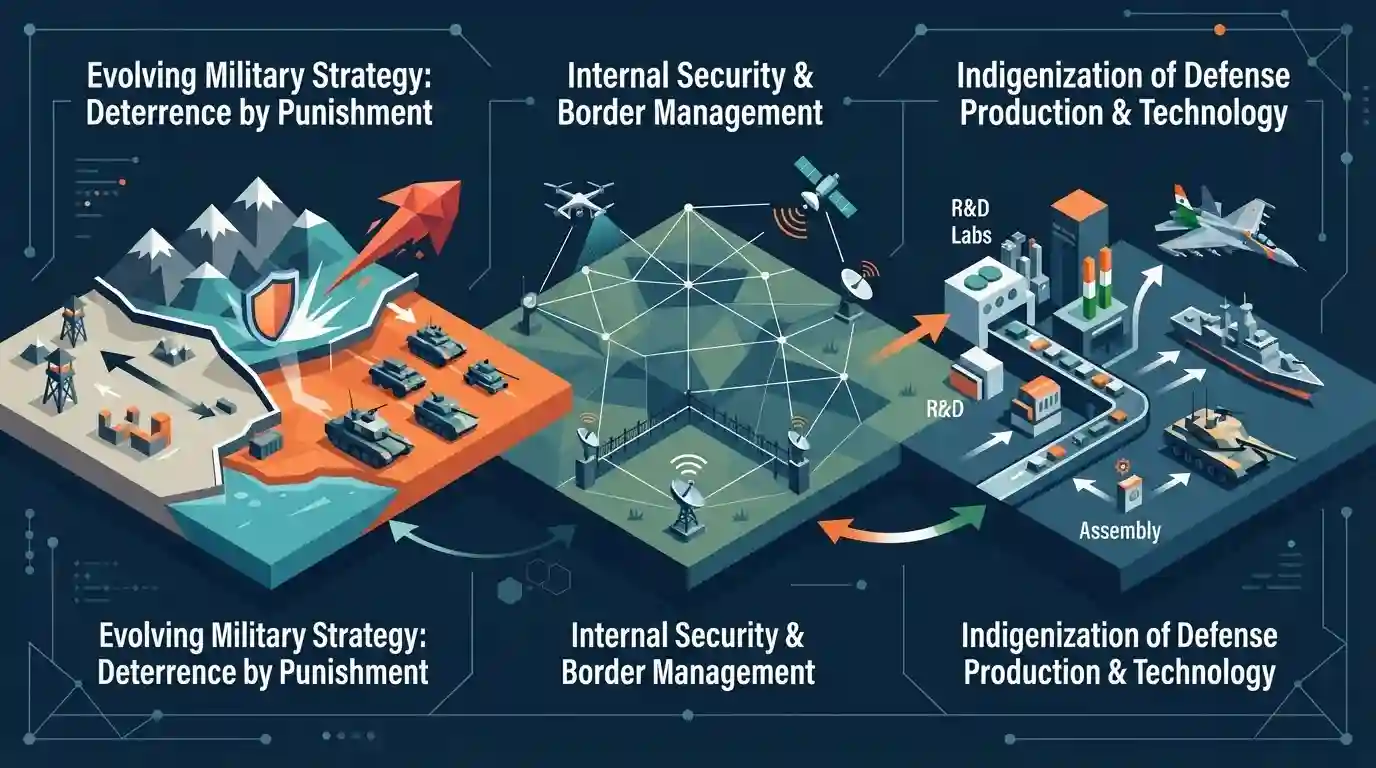
Defence Minister Rajnath Singh highlighted India's evolving military strategy, moving away from the 'perimeter fallacy' of static border defense toward a robust doctrine of 'deterrence by punishment'. He underscored the importance of proactive security postures, indigenization in defense production, and technological integration to tackle contemporary geopolitical challenges.
ముఖ్య అంశాలు
- Defence Minister Rajnath Singh cautioned against the 'perimeter fallacy', emphasizing that modern national security requires moving beyond passive defense at borders to proactive measures.
- Highlighted India's strategic transition from passive containment to 'deterrence by punishment', signaling readiness to impose heavy costs on aggressors.
- Stressed the necessity of indigenous defense manufacturing, technology adoption, and strategic autonomy to counter emerging multi-domain threats.
ముఖ్యమైన పదాలు
Perimeter Fallacy

A strategic concept highlighting that national security cannot be safeguarded solely by static border defense or geographical boundaries, as modern security threats include cyber-attacks, drones, and economic warfare.
UPSC context
UPSC Prelims and Mains (Internal Security / GS Paper III): Tests understanding of evolving national security doctrines and border management strategies.
Deterrence by Punishment
A military strategy involving the threat of severe retaliation and punishment to dissuade an adversary from initiating hostile actions or terrorist attacks, replacing passive containment.
UPSC context
UPSC Mains (GS Paper III - Security): Evaluates shifts in India's defence policy and proactive security postures.
Ministry of Defence
The apex government department charged with policy formulation and implementation for the defense of India and overseeing all agencies related to national security.
UPSC context
UPSC Prelims and Mains (Polity / GS Paper II & III): Important for institutional framework of national security administration.
Indian Armed Forces
The combined military forces of India—comprising the Army, Navy, and Air Force—tasked with defending the nation's territorial integrity and sovereignty.
UPSC context
UPSC Mains (GS Paper III - Security): Central to questions regarding defense preparedness, theater commands, and jointness.
అనుసంధానమైన స్థిర భావనలు
What is the difference between Deterrence by Denial and Deterrence by Punishment?
- Denial definition:: Convincing an adversary that their attack will fail by making defense impenetrable at the border (e.g., static deployment).
- Punishment definition:: Convincing an adversary that the cost of aggression will vastly outweigh any potential benefit by imposing unacceptable retaliatory costs.
- Strategic shift:: India is shifting its strategic posture from passive denial (perimeter defense) to active deterrence by punishment.
అంతర-అంశ నమూనాలు
Deterrence Doctrine + Defense Indigenization
Shifting from defensive perimeter guarding to offensive deterrence requires robust domestic defense manufacturing and cutting-edge tech integration under Atmanirbhar Bharat.
Border Management + Multi-Domain Warfare
Modern border management and multi-domain threat readiness directly intersect with space, cyber, and high-altitude warfare preparedness.

Expect statements combining 'deterrence by punishment' with defense indigenization targets like negative import lists in Prelims or Mains.
అనుసంధాన PYQలు · 2
అనుసంధాన PYQలు · 2
- 2025MainsGS3
Terrorism is a global scourge. How has it manifested in India? Elaborate with contemporary examples. What are the counter measures adopted by the State? Explain.
- 2021MainsGS3
Keeping in view India's internal security, analyse the impact of cross-border cyber attacks. Also discuss defensive measures against these sophisticated attacks.
