Defence Minister Attends SCO Meeting in Bishkek
Source:The Hindu ↗
Why It Matters
The SCO is a vital Eurasian political and security organization where India's presence is key to shaping regional counter-terrorism efforts (e.g., through RATS). Understanding India's diplomatic maneuvering within the SCO, especially regarding West Asian stability and cross-border terrorism, is directly tested in GS-II (International Relations) and GS-III (Security).
Summary
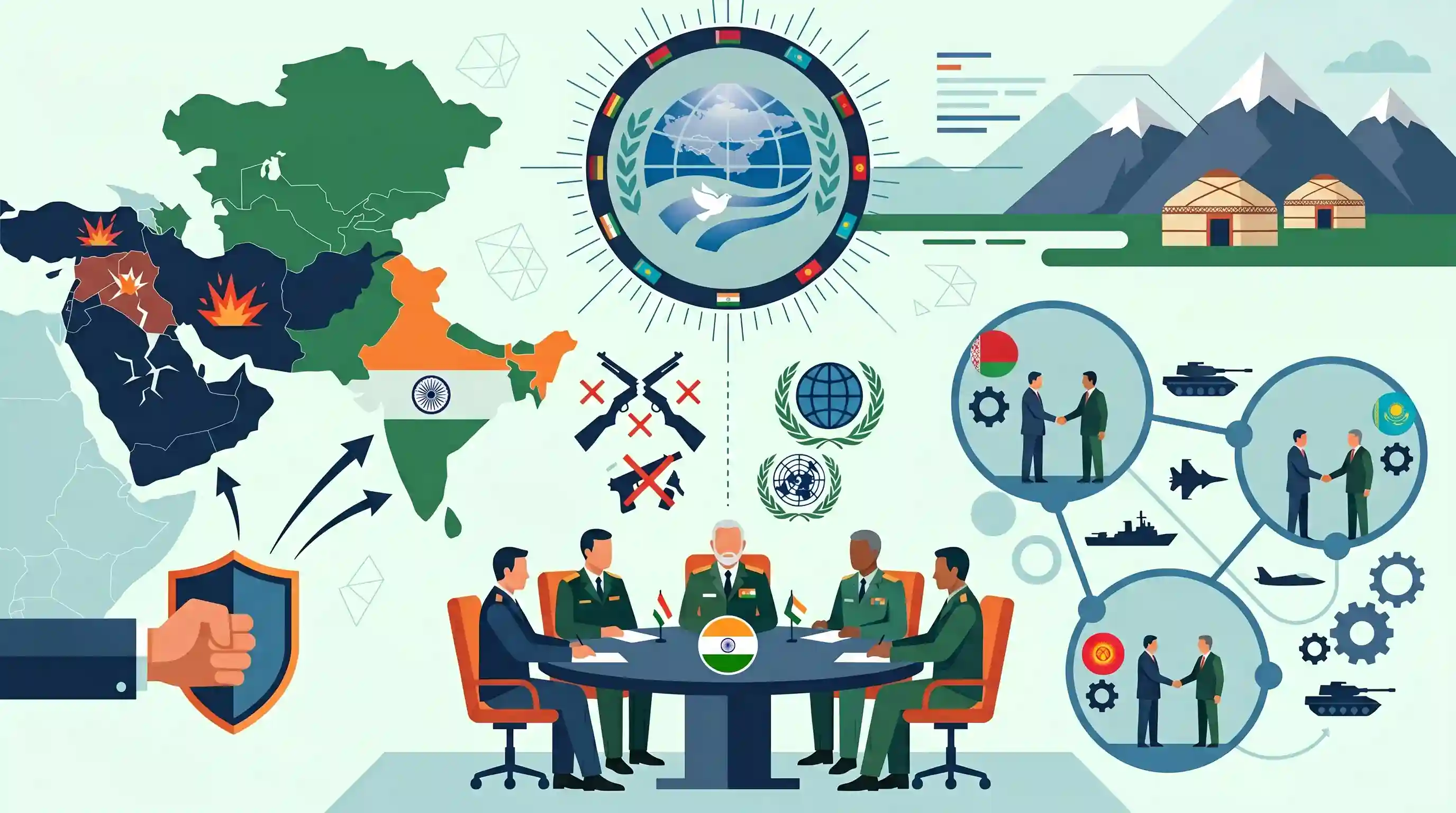
Defence Minister Rajnath Singh arrived in Bishkek, Kyrgyzstan, for the Shanghai Cooperation Organisation (SCO) Defence Ministers' Meeting. The summit focuses on addressing key regional and global security challenges, including counter-terrorism and international peace. A significant talking point is the ongoing geopolitical tensions in West Asia and strategies to mitigate their spillover effects on regional stability. India will reiterate its zero-tolerance policy against terrorism. Additionally, Singh is scheduled to hold bilateral talks with his counterparts from Belarus, Kazakhstan, and Kyrgyzstan to deepen defence cooperation.
Key Points
- Defence Minister Rajnath Singh arrived in Bishkek, Kyrgyzstan, for the SCO Defence Ministers' meeting.
- The agenda includes deliberations on regional and global security challenges, international peace, counter-terrorism, and defence collaboration.
- The meeting addresses ongoing geopolitical tensions in West Asia and strategies to mitigate their impact on regional stability.
- India intends to highlight its zero-tolerance policy towards terrorism and hold bilateral meetings with Belarus, Kazakhstan, and Kyrgyzstan.
Important Terms
Shanghai Cooperation Organisation (SCO)

A Eurasian political, economic, and security alliance founded in 2001. It currently has 10 members, including India, Pakistan, Iran, and Belarus, focusing on regional stability and counter-terrorism.
UPSC context
GS-II: Important International institutions and regional groupings involving India's interests. Relevant for mains analysis of Eurasian geopolitics.
Regional Anti-Terrorist Structure (RATS)
A permanent organ of the SCO headquartered in Tashkent, tasked with coordinating member states' efforts against terrorism, separatism, and extremism through intelligence sharing and joint exercises.
UPSC context
GS-III: Security challenges and their management; GS-II: International institutions. Essential for questions on regional security cooperation.
Zero-Tolerance Policy (Terrorism)
India's diplomatic and security doctrine that rejects any justification for terror acts and treats both terrorists and their state sponsors as equal threats.
UPSC context
GS-III: Internal Security; GS-II: India’s foreign policy. Tests understanding of India's firm stance on cross-border security.
Shanghai Spirit
The core philosophy of the SCO emphasizing mutual trust, benefit, equality, consultation, respect for cultural diversity, and the pursuit of common development.
UPSC context
GS-II: International Relations. Often used to analyze the functional principles of the SCO compared to Western alliances.
The Three Evils
The SCO's collective term for the primary regional security threats: terrorism, separatism, and religious extremism, which the organization was originally formed to combat.
UPSC context
GS-III: Security; GS-II: International groupings. Key concept in explaining the security mandate of the SCO.
West Asia (Strategic Significance)
A region critical to India's energy security (supplying ~60% of oil), diaspora welfare (8M+ Indians), and strategic connectivity (e.g., Chabahar Port).
UPSC context
GS-II: Bilateral and regional agreements affecting India’s interests. Vital for energy security and "Look West" policy questions.
Prelims Trap
"Belarus and Iran hold observer status in the Shanghai Cooperation Organisation."
Both are now full members. Iran joined in 2023, and Belarus became the 10th full member in July 2024. Old study materials mislabel them.
Static Concepts Connected
What is the mandate and structure of SCO's Regional Anti-Terrorist Structure (RATS)?
- Core Mandate: Established to facilitate intelligence sharing among member states to combat terrorism, separatism, and extremism (collectively known as the 'Three Evils').
- Headquarters: Permanently located in Tashkent, Uzbekistan, which is distinct from the main SCO Secretariat situated in Beijing, China.
- India's Posture: India actively utilizes the RATS framework to reinforce its zero-tolerance policy on terrorism and address cross-border terror threats.
How does India structure its bilateral defense cooperation with Central Asian Republics?
- Policy Framework: Anchored in the Connect Central Asia Policy (launched 2012 in Bishkek), which integrates security, political, and economic diplomacy.
- Joint Exercises: India conducts regular bilateral special forces drills to build capacity, such as 'Khanjar' with Kyrgyzstan and 'Kazind' with Kazakhstan.
Cross-Topic Patterns
SCO + INSTC Integration
Engaging Central Asian states via SCO provides the geopolitical framework needed to secure the International North-South Transport Corridor (INSTC), facilitating trade with Eurasia while bypassing Pakistan.
Geopolitical spillover from West Asia
Tensions in West Asia directly threaten energy supply lines and elevate radicalization risks in Central Asia, making it a pivotal agenda item for the SCO's collective security apparatus.

A chronological mapping of SCO expansion (Iran 2023, Belarus 2024) paired with matching Central Asian joint military exercises is likely.
Linked PYQs · 4
Linked PYQs · 4
- 2023MainsGS2
‘Virus of Conflict is affecting the functioning of the SCO’ In the light of the above statement point out the role of India in mitigating the problems.
- 2021MainsGS2
Critically examine the aims and objectives of SCO. What importance does it hold for India?
- 2022PrelimsGS1
Consider the following: 1. Asian Infrastructure Investment Bank 2. Missile Technology Control Regime 3. Shanghai Cooperation Organisation India is a member of which of the above?
- 2021MainsGS3
Analyse the complexity and intensity of terrorism, its causes, linkages and obnoxious nexus. Also suggest measures required to be taken to eradicate the menace of terrorism.
