Armed Forces Veterans Day Focus on Welfare and National Integration
Source:The Hindu ↗
Why It Matters
The article touches upon the historical context of India's foreign policy (IPKF in Sri Lanka) and domestic governance focused on the welfare of ex-servicemen (OROP, ECHS). Understanding these welfare measures and historical military-diplomatic missions is crucial for the Governance and International Relations segments of GS Paper 2.
Summary
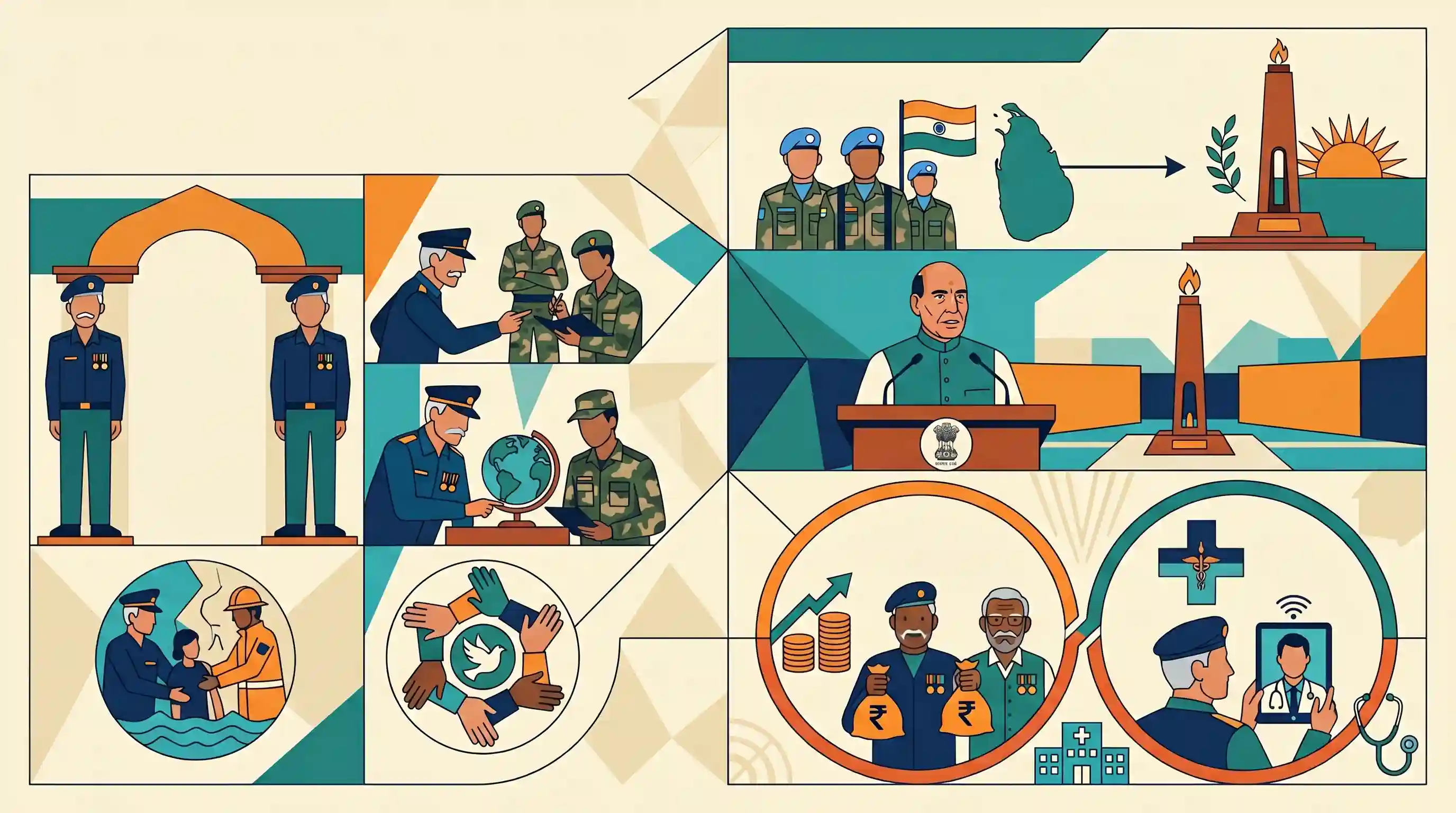
Defence Minister Rajnath Singh addressed the 10th Armed Forces Veterans Day in New Delhi, paying tribute to the courage and sacrifices of the Indian Peacekeeping Force (IPKF) during Operation Pawan in Sri Lanka. Singh emphasized that the sacrifices of these soldiers, which previously lacked adequate recognition, are now being duly honored by the government at the National War Memorial. Describing ex-servicemen as 'living pillars of national consciousness', he urged them to actively guide the youth and Agniveers, assist civil administration in emergencies, and promote social harmony. The Minister also reiterated the government's commitment to veterans' welfare, highlighting the financial stability brought by the One Rank One Pension (OROP) scheme and ongoing efforts to strengthen healthcare access through the Ex-Servicemen Contributory Health Scheme (ECHS) and telemedicine.
Key Points
- Defence Minister Rajnath Singh addressed the 10th Armed Forces Veterans Day in New Delhi, honoring the sacrifices of veterans.
- The contributions and sacrifices of the Indian Peacekeeping Force (IPKF) during Operation Pawan in Sri Lanka were officially acknowledged, correcting decades of oversight.
- Veterans were called upon to serve as pillars of national consciousness by guiding the youth, mentoring Agniveers, assisting civil administrations, and promoting social harmony.
- The government highlighted its ongoing commitment to ex-servicemen welfare through the successful implementation of the One Rank One Pension (OROP) scheme.
- Plans to expand and strengthen the Ex-Servicemen Contributory Health Scheme (ECHS) through rural outreach and telemedicine were emphasized to ensure accessible healthcare for all veterans.
Important Terms
Operation Pawan

A 1987-1990 military operation by the Indian Peacekeeping Force (IPKF) to seize control of the Jaffna Peninsula from LTTE militants under the Indo-Sri Lanka Accord.
UPSC context
GS Paper 2/3; tests India-Sri Lanka relations and history of regional security interventions.
One Rank One Pension (OROP)
Policy ensuring uniform pension for armed forces personnel of the same rank and service duration, irrespective of their retirement date, to maintain pay-pension equity.
UPSC context
GS Paper 2/3; covers welfare schemes for vulnerable sections and security force management.
Indian Peacekeeping Force (IPKF)
The Indian military contingent deployed to Sri Lanka (1987–1990) to perform peacekeeping and counter-insurgency operations aimed at ending the Sri Lankan Civil War.
UPSC context
GS Paper 2; tests knowledge of India's neighborhood relations and diplomatic-military history.
Ex-Servicemen Contributory Health Scheme (ECHS)
A flagship healthcare initiative launched in 2003 providing comprehensive, cashless medical treatment to retired armed forces personnel and their eligible dependents nationwide.
UPSC context
GS Paper 2; relates to social justice and government interventions for specific population groups.
Armed Forces Veterans Day
Observed annually on January 14 to honor the service of veterans, marking the 1953 retirement of Field Marshal K.M. Cariappa, the first Indian Commander-in-Chief.
UPSC context
GS Paper 3; recognizes the professional status and social welfare of security forces.
Prelims Trap
"Operation Pawan was an Indian military intervention to foil a coup in the Maldives."
This describes Operation Cactus (1988). Operation Pawan (1987) involved the Indian Peace Keeping Force (IPKF) disarming the LTTE in Sri Lanka under the Indo-Sri Lanka Accord.
Static Concepts Connected
What was the mandate of the IPKF under the 1987 Indo-Sri Lanka Accord?
- Strategic Objective: To disarm militant groups like the LTTE and ensure the implementation of the 13th Amendment for devolving powers to Sri Lankan provinces.
- Operation Pawan: A late-1987 military offensive by the IPKF to wrest control of the Jaffna Peninsula from LTTE forces who refused to disarm.
- Eventual Withdrawal: Amidst heavy casualties and shifting political stances in both India and Sri Lanka, the IPKF was fully withdrawn by March 1990.
What is the core principle of the One Rank One Pension (OROP) scheme?
- Uniformity Rule: It guarantees identical pension benefits to personnel retiring in the same rank with the same length of service, regardless of their retirement date.
- Historical Parity: It bridges the financial disparity between older retirees and newer ones whose pensions were augmented by successive Central Pay Commissions.
- Koshiyari Committee: The Bhagat Singh Koshiyari Committee (2011) strongly recommended OROP's implementation, calling the past pension disparities a breach of equity.
Cross-Topic Patterns
Agniveers + CAPF integration
The call for veterans to mentor Agniveers highlights the broader governance challenge of integrating short-tour military recruits into civil administration and paramilitary forces post-service.
Post-Independence Military Diplomacy
Operation Pawan (Sri Lanka) and Operation Cactus (Maldives) represent India's late-1980s assertion as a net security provider, a key theme in post-independence Indian foreign policy.

Expect a Prelims match-the-following on post-independence military ops (Pawan, Cactus, Meghdoot) & their geographic/geopolitical goals.
Linked PYQs · 3
Linked PYQs · 3
- 2022MainsGS2
India is an age-old friend of Sri Lanka.’ Discuss India's role in the recent crisis in Sri Lanka in the light of the preceding statement.
- 2022MainsGS2
Besides the welfare schemes, India needs deft management of inflation and unemployment to serve the poor and the underprivileged sections of the society. Discuss.
- 2019MainsGS2
Performance of welfare schemes that are implemented for vulnerable sections is not so effective due to absence of their awareness and active involvement at all stages of policy process. Discuss.
