Strategic Significance of India Opposing BRI at SCO
Source:Indian Express ↗
Why It Matters
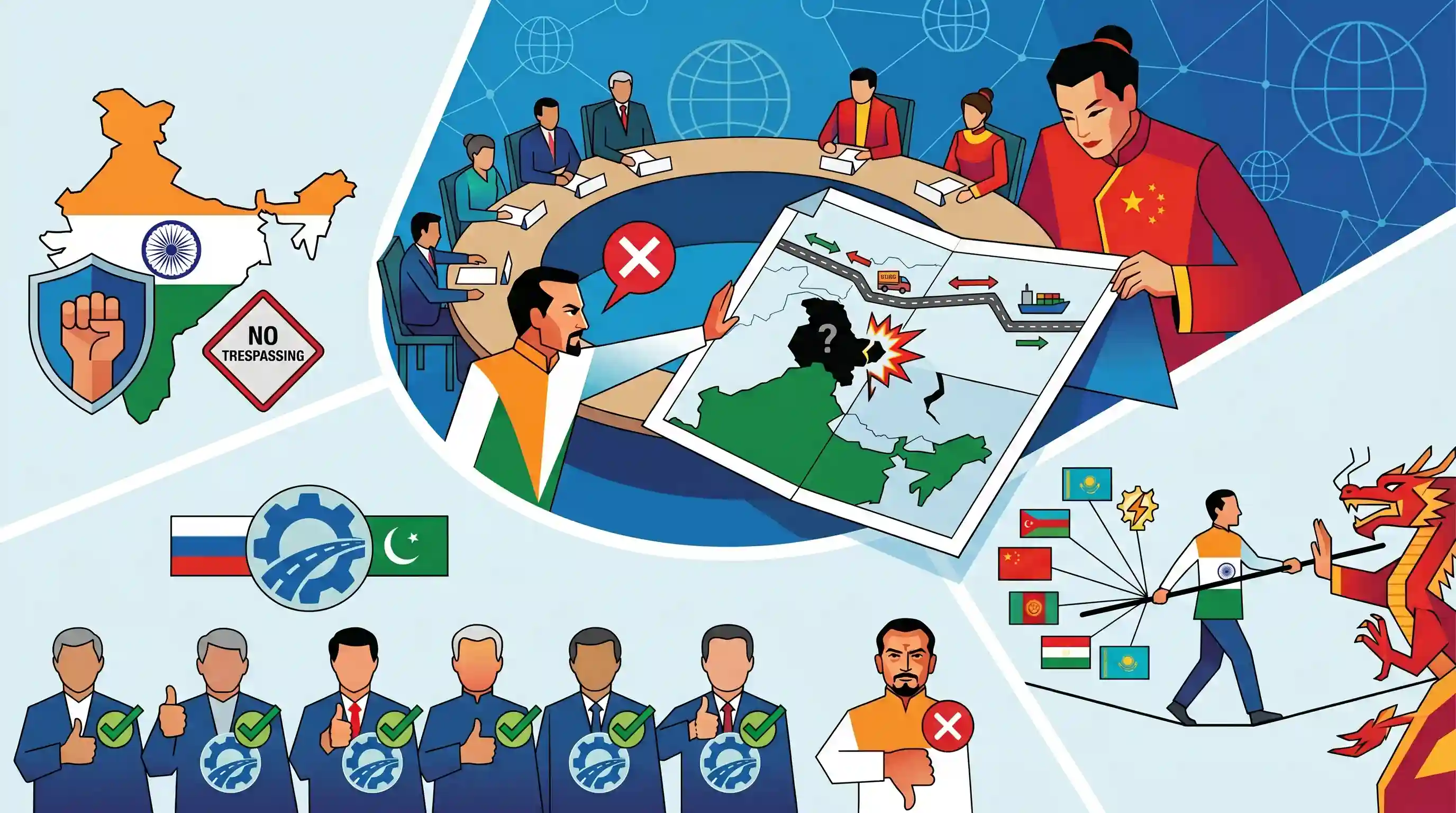
This highlights India's core diplomatic principles—protecting territorial sovereignty against the CPEC and asserting strategic autonomy within the China-led SCO. It is directly relevant for GS2 (International Relations) and GS3 (Security implications of border infrastructure).
Summary
India's Defence Minister Rajnath Singh refused to sign a draft joint statement at the Shanghai Cooperation Organisation (SCO) meeting due to references endorsing China's Belt and Road Initiative (BRI). India has consistently opposed the BRI because its central component, the China-Pakistan Economic Corridor (CPEC), passes through Pakistan-occupied Kashmir (PoK), thus violating India's sovereignty. The refusal highlights three main points of significance: first, India's uncompromising stance on territorial integrity; second, its assertion of strategic autonomy by being the sole SCO member to reject the BRI; and third, its delicate diplomatic balancing act to maintain engagement with Central Asia while checking Chinese dominance in the region.
Key Points
- Defence Minister Rajnath Singh refused to sign an SCO draft statement because it contained paragraphs endorsing China's Belt and Road Initiative (BRI).
- India consistently opposes the BRI because its flagship project, the China-Pakistan Economic Corridor (CPEC), passes through Pakistan-occupied Kashmir (PoK), directly violating India's sovereignty and territorial integrity.
- India is the only member state within the Shanghai Cooperation Organisation (SCO) that refuses to endorse the BRI, demonstrating its strategic autonomy and independent foreign policy even within China-dominated groupings.
- This stance reflects India's broader strategy of utilizing the SCO to engage with Central Asian Republics and Russia while simultaneously pushing back against Chinese regional hegemony.
Important Terms
Belt and Road Initiative (BRI)

A global infrastructure strategy launched by China in 2013 to connect Asia, Africa, and Europe through land and maritime networks, aiming to enhance regional connectivity and trade.
UPSC context
GS Paper-II/International Relations; tests understanding of regional geopolitics, sovereignty concerns, and India's strategic autonomy in multilateral forums.
China-Pakistan Economic Corridor (CPEC)
A 3,000-km flagship BRI project connecting China's Xinjiang to Pakistan's Gwadar Port; India opposes it as it passes through Pakistan-occupied Kashmir (PoK), violating Indian sovereignty.
UPSC context
GS Paper-II/Bilateral Relations; critical for understanding India-China-Pakistan dynamics and challenges to territorial integrity.
Shanghai Cooperation Organisation (SCO)
A permanent Eurasian intergovernmental organization founded in 2001, focusing on security, economic, and political cooperation. India and Pakistan became full members in 2017.
UPSC context
GS Paper-II/Regional Groupings; tests India's engagement with Central Asia and its ability to balance interests within China-dominated organizations.
Prelims Trap
"All SCO member states have endorsed China's Belt and Road Initiative in joint declarations."
Aspirants often assume multilateral joint statements require absolute unanimity. However, India consistently and uniquely registers formal dissent on BRI paragraphs in SCO documents due to CPEC.
Static Concepts Connected
What are the core institutions and full membership of the SCO?
- Membership: China, Russia, India, Pakistan, Iran, Belarus, and four Central Asian states (Kazakhstan, Kyrgyzstan, Tajikistan, Uzbekistan).
- SCO Secretariat: Located in Beijing, it handles day-to-day administrative and coordination functions for the grouping.
- RATS: The Regional Anti-Terrorist Structure (RATS), based in Tashkent, coordinates efforts to combat terrorism, separatism, and extremism.
What is the geographical route of the China-Pakistan Economic Corridor (CPEC)?
- Origin: Starts from Kashgar in the Xinjiang Uygur Autonomous Region of China.
- Disputed Transit: Passes through the Karakoram Highway and Gilgit-Baltistan (PoK), directly challenging India's territorial sovereignty.
- Destination: Culminates at the Chinese-operated Gwadar Port in the Balochistan province of Pakistan on the Arabian Sea.
Cross-Topic Patterns
SCO, INSTC and Chabahar connectivity matrix
India leverages the SCO for Central Asian engagement while simultaneously pushing the INSTC and Chabahar port to bypass Pakistan's geographic blockade, creating parallel connectivity architectures to counter CPEC.
Strategic Autonomy via Multi-alignment
India's issue-based alignment allows simultaneous membership in the Quad (Indo-Pacific maritime security) and SCO (Eurasian continental security) without yielding to Chinese consensus pressure in either theater.

Expect a 2026 Prelims question testing India's unique 'non-endorsement' of BRI within SCO, alongside the geographic routing of CPEC/PoK.
Linked PYQs · 4
Linked PYQs · 4
- 2023MainsGS2
‘Virus of Conflict is affecting the functioning of the SCO’ In the light of the above statement point out the role of India in mitigating the problems.
- 2021MainsGS2
Critically examine the aims and objectives of SCO. What importance does it hold for India?
- 2014MainsGS3
China and Pakistan have entered into an agreement for development of an economic corridor. What threat does this pose for India's security? Critically examine.
- 2011MainsGS2
Critically examine the security and strategic implications of the so-called 'string of pearls' theory for India.
