Lucknow Cantonment development projects launched with relaxed rules
Source:hindustantimes ↗
Why It Matters
UPPSC regularly asks questions on state-specific infrastructure plans (e.g., Lucknow Plan, Ganga Expressway), regional governance, and historical facts about Uttar Pradesh's administration (such as Dr. Sampurnanand's tenure and the inception of the country's first Sainik School in Lucknow). The change in Cantonment height restrictions also marks a critical shift in urban planning for defence lands.
Summary
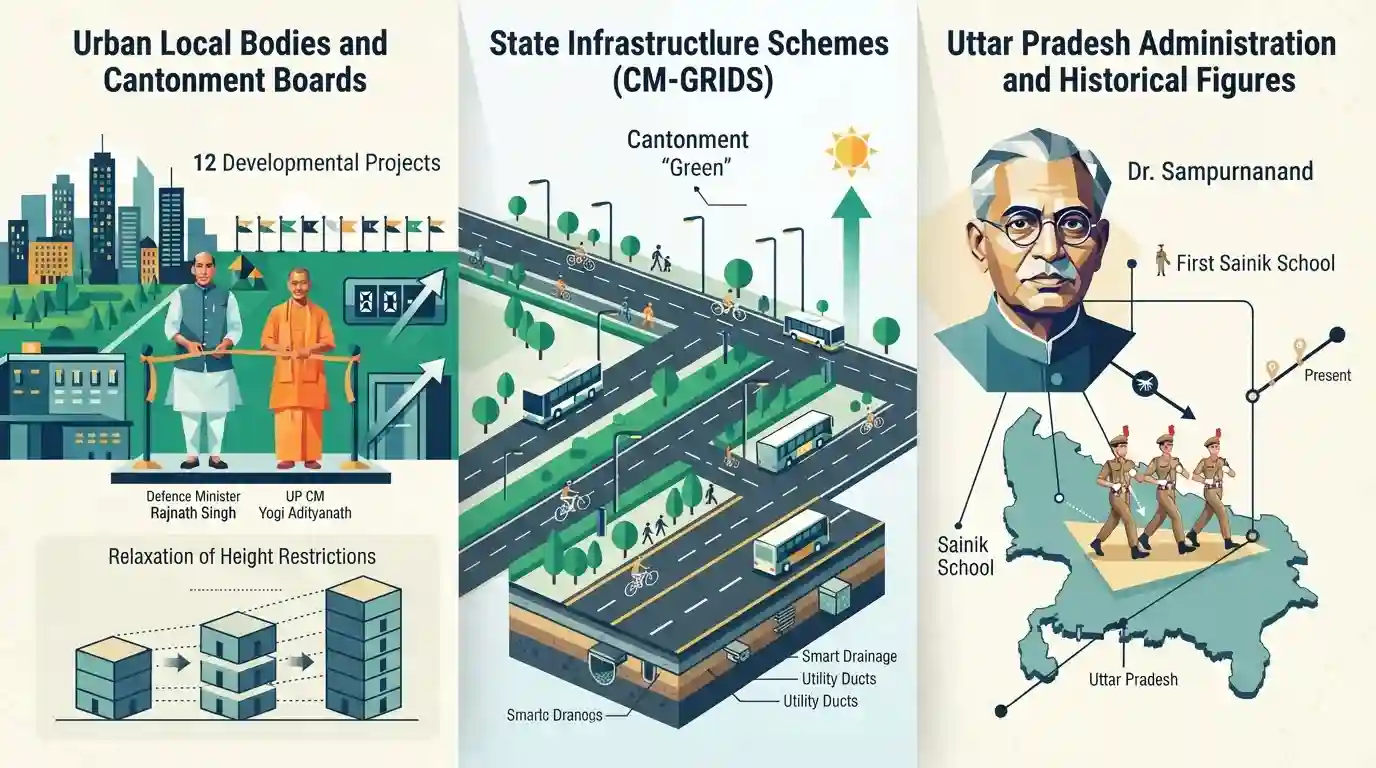
Defence Minister Rajnath Singh and UP CM Yogi Adityanath launched 12 developmental projects in Lucknow Cantonment. Key announcements included the relaxation of building height restrictions in Cantonment areas from three to five floors, and the deployment of the Chief Minister Green Road Infrastructure Development Scheme (CM-GRIDS). Yogi Adityanath also highlighted UP's historic leadership in military education, tracing the origin of India's Sainik Schools back to UP under the chief ministership of Dr. Sampurnanand.
Key Points
- Union Defence Minister Rajnath Singh and UP Chief Minister Yogi Adityanath laid the foundation stone for 12 development projects worth Rs 101 crore in Lucknow Cantonment.
- Building height restrictions in Lucknow and other Cantonment areas have been relaxed, increasing the permissible height from three floors to five floors to facilitate modern redevelopment.
- The state's smart road initiatives, including the Chief Minister Green Road Infrastructure Development Scheme (CM-GRIDS) and the Kisan Path outer ring road, are being constructed to enhance regional connectivity.
- Chief Minister Yogi Adityanath highlighted that the tradition of military/Sainik schools in India originated in Uttar Pradesh under the leadership of the then Chief Minister Dr. Sampurnanand (who established the UP Sainik School in Lucknow in July 1960).
Important Terms
Chief Minister Green Road Infrastructure Development Scheme (CM-GRIDS)

A flagship urban infrastructure scheme of the Uttar Pradesh government to upgrade municipal roads into integrated, eco-friendly, safe, and sustainable complete streets with modern public amenities.
UPSC context
UPPSC GS Paper V & VI: UP Infrastructure, Urban Governance, and State Government Schemes.
Cantonment Boards
Democratic civic administration bodies operating under the Cantonments Act, 2006, and overseen by the Ministry of Defence to provide municipal services to civilians living in cantonments.
UPSC context
UPPSC GS Paper II: Urban Local Bodies, Central-State Relations, and Local Governance.
Kisan Path project
Officially known as National Highway 230 or the Lucknow Outer Ring Road, this 104 km circular expressway bypasses Lucknow to divert heavy commercial traffic and spur regional connectivity.
UPSC context
UPPSC GS Paper V: Infrastructure development and transport connectivity projects in Uttar Pradesh.
Sainik Schools Society
An autonomous organisation registered under the Ministry of Defence that establishes and manages English-medium residential Sainik Schools across India to prepare cadets for the military officer cadre.
UPSC context
UPPSC GS Paper II & III: Education, governance, and defence security human resource development.
Lucknow Cantonment
A historic, strategically important military-civilian administrative enclave in Lucknow, Uttar Pradesh, governed by a Cantonment Board under the direct administrative control of the Union Ministry of Defence.
UPSC context
UPPSC GS Paper V: Regional history, local military administration, and urban development in UP.
Prelims Trap
All Sainik Schools in India, including the first one in Lucknow, are fully funded and managed by the Union Ministry of Defence.
The Lucknow Sainik School (established July 1960) is the first of its kind but is uniquely financed and operated entirely by the UP State Government, not the central Ministry of Defence.
Static Concepts Connected
Under which administrative setup do Cantonment Boards operate in India?
- Administrative Control: Function directly under the administrative control of the Union Ministry of Defence, not the state's Urban Development department.
- Statutory Basis: Regulated by the Cantonments Act, 2006, which categorizes boards into four classes based on civilian population.
- Democratic Mix: Comprise both elected members (for a 5-year term) and ex-officio/nominated military and civil officials.
- Uttar Pradesh Share: Uttar Pradesh hosts the largest number of notified cantonment boards in India, totaling 13.
What were the major administrative contributions of Dr. Sampurnanand to Uttar Pradesh?
- Chief Ministership: Served as the second Chief Minister of Uttar Pradesh from 1954 to 1960, succeeding Govind Ballabh Pant.
- Sainik School Pioneer: Conceptualized and established India's first-ever Sainik School in Lucknow (July 1960) to train military officers.
- Prison Reforms: Introduced pioneering open-prison systems (known as Sampurnanand Shivirs) in UP to reform convicts.
- Sanskrit Promotion: Renowned Sanskrit scholar; Varanasi's Sanskrit Vishwavidyalaya was later renamed in his honor.
Cross-Topic Patterns
Cantonments vs State Municipal Jurisdiction
Harmonizing central Cantonment regulations (like height relaxations) with UP's CM-GRIDS highlights the complex administrative overlap between Union defence land and State urban infrastructure schemes.
Sainik Schools & UP's Defence Legacy
Tracing UP's creation of India's first state-run Sainik School links UP's mid-20th-century educational policies with national defence recruitment history.

UP-specific statement on Sainik School origins or CM-GRIDS/URIDA nodal agency setup highly likely in regional GS paper.
Linked PYQs · 2
Linked PYQs · 2
- 2023UPPSC_PRELIMSGS1
Which of the following Scheme/Programme is not the Central Government Programme and it is Uttar Pradesh Government's Programme?
- 2004UPPSC_PRELIMSGS1
Lucknow Plan is associated with the development of:
