Rajgir Zoo Safari Asiatic Lion Breeding Success and Conservation
Source:timesofindia ↗
Why It Matters
Highlights Bihar's growing infrastructure and success in ex-situ wildlife conservation and ecotourism, particularly regarding the endangered Asiatic Lion. BPSC frequently asks about wildlife sanctuaries, conservation statuses, and geography specific to Bihar.
Summary
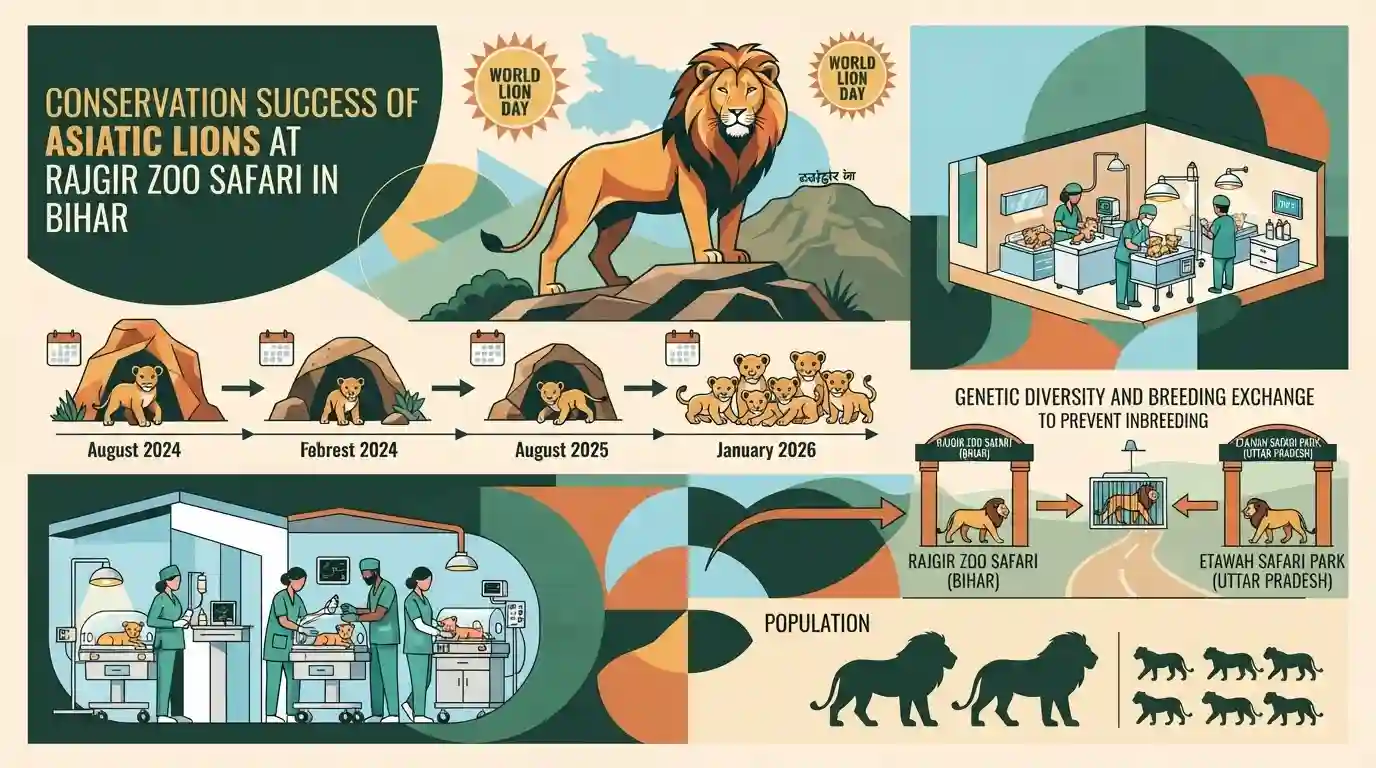
The Rajgir Zoo Safari in Bihar is marking World Lion Day by celebrating a major achievement in wildlife conservation: four consecutive successful breeding events of the endangered Asiatic lion between August 2024 and January 2026. The safari currently houses four adults and six cubs, utilizing advanced facilities like a Neonatal Intensive Care Unit (NICU) for hand-rearing. It also participates in scientific breeding exchanges with Etawah Safari Park in Uttar Pradesh to maintain genetic diversity and prevent inbreeding.
Key Points
- The Rajgir Zoo Safari in Bihar is celebrating World Lion Day to showcase its successful Asiatic lion conservation efforts.
- The safari recorded four consecutive Asiatic lion breeding events between August 2024 and January 2026.
- To maintain genetic diversity and prevent inbreeding, the safari implements a scientific breeding program, including exchanging lions with Etawah Safari Park in Uttar Pradesh.
- The facility is equipped with a wildlife hospital and a Neonatal Intensive Care Unit (NICU) specifically for hand-rearing vulnerable cubs.
- The safari currently houses four adult Asiatic lions and six cubs, highlighting Bihar's active role in ex-situ conservation of endangered species.
Important Terms
Rajgir Zoo Safari

A modern wildlife park and emerging conservation breeding center located in Nalanda, Bihar. It features a specialized neonatal intensive care unit and has successfully bred endangered Asiatic lions, significantly contributing to India's ex-situ wildlife management.
UPSC context
Important for GS-3 (Environment) and Bihar PSCs; illustrates ex-situ conservation success, genetic diversity preservation, and regional ecotourism initiatives.
Etawah Safari Park
A drive-through safari park in Uttar Pradesh featuring a dedicated Asiatic lion breeding center. It collaborates with other zoological parks nationwide for scientific animal exchanges to maintain healthy bloodlines and prevent inbreeding among captive lion populations.
UPSC context
Relevant for GS-3 (Biodiversity); highlights interstate ecological cooperation, captive breeding challenges, and strategies to prevent inbreeding in endangered species.
Asiatic Lion
An endangered lion subspecies (Panthera leo persica) whose wild population is largely restricted to Gujarat. Zoos participate in scientific breeding programs to expand their captive reserve population, ensuring genetic health and protecting them from extinction threats.
UPSC context
Highly relevant for GS-3 (Environment); tests knowledge of IUCN status (Endangered), endemic habitats, and ex-situ versus in-situ conservation methods.
World Lion Day
Observed globally on August 10th to raise awareness about the critical need for lion conservation. It aims to gather support against habitat loss, human-wildlife conflict, and poaching that threaten both African and Asiatic lion populations.
UPSC context
Relevant for GS-3 and Prelims; tests awareness of key international environmental observances and species-specific protection campaigns.
Prelims Trap
Asiatic Lions are exclusively found and conserved only within Gujarat.
While naturally endemic to the Gir forest (in-situ), Asiatic lions are actively conserved across other Indian states (ex-situ) like Bihar and UP to maintain genetic diversity.
Static Concepts Connected
What distinguishes ex-situ from in-situ conservation, and what regulates it?
- Ex-situ: Conserving species outside natural habitats (zoos, gene banks, safaris). Guards against localized extinction and aids scientific breeding.
- In-situ: Protecting species within their natural ecosystems (national parks, wildlife sanctuaries, biosphere reserves).
- CZA Regulation: The Central Zoo Authority (statutory body under WPA 1972) regulates all recognized zoos and coordinates conservation breeding programs across India.
What is the specific protection status of the Asiatic Lion in India?
- IUCN Status: Classified as Endangered on the IUCN Red List, distinct from the African lion which is generally listed as Vulnerable.
- WPA 1972: Listed under Schedule I, affording it the highest degree of legal protection against hunting and commercial exploitation.
- Project Lion: Launched in 2020 for habitat development, disease management, and exploring secondary wild habitats like Barda Wildlife Sanctuary.
Cross-Topic Patterns
In-situ Relocation vs Ex-situ Captive Breeding
While African Cheetahs underwent transcontinental in-situ relocation (Kuno), Asiatic lion conservation balances in-situ protection (Gir) with rigorous ex-situ captive breeding (Rajgir, Etawah) to build genetic resilience.
CZA's Statutory Role in Genetic Diversity
The Central Zoo Authority's statutory mandate directly drives scientific animal exchanges across states, bridging the gap between localized safaris and national genetic diversity goals.

Expect a multi-statement Prelims question contrasting in-situ (Gir/Barda) vs ex-situ (Rajgir/Etawah) Asiatic lion conservation strategies.
Linked PYQs · 4
Linked PYQs · 4
- 2025BPSC_PRELIMSGS1
The species which are in danger of extinction are known as?
- 2025BPSC_PRELIMSGS1
Which of the following parks/sanctuaries come under the project tiger in Bihar?
- 2019BPSC_PRELIMSGS1
Which one of the following wildlife sanctuaries is situated in Munger district of Bihar?
- 2023BPSC_PRELIMSGS1
Which of the following National Parks/Wildlife Sanctuaries are in Bihar? 1. Valmiki National Park 2. Dudhwa National Park 3. Gajner Wildlife Sanctuary 4. Bhimbandh Wildlife Sanctuary Select the correct answer using the codes given below.
