Sadulpur Junction Redevelopment Boosts Shekhawati Rail Connectivity
Source:etvbharat ↗
Why It Matters
This development bridges physical infrastructure upgrades with local heritage conservation and agricultural logistics. For RPSC RAS, understanding the historical legacy of Maharaja Sadul Singh (Bikaner's role in the integration of Rajasthan), the Shekhawati tourist circuit, and central schemes like the Amrit Bharat Station Scheme in Rajasthan is highly relevant.
Summary
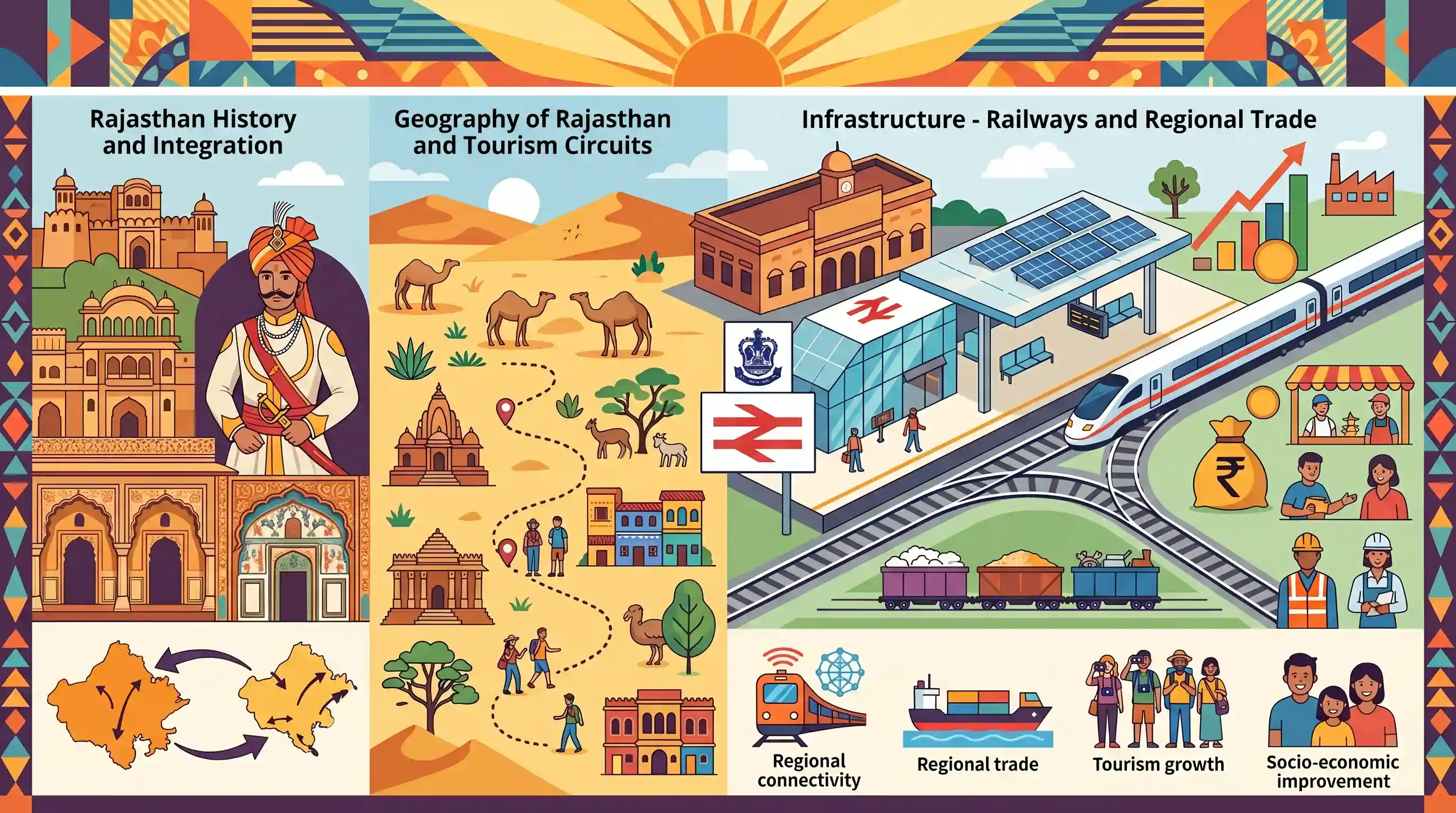
The newly redeveloped Sadulpur Junction in Rajasthan's Churu district, revamped under the Amrit Bharat Station Scheme, is set to boost regional connectivity, trade, and tourism. Strategically located at the intersection of major rail corridors and named after Bikaner's historical ruler Maharaja Sadul Singh, the ₹18.70 crore project upgrades infrastructure with modern amenities, solar power, and local art, driving socio-economic growth in the Shekhawati region.
Key Points
- Sadulpur Junction (SDLP) in the Churu district of Rajasthan is being redeveloped under the Central Government's Amrit Bharat Station Scheme (ABSS) at an estimated cost of ₹18.70 crore.
- Strategically positioned at the intersection of the Delhi–Bikaner and Hisar–Jodhpur rail corridors, the station acts as a crucial transport link between Delhi, Haryana, and Rajasthan.
- The station is named after Maharaja Sadul Singh, the last ruling Maharaja of the Bikaner princely state, who was famously the first ruler in Rajasthan to sign the Instrument of Accession to the Indian Union on August 7, 1947.
- The modernization includes upgraded passenger amenities, Divyangjan-friendly signages, local heritage-themed art murals on walls/ceilings, and a newly installed 40 kW solar power plant for clean energy generation.
- The revamp is expected to provide a major economic boost to the Shekhawati region by enhancing agricultural trading (linking major mandis of Delhi, Faridabad, and Rajasthan) and attracting weekend tourists to regional heritage and handicraft sites.
Important Terms
Amrit Bharat Station Scheme

A Ministry of Railways initiative launched in 2023 to modernise and redevelop over 1,300 stations across India through long-term master planning, enhanced amenities, and sustainable, multi-modal integration.
UPSC context
GS Paper III: Infrastructure. Tests knowledge of national transportation schemes, regional connectivity, and infrastructure development.
Maharaja Sadul Singh
The last reigning Maharaja of Bikaner (1943–1949) who played a crucial role in post-independence integration as the first prince to sign the Instrument of Accession to India.
UPSC context
GS Paper I: Post-Independence Consolidation. Evaluates understanding of princely state integration and key historical figures.
Shekhawati Region
A semi-arid historical region in northeastern Rajasthan renowned for its heritage havelis featuring unique, vibrant fresco paintings, often described as an 'open-air art gallery.'
UPSC context
GS Paper I: Art & Culture and Geography. Tests knowledge of regional architecture, murals, and semi-arid landscape characteristics.
North Western Railway
One of the railway zones of India, headquartered in Jaipur, Rajasthan, responsible for managing key rail corridors and connectivity across Rajasthan, Haryana, Punjab, and Gujarat.
UPSC context
GS Paper I/III: Economic Geography and Infrastructure. Tests knowledge of India's railway zones, logistics corridors, and regional trade.
Prelims Trap
The Princely State of Mewar (Udaipur) was the first Rajputana state to sign the Instrument of Accession in August 1947.
Bikaner (Maharaja Sadul Singh) was the first Rajputana state to sign on August 7, 1947. Mewar (Udaipur) joined only during the political integration phases starting in 1948.
Static Concepts Connected
Who were the key figures and milestones in the accession of Rajasthan's princely states?
- First signatory: Maharaja Sadul Singh of Bikaner was the first Rajputana ruler to sign the Instrument of Accession on August 7, 1947.
- Last signatory: Maharaja Udaybhan Singh of Dholpur was the last Rajputana ruler to sign the instrument on August 14, 1947.
- Seven-stage integration: The physical unification of Rajasthan was completed in seven distinct phases, spanning from March 1948 to November 1956.
What defines the unique art style of the Shekhawati region's painted havelis?
- Fresco technique: Artists utilized the fresco buono technique, applying natural pigments onto wet lime plaster, allowing the colors to bind deep within the walls.
- Merchant patronage: The art was primarily patronized by wealthy Marwari merchants (seths) rather than Rajput royalty, reflecting trade wealth from the 18th to 20th centuries.
- Eclectic iconography: Murals depict traditional religious epics alongside unique modern intrusions, such as British soldiers, motor cars, aeroplanes, and railway trains.
Cross-Topic Patterns
Transport infra + Heritage preservation
Modernizing transit hubs using local art motifs (like Shekhawati frescoes) directly aligns public infrastructure spending with the preservation of endangered regional art forms.
Integration history + Federal evolution
The phased integration of Rajputana states highlights the transition from treaty-based British paramountcy to a uniform federal democratic structure under the Indian Constitution.

UPSC may test the chronological order of Rajputana states' accession to India alongside architectural features of Shekhawati havelis.
Linked PYQs · 2
Linked PYQs · 2
- 2024RPSC_PRELIMSGS1
Which of the following group of princely states of Rajasthan are arranged in ascending order as per their accession to the Indian Union after independence?
- 2025RPSC_PRELIMSGS1
Which tourist circuit do Mount Abu and Ranakpur belong to?
