Rajasthan Forest Department Deploys AI Surveillance in Sanctuaries
Source:hindustantimes ↗
Why It Matters
Crucial for RPSC RAS aspirants tracking e-governance, technological integration in forest management, and state environmental security initiatives.
Summary
The Rajasthan Forest Department is introducing AI-based surveillance systems across wildlife sanctuaries in the state to enhance biodiversity conservation, prevent poaching, and mitigate human-wildlife conflict using modern data-driven tools.
Key Points
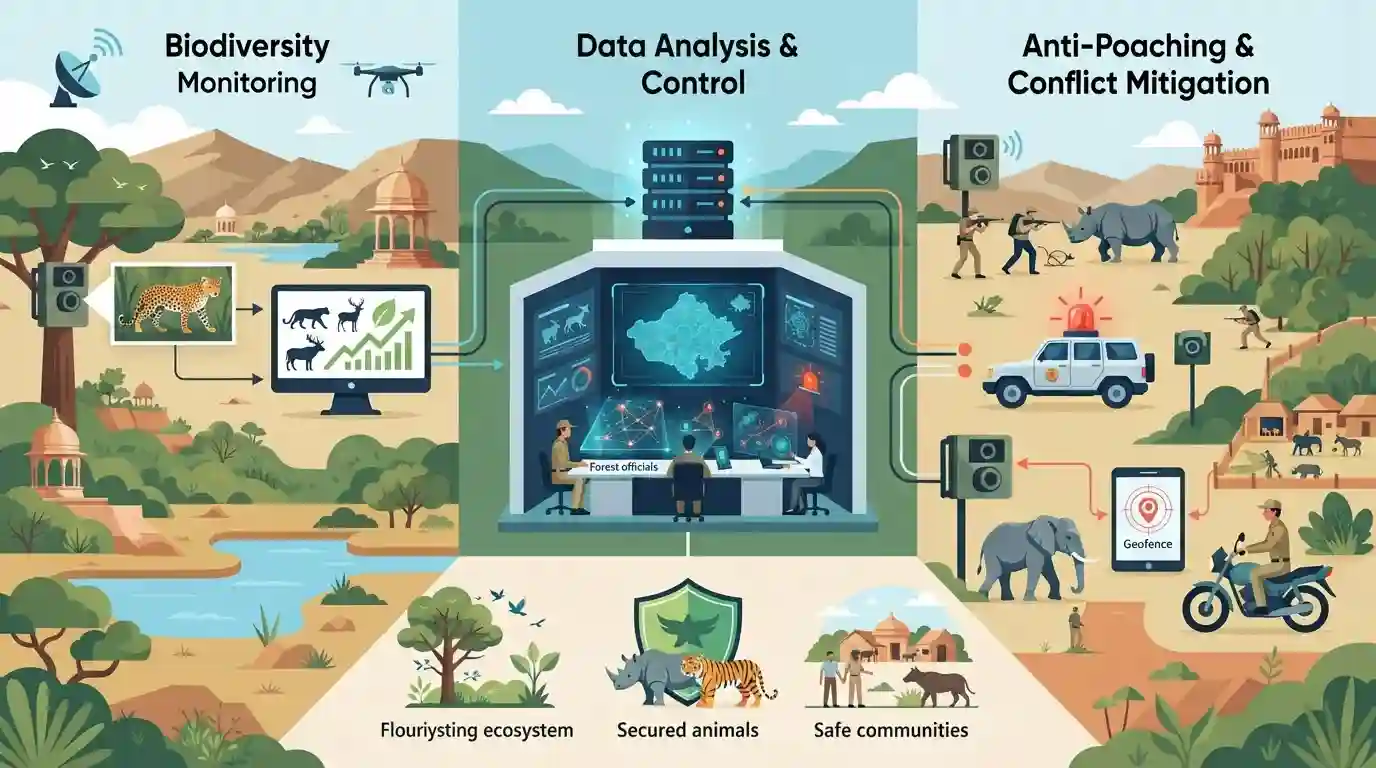
- The Rajasthan Forest Department is set to deploy Artificial Intelligence (AI) based surveillance systems in the state's wildlife sanctuaries to strengthen forest protection, monitor wildlife movement, and curb poaching.
- The AI-driven technology integrates camera traps and sensor networks to detect unauthorized human entry, animal tracking, and early warning systems for forest fires or human-wildlife conflict.
- This initiative marks a shift towards modern tech-enabled conservation strategies in Rajasthan's protected areas, complementing existing tiger reserves and wildlife sanctuaries.
Important Terms
Rajasthan Forest Department

The state government body responsible for the conservation, management, and protection of forests and wildlife resources across Rajasthan's protected areas.
UPSC context
RPSC Paper I/III (Environment & Geography): Tests knowledge of state-level institutional frameworks for biodiversity governance and wildlife management in Rajasthan.
National Tiger Conservation Authority
A statutory body established under the Wildlife (Protection) Act, 1972, to oversee tiger conservation, management of tiger reserves, and anti-poaching measures nationwide.
UPSC context
RPSC/UPSC Environment: Frequently tested statutory body under MoEFCC responsible for Project Tiger and tiger reserve oversight.
Prelims Trap
Ramgarh Vishdhari and Keoladeo National Park were covered in the first phase of the AI wildlife surveillance project.
Aspirants often confuse the phases; Ramgarh Vishdhari, Kumbhalgarh, and Keoladeo are part of the second phase, while Ranthambore, Sariska, and Jawai were covered in the first phase.
Static Concepts Connected
What are the major tiger reserves and wildlife sanctuaries in Rajasthan under active conservation?
- Tiger Reserves: Rajasthan houses prominent tiger reserves including Ranthambore (Sawai Madhopur), Sariska (Alwar), Mukundra Hills (Kota), and Ramgarh Vishdhari (Bundi).
- Leopard Reserves: Key leopard conservation areas include Jhalana (Jaipur) and Jawai Leopard Conservation Reserve (Pali).
- Wetland Sites: Wetland conservation includes Keoladeo National Park (Bharatpur), a Ramsar site and UNESCO World Heritage site.
Cross-Topic Patterns
AI Surveillance + State E-Governance Infrastructure
Rajasthan's deployment of AI thermal cameras in wildlife sanctuaries intersects with digital governance initiatives like RISL and DoIT&C, showing convergence between e-governance and state environmental management.

RPSC often tests specific wildlife reserves and tech interventions; expect matching questions on sanctuaries and AI deployment phases.
Linked PYQs · 2
Linked PYQs · 2
- 2023RPSC_PRELIMSGS1
The National Tiger Conservation Authority has conferred the status of the fifth tiger sanctuary in Rajasthan, to which of the following sanctuaries?
- 2021RPSC_PRELIMSGS1
The State Remote Sensing Application Centre, operating under the Department of Science and Technology, is located in
