Jal Jeevan Mission Funds Released for Rajasthan by Centre
Source:the-buckstopper ↗
Why It Matters
This development is important for RPSC Prelims as it touches upon major flagship schemes (Jal Jeevan Mission), Centre-State funding patterns (50:50), and issues of governance and accountability in public administration in Rajasthan.
Summary
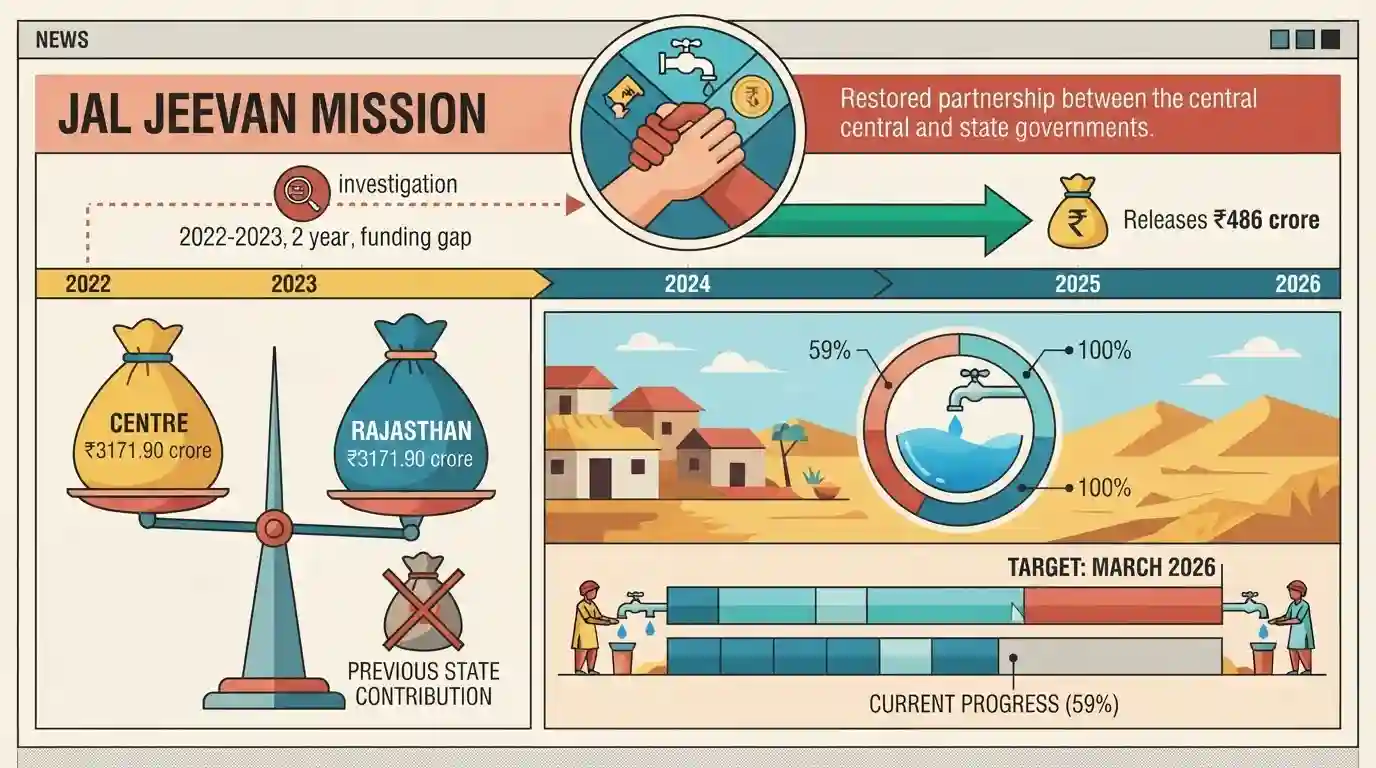
The Central government has released Rs 486 crore to Rajasthan for the Jal Jeevan Mission (JJM), restoring funding after a two-year gap caused by corruption investigations under the previous state government. The JJM operates on a 50:50 funding model between the Centre and the State. Demonstrating its commitment, Rajasthan has already contributed Rs 3,171.90 crore this fiscal year. The state has currently achieved 59% of its tap connection target and plans to cover all remaining rural households by an extended deadline of March 2026.
Key Points
- The Centre has released Rs 486 crore for the Jal Jeevan Mission (JJM) in Rajasthan after a two-year halt.
- Central funding had been suspended due to probes by the Enforcement Directorate into alleged corruption during the previous state administration.
- Under the JJM, the funding pattern for general category states like Rajasthan is equally shared (50:50) between the Centre and the State.
- Rajasthan has so far provided tap connections to 63,62,746 households, achieving 59% of its total target.
- The state government has extended its deadline to provide tap connections to all remaining rural households to March 2026.
Important Terms
Jal Jeevan Mission (JJM)

A Centrally Sponsored Scheme under the Ministry of Jal Shakti aiming to provide safe, adequate drinking water through Functional Household Tap Connections (FHTCs) to every rural Indian household.
UPSC context
GS Paper II (Government Policies) & GS Paper III (Water Resources); tests flagship welfare schemes, decentralised governance, and water security.
Enforcement Directorate (ED)
A premier financial investigation agency under the Ministry of Finance's Department of Revenue, tasked with investigating money laundering, foreign exchange violations, and economic offenses in India.
UPSC context
GS Paper III (Internal Security) & GS Paper II (Regulatory Bodies); tests financial crime regulation and institutional accountability.
Public Health Engineering Department (PHED)
The primary state-level government department responsible for planning, executing, and maintaining public water supply, sanitation, and waste management infrastructure, particularly in rural areas.
UPSC context
GS Paper II (State Governance/Public Service Delivery); tests implementation of welfare schemes and local-level infrastructure management.
Prelims Trap
The Jal Jeevan Mission is a Central Sector Scheme with 100% central funding for arid, drought-prone states like Rajasthan.
JJM is a Centrally Sponsored Scheme, not a Central Sector Scheme. Rajasthan, despite its arid terrain, is a general-category state funded on a 50:50 basis.
Static Concepts Connected
What is the institutional framework for decentralized water governance under the Jal Jeevan Mission?
- Pani Samitis: Sub-committees of Gram Panchayats responsible for planning, implementation, and long-term maintenance of village water supply infrastructure.
- Gender Mandate: Guidelines mandate that women must constitute at least 50% of the members of these water committees to ensure inclusive governance.
- Community Contribution: Villagers contribute 10% (5% in hilly/SC/ST areas) of capital costs in cash or labor to foster ownership and sustainability.
How does the Hybrid Annuity Model (HAM) operate in public infrastructure funding?
- Risk Sharing: Combines EPC and BOT models, where the government pays 40% during construction, and the developer finances the remaining 60%.
- Annuity Payments: The government repays the developer’s 60% share through fixed, performance-linked annuity payments over a specified concession period.
- O&M Guarantee: Ensures the private contractor remains responsible for operations and maintenance, mitigating post-construction neglect of public assets.
Cross-Topic Patterns
Fiscal Federalism vs. Governance Probes
Central withholding of welfare funds over state-level corruption allegations testing the boundaries of fiscal federalism and cooperative governance under Article 282.
Water Security & Gender Empowerment
Mandating 50% female representation in Pani Samitis directly converts water infrastructure creation into a tool for rural women's leadership and financial decision-making.

Multi-statement questions in 2026 may test JJM 2.0 operational metrics (55 LPCD), the 50% gender mandate in VWSCs, and HAM model financing.
Linked PYQs · 2
Linked PYQs · 2
- 2025RPSC_PRELIMSGS1
What is the main objective of the “Rajasthan Urban Area Development Program (Phase-III)”?
- 2021RPSC_PRELIMSGS1
What is the share of the Rajasthan government in the financing of the National Agricultural Extension and Technical Mission?
