Rajasthan Legislative Assembly Uniform Civil Code Bill Procedures
Source:rasonly ↗
Why It Matters
The introduction of the UCC touches directly upon Article 44 (Directive Principles of State Policy). The procedural dynamics of the assembly (Question Hour, Zero Hour, and Adjournment Sine Die) are fundamental concepts in the State Legislature portion of the syllabus, making this highly relevant for RPSC RAS Prelims.
Summary
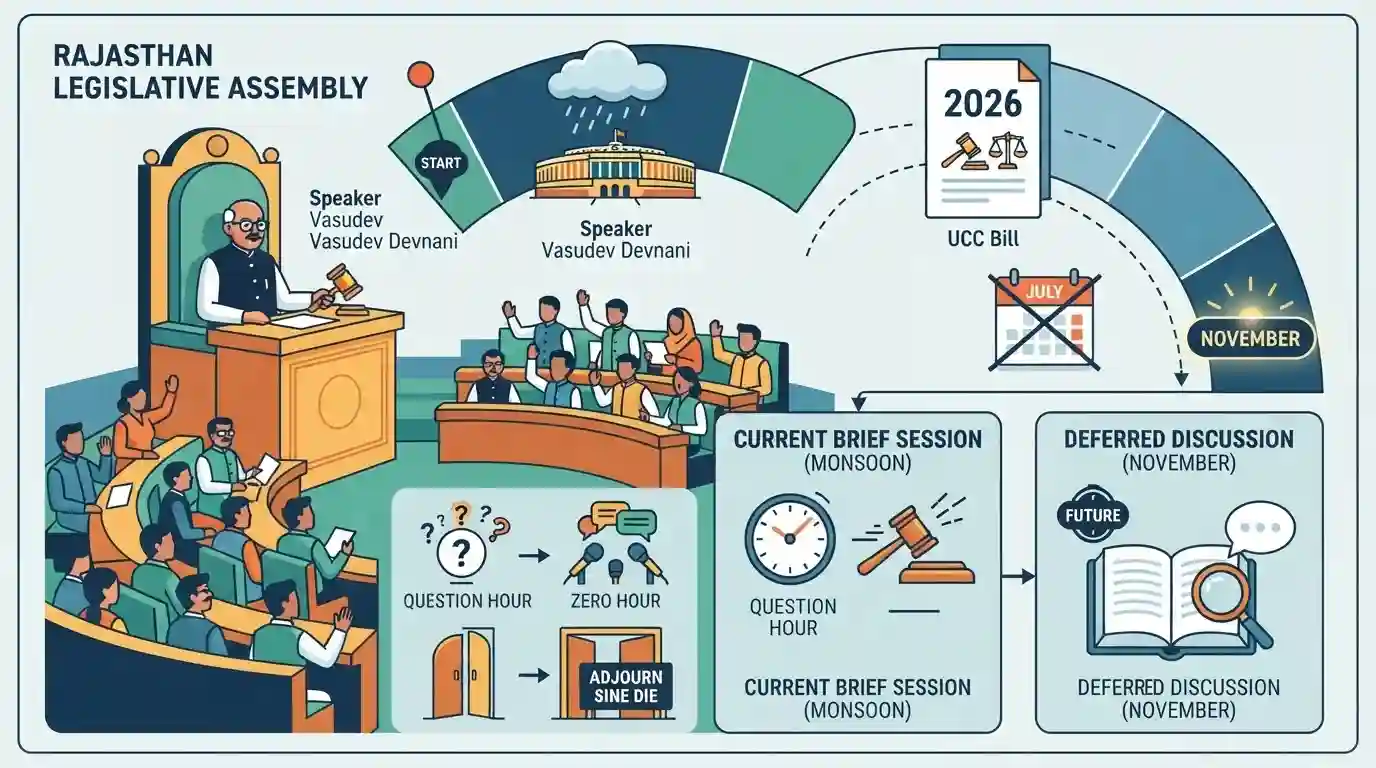
The Monsoon session of the Rajasthan Legislative Assembly has commenced, drawing significant attention due to the anticipated introduction of the Uniform Civil Code (UCC) Bill 2026. Chaired by Speaker Vasudev Devnani, the current session is expected to be brief, with plans to adjourn sine die after conducting the Question Hour and Zero Hour. Consequently, comprehensive discussions and the eventual passage of the contentious UCC Bill are likely to be postponed to a subsequent legislative session, potentially occurring in November.
Key Points
- The Monsoon session of the Rajasthan Legislative Assembly commenced on August 21, 2026.
- The Uniform Civil Code (UCC) Bill 2026 is expected to be introduced during this legislative session.
- The assembly proceedings are being overseen by Speaker Vasudev Devnani.
- The session is likely to be adjourned sine die (indefinitely) following the Question Hour and Zero Hour.
- Detailed discussions and the passage of the UCC Bill are anticipated to be deferred to the next session, potentially in November.
Important Terms
Uniform Civil Code (UCC) Bill 2026

Proposed legislation standardizing personal laws for marriage, divorce, succession, and live-in relationships in Rajasthan. Scheduled Tribes are exempt. First introduced in the 2026 Monsoon session but deferred for comprehensive discussion.
UPSC context
Tests Polity and Governance (DPSP Article 44). Crucial for RPSC questions on state bills and current legislative developments.
Rajasthan Legislative Assembly
The unicameral state legislature of Rajasthan, currently chaired by Speaker Vasudev Devnani. Responsible for debating and enacting state laws, it recently convened for its Monsoon Session.
UPSC context
Core topic in RPSC Polity (State Legislature). Key for understanding law-making processes and the composition of the state's government.
Adjournment Sine Die
A parliamentary procedure where a sitting is terminated for an indefinite period without a scheduled date for resumption. Often declared by the Speaker at the end of a session.
UPSC context
Essential for RPSC Polity. Tests understanding of legislative rules, procedures, and the powers of the Speaker.
Question Hour
The first hour of a parliamentary sitting, dedicated to Members of Parliament asking questions to ministers to hold the executive accountable. Regulated by formal rules and requiring prior notice.
UPSC context
Important for Polity questions regarding legislative control over the executive and the functioning of the state assembly.
Zero Hour
An Indian parliamentary innovation immediately following Question Hour, allowing members to raise urgent matters of public importance without prior notice.
UPSC context
Frequently tested in RPSC Polity exams to distinguish it from formal procedures and understand unique legislative practices.
Prelims Trap
"The Governor of Rajasthan has the power to adjourn the legislative assembly sine die."
Adjournment sine die terminates a sitting and is exclusively done by the Speaker. Prorogation terminates the entire session and is done by the Governor.
Static Concepts Connected
What distinguishes Adjournment Sine Die from Prorogation?
- Adjournment Sine Die: Terminates a sitting for an indefinite period without setting a reconvening date. It is exercised exclusively by the Speaker/Presiding Officer.
- Prorogation: Terminates the entire session of the House. This power is executed by the Governor of the state under Article 174.
How can a State enact a Uniform Civil Code (UCC)?
- Constitutional Basis: Personal laws (marriage, succession) fall under Entry 5 of the Concurrent List (Schedule VII), allowing both Parliament and State Legislatures to legislate.
- Presidential Assent: State UCC laws that override existing Central laws require the President's assent to be valid, as per Article 254(2) of the Constitution.
Cross-Topic Patterns
UCC + Concurrent List Dynamics
Rajasthan's move highlights the federal nature of personal laws. Expect questions connecting Article 44 with a State's legislative power under Entry 5 of the Concurrent List.
Zero Hour & Legislative Devices
With the session wrapping up post-Zero Hour, expect static questions revisiting this 1962 Indian parliamentary innovation and how it enables raising urgent matters without prior notice.

Statements will likely merge Article 44 with the procedural powers of the Speaker (sine die) and State powers under the Concurrent List.
Linked PYQs · 2
Linked PYQs · 2
- 2023RPSC_PRELIMSGS1
Match the following list – P (Directive Principles) with list – R (Article): List – P List – R A. Equal justice and free legal aid I. Article 48 A B. Protection of the environment II. Article 39 A C. Right to work III. Article 41 D. Preservation of monuments IV. Article 49 Choose the correct option: . A B C D
- 2021RPSC_PRELIMSGS1
Which of the following pairs of Directive Principles of State Policy as described in the Constitution of India is correctly matched?
