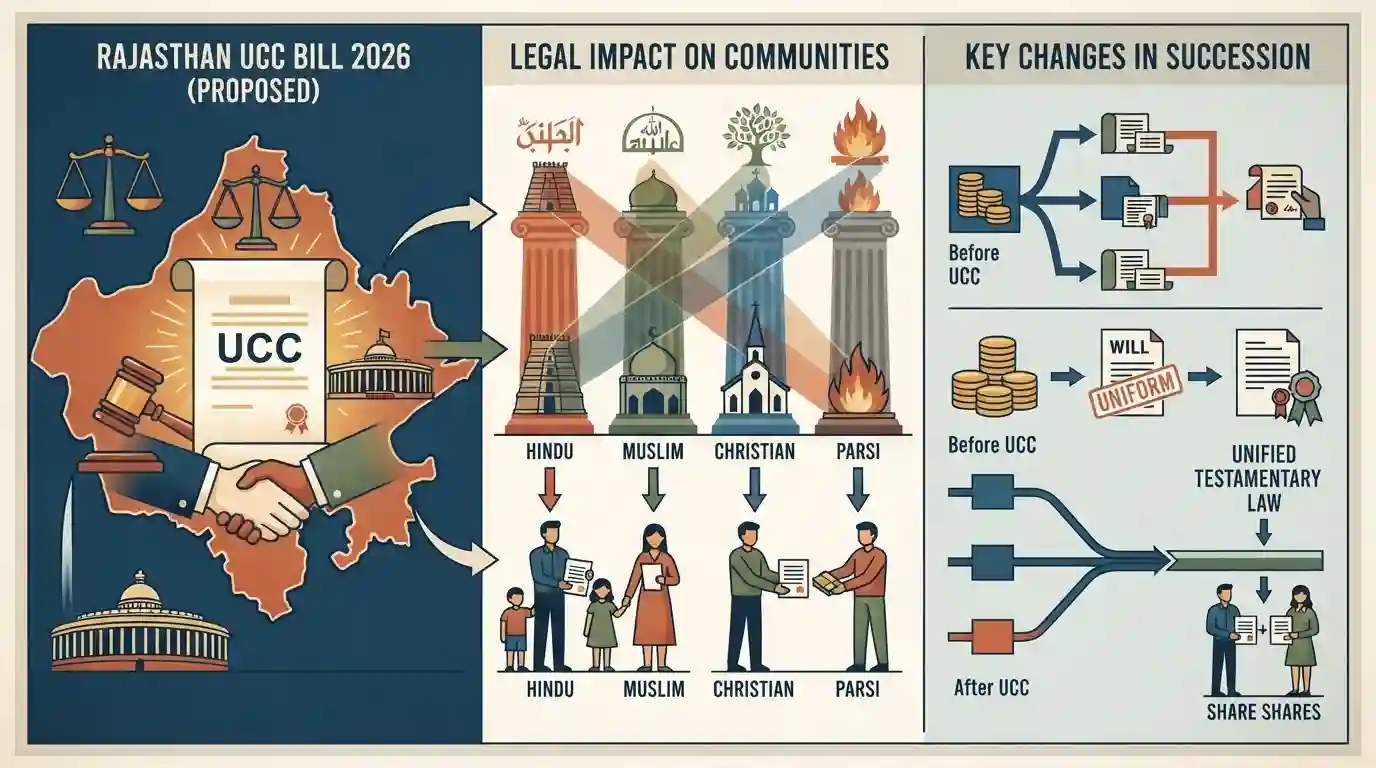
Rajasthan UCC Bill impact on inheritance and wills across religions
Source:iwills ↗
Why It Matters
Crucial for RPSC RAS aspirants tracking legislative developments in Rajasthan, state-level initiatives regarding civil codes, and constitutional questions surrounding Article 44.
Summary
An analysis of the Rajasthan UCC Bill 2026 and its prospective legal impacts on wills, inheritance, and testamentary succession rights for Hindu, Muslim, Christian, and Parsi communities in the state.
Key Points
- The proposed Rajasthan Uniform Civil Code (UCC) Bill 2026 brings distinct implications for testamentary succession and wills across different religious communities including Hindus, Muslims, Christians, and Parsis.
- Under religious personal laws, testamentary succession (wills) historically followed separate frameworks, such as Islamic law restrictions on bequeathing more than one-third of property without consent, versus broader secular rules under the Indian Succession Act.
- A uniform civil code framework impacts personal property rights, gender equality in inheritance, and community-specific legal protections guaranteed under historical statutes.
- The debate highlights the balance between uniform state legislation under Directive Principles of State Policy (Article 44) and the preservation of religious and cultural freedom.
Important Terms
Rajasthan UCC Bill 2026

A legislative proposal introduced in the Rajasthan Legislative Assembly to establish common civil rules governing marriage, divorce, succession, and inheritance across communities, replacing diverse personal laws.
UPSC context
Polity & Governance (Mains GS-2): Uniform Civil Code implementation, state legislation, and federal dynamics of personal law reforms.
Indian Succession Act 1925
Comprehensive central legislation governing testamentary and intestate succession (Wills) for communities like Christians and Parsis, and certain aspects for other groups.
UPSC context
Indian Society & Polity: Legal frameworks governing inheritance rights, secular laws, and intersection with religious personal laws.
Rajasthan State Legislature
The unicameral law-making body of Rajasthan empowered under Article 168 to enact laws on state and concurrent list subjects like personal laws.
UPSC context
RPSC & Polity: State legislative procedure, law-making powers, and ordinance/bill introductions in the Rajasthan Assembly.
Supreme Court of India
The apex judicial body of India responsible for interpreting the Constitution, reviewing state/central legislation, and adjudicating matters related to fundamental rights and personal laws.
UPSC context
Indian Constitution (Mains GS-2): Judicial review, constitutional interpretation, and directives concerning Article 44 (UCC).
Prelims Trap
The Rajasthan UCC Bill universally covers all citizens residing within the territorial jurisdiction of the state without any exception.
Aspirants often assume a state UCC bill automatically overrides all central tribal protections and applies universally across every demographic within the state boundaries.
Static Concepts Connected
What are the constitutional provisions regarding the Uniform Civil Code (UCC)?
- Constitutional Mandate: Article 44 directs the State to endeavor to secure for the citizens a Uniform Civil Code throughout the territory of India.
- Non-Justiciable: It is placed under Part IV (Directive Principles of State Policy) and is non-justiciable by courts.
- Goa Precedent: Goa is currently the only state with a form of civil code inherited from Portuguese civil law.
Cross-Topic Patterns
UCC and Fundamental Rights Tension
Article 44 sits in the DPSP chapter, while freedom of religion is protected under Articles 25-26. RPSC frequently tests the tension between state legislative competence under the Concurrent List and fundamental religious freedoms.
Tribal Customs and State Legislation Exemptions
The exclusion of Scheduled Tribes from the Rajasthan UCC Bill mirrors the Sixth Schedule protections and constitutional exemptions provided in other state-level family law reforms.

Article 44 + scope of state-level UCC bills (like ST exclusions) will likely form a multi-statement RPSC assertion question.
Linked PYQs · 3
Linked PYQs · 3
- 2025RPSC_PRELIMSGS1
Which group of fundamental rights, provided by the articles, are exclusively conferred upon ‘citizens’ of India?
- 2023RPSC_PRELIMSGS1
Match the following list – P (Directive Principles) with list – R (Article): List – P List – R A. Equal justice and free legal aid I. Article 48 A B. Protection of the environment II. Article 39 A C. Right to work III. Article 41 D. Preservation of monuments IV. Article 49 Choose the correct option: . A B C D
- 2021RPSC_PRELIMSGS1
The Vishakha vs. State of Rajasthan and others case relates to
