Rajasthan Government Reshuffles Indian Forest Service Officers
Source:egov ↗
Why It Matters
State administrative updates, particularly those involving the Indian Forest Service, reflect the government's priorities in environmental conservation and eco-tourism. Transfers in statutory bodies like the State Biodiversity Board and SEIAA are relevant for understanding the governance framework of environmental regulations and wildlife protection in Rajasthan, making them a crucial topic for RPSC Prelims.
Summary
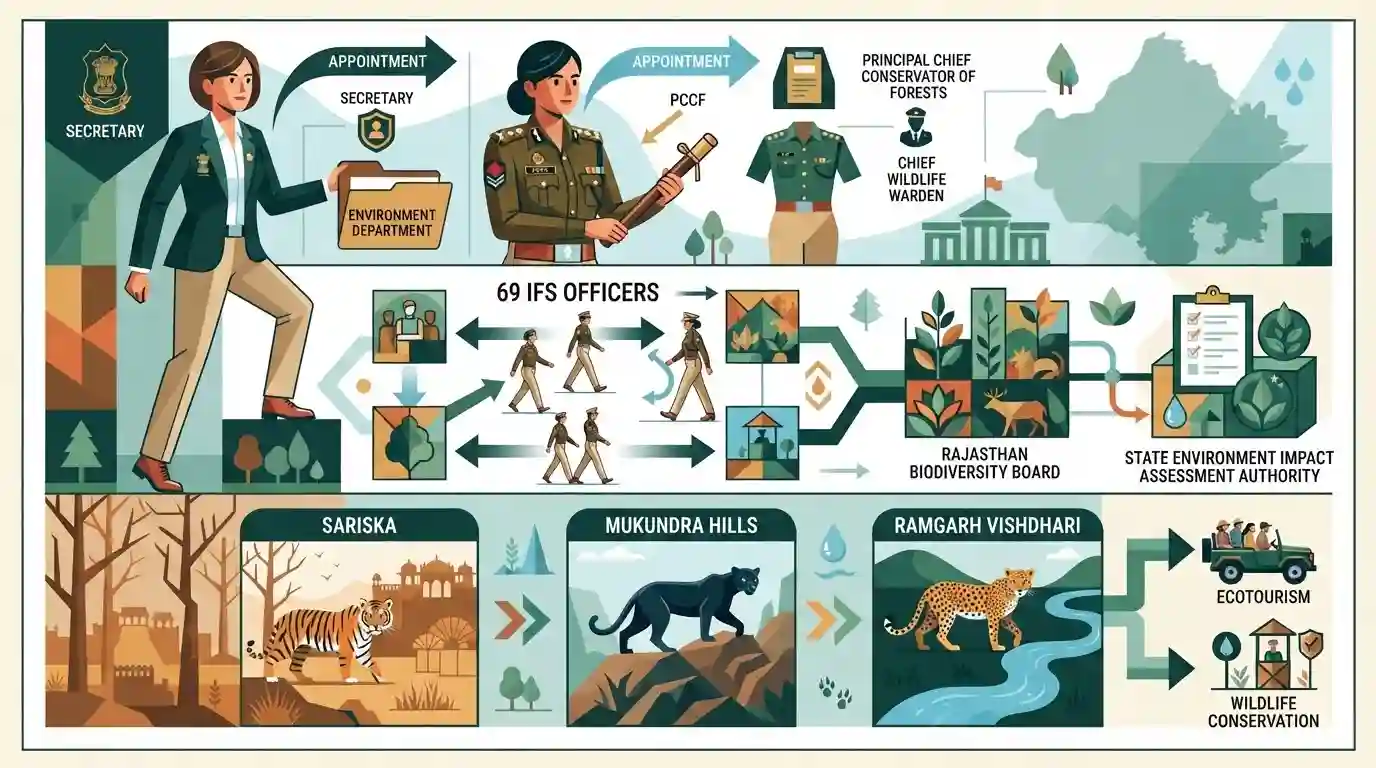
In a significant administrative reshuffle, the Rajasthan government has transferred 69 Indian Forest Service (IFS) officers. Shailja Deval has been assigned the critical role of Secretary of the Environment Department, while Shikha Mehra takes charge as the Principal Chief Conservator of Forests (PCCF) and Chief Wildlife Warden. The reshuffle affects the management of key environmental bodies like the Rajasthan Biodiversity Board and the State Environment Impact Assessment Authority, as well as prominent wildlife reserves including Sariska, Mukundra Hills, and Ramgarh Vishdhari. This move aims to streamline forest administration, boost ecotourism, and strengthen wildlife conservation across the state.
Key Points
- The Rajasthan government executed a major administrative reshuffle by transferring 69 Indian Forest Service (IFS) officers.
- Shailja Deval has been appointed as Secretary of the Environment Department.
- Shikha Mehra has been named the Principal Chief Conservator of Forests (PCCF) and Chief Wildlife Warden of Rajasthan.
- Crucial wildlife reserves such as Sariska, Mukundra Hills, and Ramgarh Vishdhari saw leadership changes to enhance conservation and ecotourism efforts.
- Key appointments were also made to bodies like the Rajasthan Biodiversity Board and the State Environment Impact Assessment Authority (SEIAA).
Important Terms
Indian Forest Service (IFS)

One of the three All India Services, established in 1966. Its officers manage the country's forests and wildlife, serving both state and central governments to implement the National Forest Policy and conserve natural resources.
UPSC context
Crucial for GS-II (Governance) and GS-III (Environment) regarding All India Services and forest administration.
State Environment Impact Assessment Authority (SEIAA)
A state-level statutory body constituted under the Environment (Protection) Act, 1986. It evaluates and grants environmental clearances for Category-B localized development projects based on Expert Appraisal Committee recommendations.
UPSC context
Frequently tested in GS-III (Environment) and Prelims regarding statutory bodies, environmental clearances, and the EIA process.
Chief Wildlife Warden
The principal statutory authority appointed by State Governments under the Wildlife (Protection) Act, 1972. They head the state's wildlife wing, manage Protected Areas, and grant special permissions regarding scheduled wild animals.
UPSC context
Key concept in GS-III (Environment) concerning the Wildlife (Protection) Act, 1972, and the management of Sanctuaries and National Parks.
Ramgarh Vishdhari Tiger Reserve
India's 52nd tiger reserve located in Rajasthan's Bundi district. It acts as a vital corridor linking Ranthambore and Mukundra Hills Tiger Reserves, featuring the Mez river and semi-arid dry deciduous forests.
UPSC context
Highly relevant for Prelims Geography and GS-III (Environment) regarding Project Tiger and India's Protected Area network.
Rajasthan Biodiversity Board
A state-level statutory body established under the Biological Diversity Act, 2002. It functions to conserve local biodiversity, promote its sustainable use, and ensure equitable sharing of biological resources across the state.
UPSC context
Relevant for GS-III (Environment) and Prelims to understand decentralized institutional mechanisms mandated by the Biological Diversity Act.
Prelims Trap
Chief Wildlife Wardens of States are appointed by the Central Government on the recommendation of NTCA.
Chief Wildlife Wardens are appointed by the State Government under the Wildlife (Protection) Act, 1972, not the Centre. They wield immense statutory power over state wildlife.
Static Concepts Connected
Which statutes govern SEIAA, Biodiversity Boards, and Chief Wildlife Wardens?
- SEIAA: Constituted by the Central Government under the Environment (Protection) Act, 1986 to grant environmental clearances for Category B projects at the state level.
- State Biodiversity Boards: Established by State Governments to exercise powers and implement the provisions of the Biological Diversity Act, 2002.
- Chief Wildlife Warden: Appointed by the State Government under the Wildlife (Protection) Act, 1972; acts as the supreme statutory authority for wildlife within the state.
What are the geographical features of Rajasthan's prominent tiger reserves?
- Sariska: Nestled in the Aravalli Hills with tropical dry deciduous forests; holds the distinction of being India's first reserve to successfully relocate Royal Bengal tigers.
- Mukundra Hills: Located in southeastern Rajasthan, geologically forming a rugged extension of the Vindhyan mountain ranges.
- Ramgarh Vishdhari: India's 52nd tiger reserve; serves as a crucial wildlife corridor connecting Ranthambore in the northeast to Mukundra Hills in the south.
Cross-Topic Patterns
All India Services + State Cadres
IFS is an All India Service under Article 312. While recruited by the Centre, officers serve in State Cadres, giving state governments executive power over their internal transfers and postings.
Landscape Conservation + Wildlife Corridors
The contiguous nature of Ranthambore, Ramgarh Vishdhari, and Mukundra Hills reflects UPSC's growing focus on landscape-level conservation and wildlife corridors to combat habitat fragmentation.

Expect a map-based Prelims question ordering Rajasthan’s tiger reserves North-to-South, or matching them with their mountain ranges.
Linked PYQs · 3
Linked PYQs · 3
- 2023RPSC_PRELIMSGS1
The National Tiger Conservation Authority has conferred the status of the fifth tiger sanctuary in Rajasthan, to which of the following sanctuaries?
- 2018RPSC_PRELIMSGS1
Which of the following hills are the extensions of the Vindhyan mountain ranges in Rajasthan?
- 2016RPSC_PRELIMSGS1
In which year did the Government of Rajasthan enact the Rajasthan Biological Diversity Rules and establish the Rajasthan State Biodiversity Board?
