Rajasthan Tops Nation in Crop Insurance Coverage Under PMFBY Scheme
Source:social-news ↗
Why It Matters
Crop insurance is vital for ensuring agricultural sustainability, especially in rainfed and climatically vulnerable regions like Rajasthan. Understanding the scale and implementation of PMFBY is critical for questions regarding agrarian welfare and state economy.
Summary
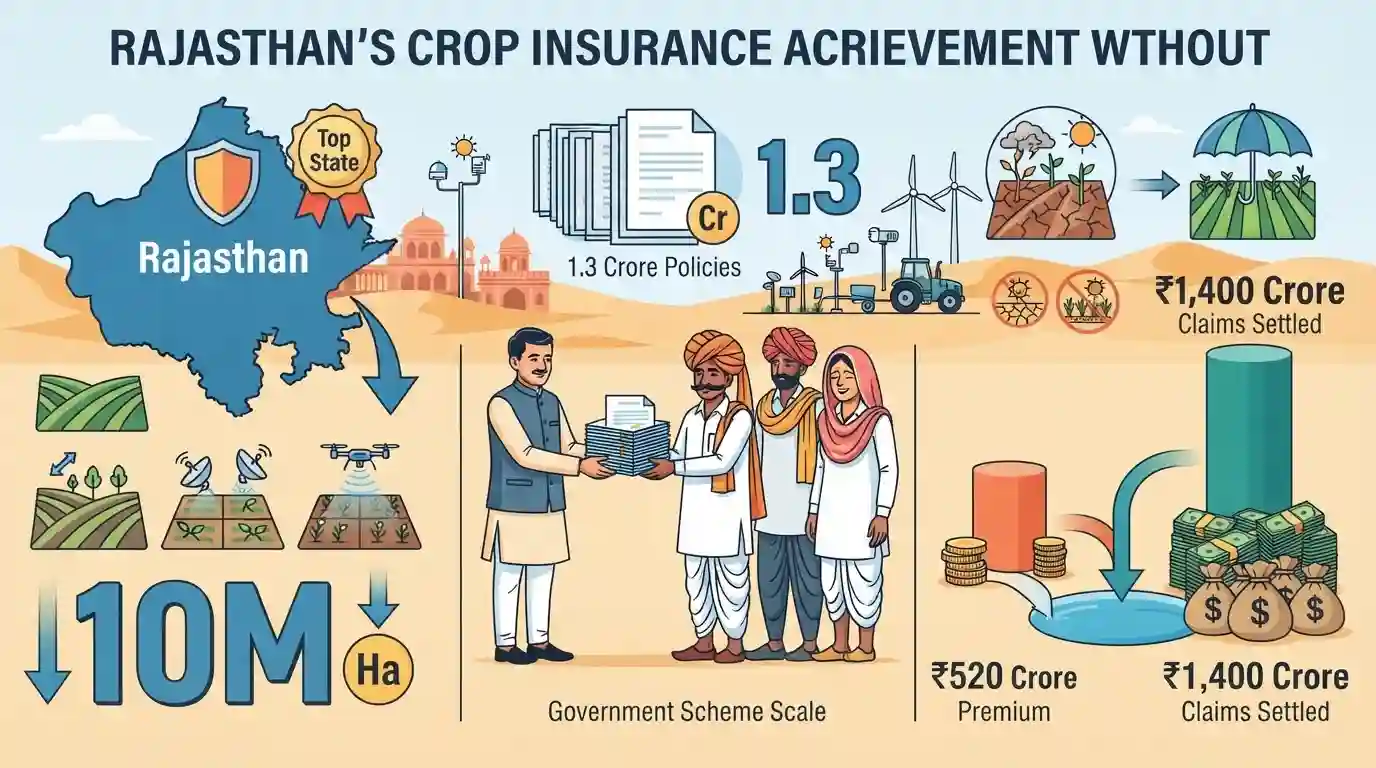
Rajasthan has emerged as the top state in India for crop insurance, bringing over 10 million hectares of agricultural land under the Pradhan Mantri Fasal Bima Yojana (PMFBY) during the ongoing Kharif season. The state government distributed 1.3 crore policies to farmers, ensuring broad protection against crop failures due to natural calamities. Financial data shows that while farmers paid around ₹520 crore in premiums, total claims settled reached nearly ₹1,400 crore. The achievement underscores the effectiveness of technology-driven assessments and state-led awareness programs in bolstering agricultural resilience in a drought-prone state.
Key Points
- Rajasthan has insured over 10 million hectares of agricultural land under the PMFBY during the current Kharif season, the highest in the country.
- The state distributed 1.3 crore crop insurance policies, reflecting massive participation by farmers.
- Against a farmer premium contribution of ₹520 crore, claims worth approximately ₹1,400 crore were settled, demonstrating significant financial risk coverage.
- The extensive coverage is attributed to digital tools and intensive awareness campaigns under the 'Meri Policy Mere Haath' initiative.
Important Terms
Pradhan Mantri Fasal Bima Yojana (PMFBY)

A flagship government-backed crop insurance scheme that financially protects farmers from crop losses due to natural calamities. It features highly subsidized premium rates for Kharif, Rabi, and commercial crops.
UPSC context
GS Paper 3 (Agriculture). Tests knowledge of farmer welfare schemes, risk mitigation, and agricultural safety nets.
State Agriculture Department
The state-level administrative body responsible for executing agricultural policies, managing farmer welfare programs, and overseeing the grassroots implementation of central schemes like PMFBY.
UPSC context
GS Paper 2 (Governance). Tests understanding of federalism and the role of state agencies in scheme implementation.
Kharif Season
India's monsoon agricultural season, running from June to October. Crops like rice, maize, cotton, and soybeans are sown with the monsoon's onset and harvested in autumn.
UPSC context
GS Paper 1 & 3 (Geography/Agriculture). Tests cropping patterns, monsoon dependency, and seasonal agricultural policies.
Technology-driven Crop Assessment
The use of satellite monitoring, digital verification, and precision technology to evaluate farm-level crop damage, replacing traditional crop-cutting experiments to ensure faster, transparent claim settlements.
UPSC context
GS Paper 3 (Agriculture/Technology). Covers e-technology in aid of farmers and administrative reforms in agricultural governance.
Gross Cropped Area
The total area sown once and/or more than once in a given agricultural year. In Rajasthan, roughly 36% of this area is covered under PMFBY.
UPSC context
GS Paper 3 (Agriculture). Tests agricultural statistics, land use patterns, and the reach of insurance schemes.
Loanee Farmers
Farmers who have availed institutional agricultural credit (crop loans). Under PMFBY reforms, states advocate making crop insurance completely voluntary for them to prevent non-consensual premium deductions.
UPSC context
GS Paper 3 (Agriculture). Explores rural credit systems, financial inclusion, and systemic issues in agricultural insurance.
Prelims Trap
Participation in PMFBY is mandatory for loanee farmers, and premium subsidies are shared equally (50:50) across all Indian States and UTs.
PMFBY was made 100% voluntary for all farmers in 2020. Also, the premium subsidy sharing ratio is 90:10 for North-Eastern and Himalayan States, not a uniform 50:50.
Static Concepts Connected
What are the core components and premium structures of the PMFBY?
- Premium caps: Farmers pay a fixed 1.5% for Rabi, 2% for Kharif, and 5% for annual commercial or horticultural crops.
- Subsidy sharing: The remaining actuarial premium is shared 50:50 between Center and State, and 90:10 in Northeast and Himalayan states.
- Voluntary nature: The scheme is 100% voluntary for all categories of farmers, including those with outstanding crop loans.
What is YES-TECH and its role in agricultural risk management?
- Yield estimation: It is a satellite-based crop yield modeling tool designed to generate rapid, unbiased, and automated yield estimates.
- Dispute resolution: It minimizes empirical assessment errors and disputes between states and insurers during manual crop-cutting experiments.
- Targeted crops: It was made mandatory for wheat and paddy from Kharif 2023, expanding subsequently to key oilseeds.
Cross-Topic Patterns
Climate change + Sub-national fiscal stress
Escalating extreme weather triggers massive PMFBY payouts. Delinking Central subsidies from delayed state deposits protects vulnerable farmers from state-level budgetary distress.
Agri-tech + Welfare delivery
Integrating satellite-based YES-TECH with land records establishes a robust Digital Public Infrastructure, eliminating middleman leakages and subjective crop loss assessments.

PMFBY's latest 2024-25 reforms (YES-TECH, escrow accounts, and 12% delay penalties) are prime targets for a 2026 multi-statement question.
