Rajasthan Caracal Conservation Project For Habitat Study
Source:theprint ↗
Why It Matters
Relevant for RPSC RAS aspirants tracking state-level wildlife conservation initiatives, endangered species protection programs, and regional environmental geography.
Summary
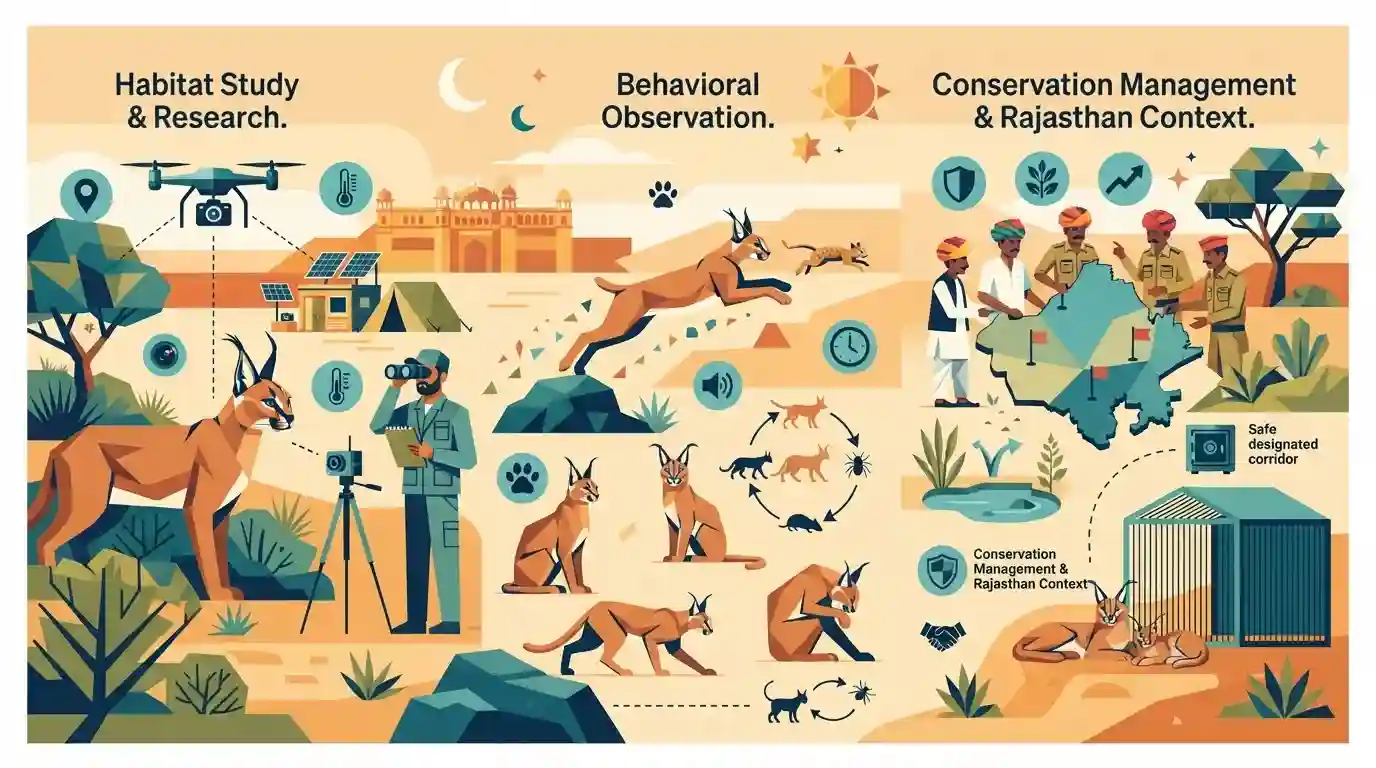
The Rajasthan government has launched a conservation project focused on studying the habitat and behavior of caracals, a rare and endangered wild cat species native to the state's arid landscapes, to ensure their long-term survival through scientific management.
Key Points
- Rajasthan has initiated a dedicated conservation project to study the habitat, behavior, and population of caracals in the state.
- The caracal (Caracal caracal) is a rare, medium-sized wild cat species facing severe population declines due to habitat loss and fragmentation in arid and semi-arid regions like Rajasthan and Gujarat.
- The project aims to use modern tracking, behavioral analysis, and habitat mapping to formulate targeted wildlife management policies for saving the species.
Important Terms
Caracal Conservation Project

A specialized initiative launched in Rajasthan to study the habitat, ecology, and behavior of the endangered caracal (Siyahgosh) across arid landscapes and tiger reserves to formulate long-term conservation strategies.
UPSC context
Important for RPSC Paper III (Environment & Biodiversity of Rajasthan); tests knowledge of state-led wildlife protection initiatives and endangered species.
Rajasthan Forest Department
The state government body responsible for protecting, managing, and conserving forests and wildlife resources across Rajasthan, collaborating with research institutes for species conservation.
UPSC context
Relevant for RPSC administrative structure and wildlife governance under Rajasthan environment and geography syllabus.
Prelims Trap
Caracals are distributed widely across moist deciduous forests and national parks throughout India.
Aspirants often assume caracals are distributed pan-India or found in dense tropical forests, whereas their Indian population is strictly restricted to arid/semi-arid scrublands of Rajasthan and Gujarat.
Static Concepts Connected
What is the conservation status and distribution of the Caracal in India?
- Conservation Status: IUCN status is Least Concern globally, but the Indian subpopulation is critically low and classified under Schedule I of the Wildlife Protection Act, 1972.
- Habitat Range: Principal Indian range is restricted to arid and semi-arid tracts of Rajasthan (Thar Desert) and Gujarat (Kutch).
- Key Identification: Distinguished easily by their long, prominent black tufts on the ears, adapted for stealth hunting in scrub and thorny forests.
Cross-Topic Patterns
Tiger Reserves and Arid Wildlife overlapping zones
Project Caracal spans Ranthambore, Dholpur-Karauli, and Ramgarh Vishdhari, overlapping major tiger reserves and testing multi-species conservation management in arid scrublands.
Scientific Collaborations in Wildlife Research
Inclusion of WII and SACON alongside state forest departments highlights the growing institutional reliance on multi-agency scientific collaborations for rare endemic fauna.

Project Caracal's inclusion across tiger reserves like Ramgarh Vishdhari makes it a prime candidate for a matching or statement-based RPSC question.
Linked PYQs · 3
Linked PYQs · 3
- 2023RPSC_PRELIMSGS1
The National Tiger Conservation Authority has conferred the status of the fifth tiger sanctuary in Rajasthan, to which of the following sanctuaries?
- 2025RPSC_PRELIMSGS1
Choose the incorrect statement with respect to the Rajasthan Forestry and Biodiversity Project (Phase-2).
- 2021RPSC_PRELIMSGS1
The state flower of Rajasthan is
