Rajasthan Introduces India First Automated Emergency Referral System
Source:medgate-today ↗
Why It Matters
RPSC Prelims heavily focuses on state-specific digital initiatives and e-governance platforms (similar to past questions on the Nidan software). Knowledge of SETU's purpose and its nodal agency is critical for the Current Affairs and Rajasthan Polity sections.
Summary
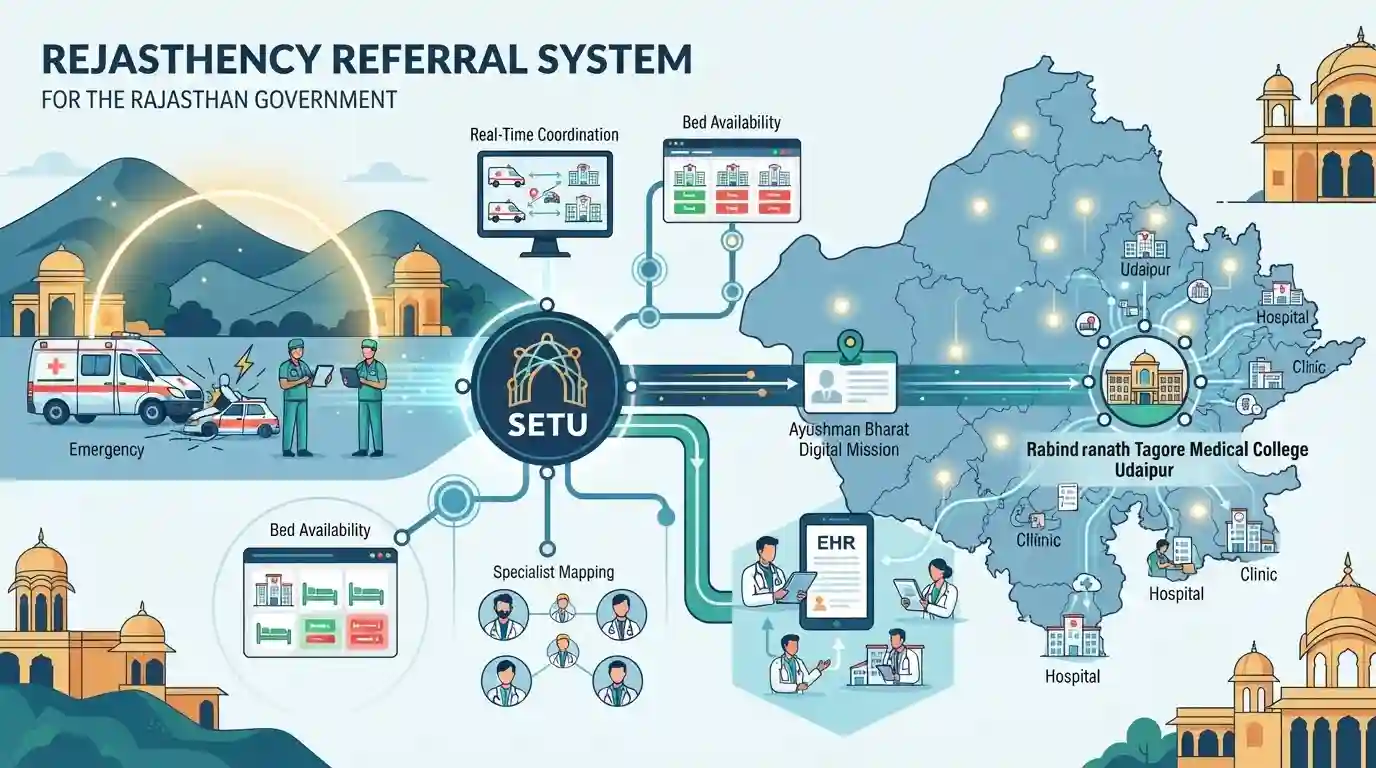
The Rajasthan government is set to launch SETU (Simplified Emergency Transfer and Urgent Referral), India's first fully automated digital emergency referral system. Designed to save critical time during the 'golden hour', SETU provides a unified platform for real-time coordination between hospitals and ambulances, live bed availability tracking, and specialist service mapping. Integrated with the Ayushman Bharat Digital Mission via ABHA IDs, it also creates seamless electronic health records. The pilot phase is rolling out across 15 districts, spearheaded by Rabindranath Tagore Medical College in Udaipur as the nodal center.
Key Points
- Rajasthan is introducing SETU, India's first fully automated digital emergency referral system.
- The system provides real-time coordination among hospitals, ambulances, and emergency response teams to optimize 'golden hour' critical care.
- It offers real-time tracking of bed availability, specialist services, and GPS-enabled ambulances on a single platform.
- Integrated with the Ayushman Bharat Digital Mission (ABDM), it uses ABHA IDs to maintain digital Electronic Health Records (EHR) for patients.
- The pilot phase covers 15 districts, with Rabindranath Tagore Medical College (RNT) in Udaipur serving as the nodal institution.
Important Terms
SETU (Simplified Emergency Transfer and Urgent Referral)

India's first automated digital emergency referral system by Rajasthan. It offers real-time hospital bed tracking, specialist mapping, and GPS ambulance coordination to prevent treatment delays and eliminate "blind arrivals" during critical emergencies.
UPSC context
GS-II (Health/Governance). A prime example of state-led e-governance innovation in emergency public healthcare delivery.
Ayushman Bharat Digital Mission (ABDM)
A central government initiative to develop a nationwide integrated digital health infrastructure. It bridges the gap among healthcare stakeholders through digital highways, facilitating interoperable, real-time access to electronic health records.
UPSC context
GS-II (Governance/Health). Crucial for topics on Digital Public Infrastructure (DPI), universal health coverage, and e-governance.
Ayushman Bharat Health Account (ABHA ID)
A unique 14-digit identifier generated under the ABDM. It serves as a central digital repository for a citizen's medical history, allowing seamless, consent-based portability of health records across registered providers nationwide.
UPSC context
GS-II (Governance). Essential for discussions on digital health passports, data privacy, and citizen-centric service delivery.
Golden Hour
The critical first 60 minutes following a traumatic injury or acute medical emergency. Rapid medical and surgical intervention during this highly responsive window dramatically increases patient survival rates and minimizes complications.
UPSC context
GS-II (Health) and GS-III (Disaster Management). A key concept when discussing emergency response systems, trauma care, and road safety.
Rabindranath Tagore Medical College
A state-run medical institution in Udaipur, Rajasthan. It serves as the primary testing ground and nodal center for piloting the SETU digital emergency referral system before its state-wide rollout.
UPSC context
GS-II (Health). Relevant as a case study of a state medical institution spearheading grassroots health-tech pilot programs.
Prelims Trap
"ABHA IDs are mandatory to access emergency healthcare and referral services under the Ayushman Bharat Digital Mission."
Creation of Ayushman Bharat Health Account (ABHA) IDs is strictly voluntary. Access to basic or emergency medical care cannot be denied if a patient lacks a digital health ID.
Static Concepts Connected
What are the core building blocks of the Ayushman Bharat Digital Mission (ABDM)?
- ABHA Number: A 14-digit voluntarily generated identifier establishing a unique identity for citizens across different healthcare providers.
- HPR & HFR: Comprehensive national registries for Healthcare Professionals (HPR) and Health Facilities (HFR) encompassing both modern and traditional medicine systems.
- PHR App: A Personal Health Record application allowing citizens to link, store, and consent-share their medical records securely with doctors.
What is the 'Golden Hour' in public health and trauma care?
- Critical Window: The crucial first 60 minutes immediately following a traumatic injury or acute medical emergency (such as a stroke or cardiac arrest).
- Clinical Significance: Prompt medical and surgical intervention during this precise period provides the highest chance of survival and prevents irreversible physiological damage.
Cross-Topic Patterns
Golden Hour & Motor Vehicles Act
The focus on 'Golden Hour' connects directly to the Good Samaritan guidelines under the Motor Vehicles (Amendment) Act 2019, which ensures cashless treatment for road accident victims.
State Sandboxes in e-Governance
State-led digital models like Rajasthan's SETU act as policy sandboxes. They frequently serve as high-yield case studies for GS-2 Governance answers on public service delivery and cooperative federalism.

A multi-statement question on digital health architecture testing ABDM registries and the voluntary nature of ABHA is highly likely in 2026.
Linked PYQs · 1
Linked PYQs · 1
- 2018RPSC_PRELIMSGS1
The Rajasthan government has released a new software to monitor trends in seasonal and non-communicable diseases, as well as diseases found in specific areas. What is the name of this software?
