Jaipur to Host 29th National e Governance Conference in July
Source:thebuckstopper ↗
Why It Matters
The hosting of the National e-Governance Conference is highly relevant to RPSC RAS aspirants as it represents a landmark milestone in Rajasthan's digital governance leadership. It highlights the convergence of state-level initiatives (like Jan Aadhaar and DoIT&C projects) with the national vision of AI-enabled, secure, and data-driven governance to achieve 'Viksit Bharat 2047'.
Summary
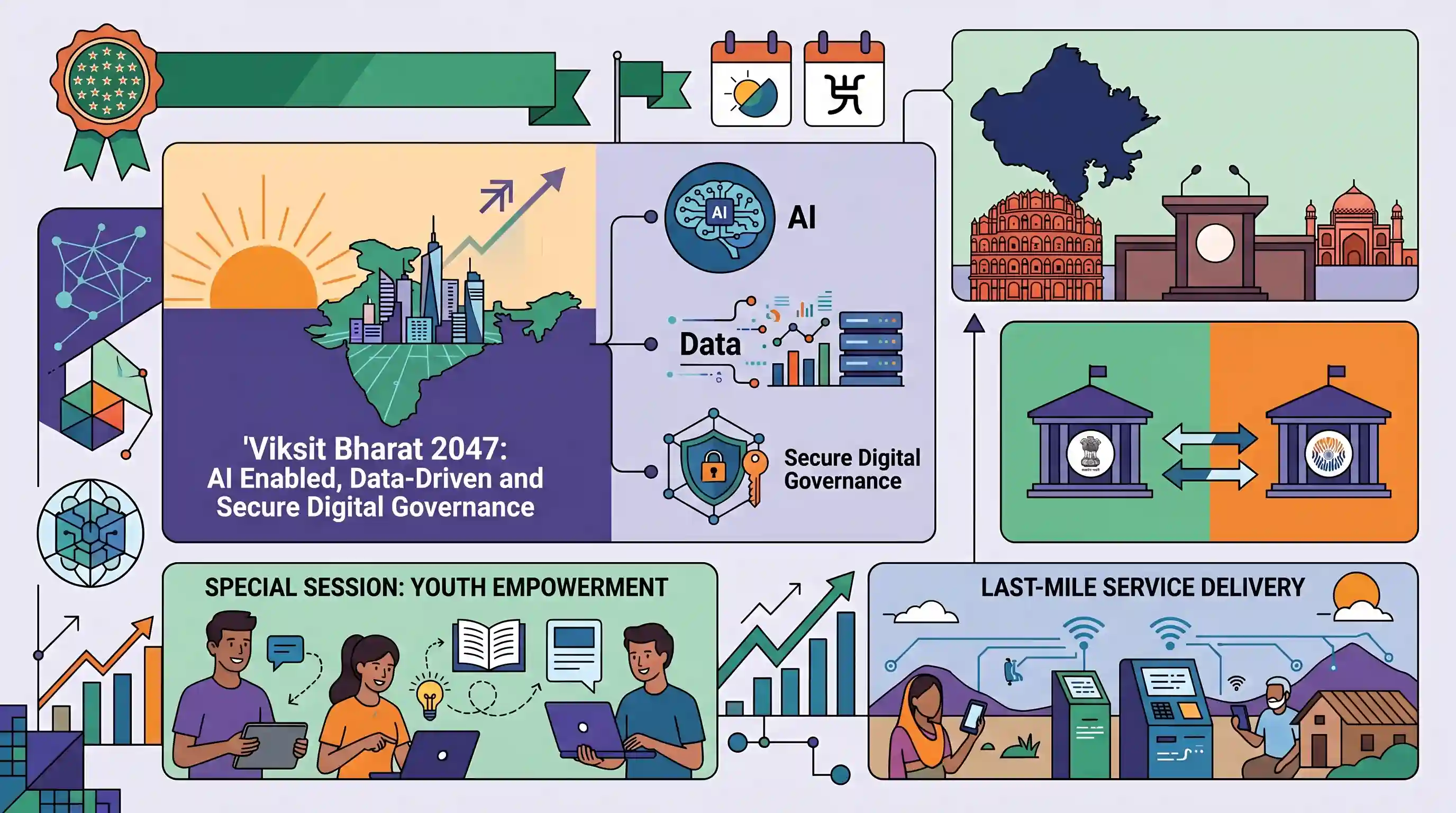
Rajasthan is set to host the 29th National e-Governance Conference (NCEG) in Jaipur on July 1-2, 2026. The prestigious annual event, organized in partnership with DARPG and MeitY, centers on the theme 'Viksit Bharat 2047: AI Enabled, Data-Driven and Secure Digital Governance'. This is the first time the state is hosting the conference, and it will feature two special sessions conducted by the Rajasthan government focused on youth empowerment and last-mile service delivery via technological innovations.
Key Points
- The 29th National e-Governance Conference (NCEG) is scheduled to be held in Jaipur, Rajasthan, on July 1-2, 2026, marking the first time Rajasthan serves as the host state for this prestigious national event.
- The event is being jointly organized by the Department of Administrative Reforms and Public Grievances (DARPG), the Ministry of Electronics and Information Technology (MeitY), and the Government of Rajasthan.
- The overarching theme of the conference is 'Viksit Bharat 2047: AI Enabled, Data-Driven and Secure Digital Governance', highlighting the integration of artificial intelligence and advanced technology in citizen service delivery.
- The Rajasthan government will lead two specific sessions at the conference, focusing on youth and delivering quick access to citizen services to the last-mile beneficiary through technological innovations.
- The conference's structure includes six plenary sessions, six breakout sessions, and an exhibition featuring 30 pioneering digital governance projects from across India.
- Key administrative review was conducted by Rajasthan Chief Secretary V Srinivas (former Secretary of DARPG) along with the current Union DARPG Secretary Nivedita Shukla Verma, emphasizes building active outreach and collaboration with startups and industry partners.
Important Terms
Viksit Bharat 2047

The long-term vision of the Government of India to transform the country into a fully developed and prosperous nation by the centenary of its independence in 2047.
UPSC context
GS Paper III (Economic Development); tests knowledge of long-term planning, sustainable growth objectives, and national vision policy.
National Conference on e-Governance (NCeG)
An annual Indian forum that brings together central and state officials, academicians, and industry experts to deliberate on digital public administration and innovative e-service delivery.
UPSC context
GS Paper II (e-Governance); tests understanding of administrative reforms, digital public infrastructure, and technological public policy.
Department of Administrative Reforms and Public Grievances (DARPG)
A union department under the Ministry of Personnel, Public Grievances and Pensions, responsible for formulating policies on administrative reforms, e-governance, and redressing public grievances.
UPSC context
GS Paper II (Administrative Reforms); tests understanding of civil services reform, institutional governance frameworks, and grievance redressal mechanisms.
Ministry of Electronics and Information Technology (MeitY)
The central ministry responsible for formulating and implementing national policies on information technology, electronics manufacturing, cybersecurity, and promoting digital public infrastructure.
UPSC context
GS Paper III (S&T) and Paper II (Governance); tests digital public infrastructure, tech-led welfare, and cybersecurity policy.
Department of Information Technology and Communication (DoIT&C), Rajasthan
The state-level department in Rajasthan responsible for driving digital transformation, managing IT infrastructure, and implementing e-governance solutions like RajNET and iStart.
UPSC context
GS Paper II (State Administration); tests knowledge of state-level digital platforms, decentralized governance, and regional IT innovations.
Prelims Trap
The National Awards for e-Governance are administered and conferred solely by the Ministry of Electronics and Information Technology (MeitY).
While MeitY is a key partner in the conference, the National Awards for e-Governance (NAeG) are primarily administered and led by the Department of Administrative Reforms and Public Grievances (DARPG) under Ministry of Personnel.
Static Concepts Connected
What are the four primary models of e-Governance?
- G2C Model: Enables direct citizen access to public services, utilities, and welfare benefits (e.g., DigiLocker, UMANG).
- G2B Model: Streamlines regulatory approvals, licensing, and taxation to enhance the ease of doing business (e.g., GSTN).
- G2G Model: Promotes seamless data sharing and workflow integration between different government departments to eliminate administrative silos.
- G2E Model: Manages internal human resources, payrolls, and performance tracking within government systems (e.g., e-Office).
What is the role and mandate of the DARPG?
- Nodal Mandate: Acts as the nodal agency for administrative reforms and citizen-centric governance under the Ministry of Personnel, Public Grievances and Pensions.
- CPGRAMS Management: Oversees the Centralized Public Grievance Redress and Monitoring System to ensure accountability and prompt grievance resolution across departments.
- NAeG Administration: Confers the annual National Awards for e-Governance to recognize exemplary digital governance models at all administration tiers.
Cross-Topic Patterns
DPI + Cooperative Federalism
National e-governance frameworks (like Agri Stack) require structural state-level coordination, proving that Digital Public Infrastructure acts as an operational bridge for cooperative federalism.
State Think-Tanks + Decentralized Planning
Rajasthan’s RITI, modeled on NITI Aayog, showcases a growing trend of states institutionalizing specialized planning bodies to align regional growth with national development objectives.

Addition of GP-level categories to NAeG signals a shift in UPSC testing towards grassroots digital delivery over elite tech portals.
Linked PYQs · 2
Linked PYQs · 2
- 2021RPSC_PRELIMSGS1
The Rajasthan Jan Aadhar Authority Ordinance was implemented
- 2024RPSC_PRELIMSGS1
Which of the following has been formed in place of Chief Minister's Rajasthan Economic Transformation Advisory Council (CMRETAC)?
