Rajasthan Uniform Civil Code Proposal and Renewable Energy Ranking
Source:nagaland-post ↗
Why It Matters
The introduction of a state-level Uniform Civil Code touches upon fundamental debates surrounding Article 44 of the Directive Principles of State Policy. Furthermore, updates on major state-specific energy infrastructure projects like the Pachpadra Refinery and solar capacity rankings are frequent topics in the RPSC Prelims exam.
Summary
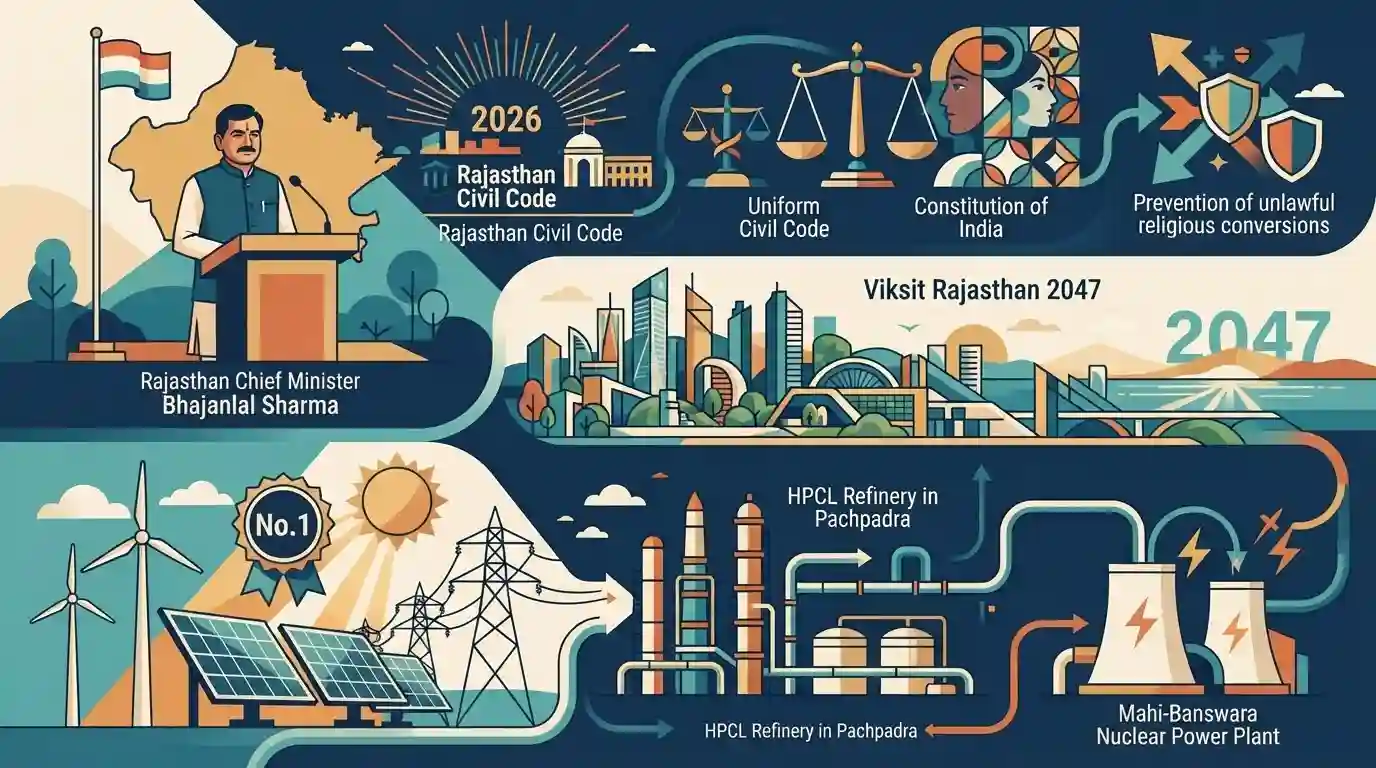
Rajasthan Chief Minister Bhajanlal Sharma announced the introduction of the Rajasthan Civil Code 2026 to implement the Uniform Civil Code in the state. Speaking at an Independence Day event in Bikaner, he also highlighted steps to prevent unlawful religious conversions and outlined the vision for 'Viksit Rajasthan' by 2047. Furthermore, he emphasized the state's top ranking in solar power capacity and noted progress on key energy projects such as the HPCL refinery in Pachpadra and the Mahi-Banswara nuclear power plant.
Key Points
- Rajasthan CM Bhajanlal Sharma announced the upcoming introduction of the Rajasthan Civil Code 2026, aiming to implement the Uniform Civil Code (Article 44) in the state.
- The Independence Day announcement at Bikaner also highlighted new legislation enacted to curb unlawful religious conversions in Rajasthan.
- The Chief Minister cited progress on major infrastructure and energy ventures, including the HPCL Rajasthan Refinery Project at Pachpadra and the Mahi-Banswara nuclear power project.
- Rajasthan's leadership in renewable energy was emphasized, noting the state ranks first nationally in solar power capacity and second overall in renewable energy capacity.
Important Terms
Rajasthan Civil Code 2026

A proposed legislation announced in August 2026 by CM Bhajanlal Sharma to implement a Uniform Civil Code in Rajasthan, establishing a common legal framework for all citizens' personal matters.
UPSC context
Highly relevant for RAS Prelims and Mains (Polity). Tests awareness of recent state legislative initiatives and governance frameworks.
Article 44
A Directive Principle of State Policy (DPSP) under Part IV of the Indian Constitution, instructing the State to secure a Uniform Civil Code (UCC) for its citizens.
UPSC context
Essential for RAS Paper III (Indian Political System). Tests foundational constitutional knowledge supporting uniform civil laws.
HPCL Rajasthan Refinery (Pachpadra)
A ₹79,459-crore, 9 MMTPA greenfield integrated refinery and petrochemical complex in Balotra district. It is a joint venture between HPCL (74%) and the Rajasthan Government (26%).
UPSC context
Vital for RAS Economy and Geography (Papers I & II). Frequently tests equity stakes and industrial infrastructure.
Viksit Rajasthan @2047
A vision document outlining a strategic roadmap to elevate Rajasthan's economy to $4.3 trillion by 2047, focusing on sustainable development, decentralization, green energy, and inclusive growth.
UPSC context
Core to RAS Mains Paper I (Economics). Evaluates knowledge of state-level policy targets and long-term development roadmaps.
Mahi-Banswara Nuclear Power Plant
An upcoming 2800 MW nuclear power plant in Banswara, developed by ASHVINI—a joint venture between Nuclear Power Corporation of India (51%) and NTPC (49%).
UPSC context
Key for RAS Paper II (Science & Tech) and Rajasthan Geography. Tests awareness of major state energy resources.
Prelims Trap
"Uniform Civil Code falls under the State List, allowing Rajasthan to enact it independently."
Personal laws fall under the Concurrent List (Entry 5). A State-level UCC requires Presidential assent under Article 254(2) to override existing central personal laws.
Static Concepts Connected
How can a State enact laws on Personal Laws (UCC)?
- Concurrent List: Personal laws (marriage, divorce, inheritance) fall under Entry 5 of the Concurrent List, allowing both Centre and States to legislate.
- Presidential Assent: Under Article 254(2), a state law contradicting existing central laws requires the President's assent to take effect.
What are the core features of the Pachpadra Refinery?
- Equity Ratio: It is a joint venture between Hindustan Petroleum Corporation Limited (74%) and the Government of Rajasthan (26%).
- Petrochemical Integration: It is India's first refinery integrated with a petrochemical complex, producing BS-VI standard fuels.
Cross-Topic Patterns
DPSP meets Fundamental Rights
The push for UCC (Article 44) alongside anti-conversion laws directly tests the constitutional balance between State Directives and the Right to Freedom of Religion (Article 25).
Baseload vs Renewable shift
While Rajasthan ranks 1st in solar, the Mahi-Banswara nuclear plant (NPCIL-NTPC JV) highlights the strategic push for baseload stability to balance intermittent renewable generation.

Expect a multi-statement question combining Rajasthan's 74:26 refinery equity, solar rankings, and Art 254(2) mechanisms for State UCC.
Linked PYQs · 4
Linked PYQs · 4
- 2023RPSC_PRELIMSGS1
Match the following list – P (Directive Principles) with list – R (Article): List – P List – R A. Equal justice and free legal aid I. Article 48 A B. Protection of the environment II. Article 39 A C. Right to work III. Article 41 D. Preservation of monuments IV. Article 49 Choose the correct option: . A B C D
- 2021RPSC_PRELIMSGS1
Which of the following pairs of Directive Principles of State Policy as described in the Constitution of India is correctly matched?
- 2021RPSC_PRELIMSGS1
In which year was the Rajasthan Solar Energy Policy announced?
- 2018RPSC_PRELIMSGS1
The proposed oil refinery in Pachpadra, Barmer, is a joint venture of which?
