Rajasthan Water Conclave Outlines Strategy for Water Management Model
Source:et-government ↗
Why It Matters
Irrigation and drinking water projects are recurrent themes in RPSC RAS Prelims. Questions frequently target the specific districts benefiting from projects (e.g., Parwan, IGNP, Narmada). The article updates aspirants on new agreements (Yamuna Water Agreement for Shekhawati) and schemes (Ramjal Setu Link, Devas III/IV) that are highly probable subjects for upcoming state examinations.
Summary
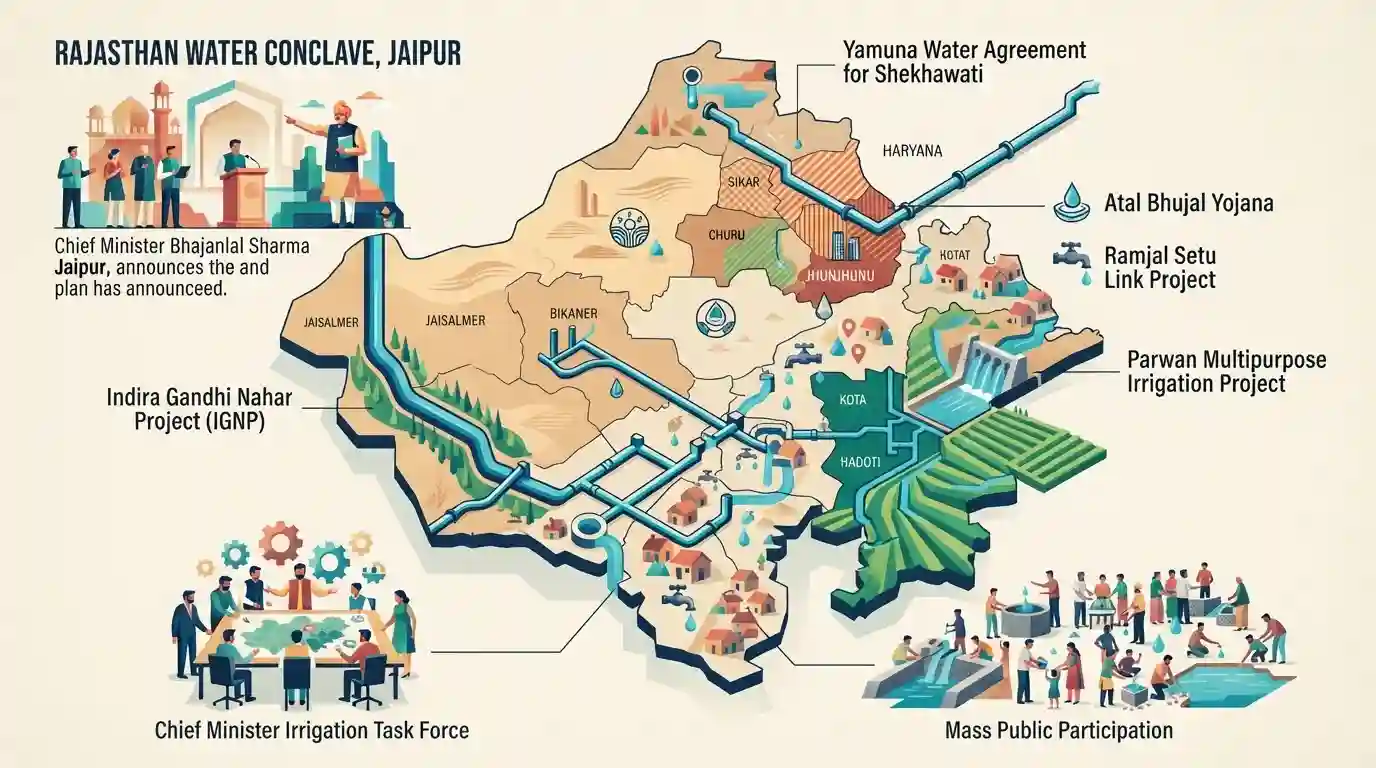
At the Rajasthan Water Conclave in Jaipur, Chief Minister Bhajanlal Sharma emphasized the state's comprehensive strategy to achieve self-reliance and become a national model in water management. He detailed major infrastructure endeavors such as the Yamuna Water Agreement aimed at the water-scarce Shekhawati region (Sikar, Jhunjhunu, Churu), the Parwan Multipurpose Irrigation Project for the Hadoti region, and the extensive Ramjal Setu Link Project. The state is actively strengthening legacy networks like the Indira Gandhi Nahar Project (IGNP) while integrating national missions including the Atal Bhujal Yojana and Jal Jeevan Mission. Through new administrative frameworks like the Chief Minister Irrigation Task Force and mass public participation campaigns, the government is pursuing sustainable water conservation alongside equitable distribution.
Key Points
- CM Bhajanlal Sharma outlined Rajasthan's objective to become a national model for water management during the Rajasthan Water Conclave in Jaipur.
- The Yamuna Water Agreement will supply essential drinking water via pipeline to the Shekhawati region, benefiting Sikar, Jhunjhunu, and Churu districts.
- Major infrastructure developments include the Ramjal Setu Link Project (serving 17 districts) and Devas III and IV projects in Udaipur (costing ₹1,691 crore).
- The state is focusing on completing the Parwan Multipurpose Irrigation Project for Kota, Baran, and Jhalawar, and strengthening the Indira Gandhi Nahar Project (IGNP) in western Rajasthan.
- Rajasthan is aligning with central schemes like Atal Bhujal Yojana and Jal Jeevan Mission, supported by governance tools like the Chief Minister Irrigation Task Force and the Kisan Saathi App.
Important Terms
Yamuna Water Agreement

A 1994 water-sharing pact among Upper Yamuna Basin states. A recent 2024/2026 framework finalizes underground pipelines to transport Rajasthan's allocated share (1,917 cusecs) from Haryana to the arid Shekhawati region.
UPSC context
GS-2 Inter-state water disputes and GS-1 Geography. Highlights cooperative federalism resolving decades-old infrastructural deadlocks for regional water equity.
Ramjal Setu Link Project
Formerly the Parvati-Kalisindh-Chambal-ERCP project, this major river-interlinking initiative transfers surplus monsoon water from Chambal tributaries to water-deficit basins in eastern Rajasthan, utilizing the Navnera Barrage and Chambal Aqueduct.
UPSC context
GS-1 Geography and GS-3 Infrastructure. Tests knowledge of regional river interlinking, inter-basin transfers, and state water security strategies.
Parwan Multipurpose Irrigation Project
An ongoing multipurpose dam and canal project on the Parwan River designed to provide vital irrigation and drinking water primarily to Rajasthan's semi-arid Hadoti region (Jhalawar, Baran, Kota).
UPSC context
GS-3 Agriculture and Infrastructure. Highly relevant for understanding regional irrigation projects that boost dryland agriculture and rural development.
Indira Gandhi Nahar Project (IGNP)
One of India’s longest canal systems, drawing water from the Sutlej and Beas rivers at Harike Barrage to combat desertification and irrigate the Thar Desert in western Rajasthan.
UPSC context
GS-1 Geography. A highly tested legacy project relating to Indus Water Treaty utilization, desert greening, and agricultural geography.
Atal Bhujal Yojana
A Central Sector Scheme backed by the World Bank targeting sustainable groundwater management in priority water-stressed states through community-led water budgeting, behavioral change, and demand-side interventions.
UPSC context
GS-2 Government Schemes and GS-3 Conservation. Tests knowledge of participatory groundwater management and institutional water governance models.
Prelims Trap
"Atal Bhujal Yojana is a Centrally Sponsored Scheme funded entirely by the central government for water extraction."
It is actually a Central Sector Scheme funded 50:50 by the Government of India and the World Bank, focusing on community-led groundwater management.
Static Concepts Connected
Which rivers form the Parbati-Kalisindh-Chambal (PKC) interlink project?
- Parbati River: Originates in the Vindhya range in Madhya Pradesh and flows into Rajasthan to join the Chambal river.
- Kalisindh River: Rises in the Malwa region of MP and joins the Chambal river in Rajasthan.
- Basin Transfer: The project transfers surplus water from these southern Chambal tributaries to deficit river basins in eastern Rajasthan.
What are the core features of the Atal Bhujal Yojana?
- Scheme Type: It is a Central Sector Scheme implemented by the Ministry of Jal Shakti.
- Funding: It is funded in a 50:50 ratio by the Government of India and the World Bank.
- Community Focus: It emphasizes participatory groundwater management, behavioral change, and the creation of Water Security Plans at the Gram Panchayat level.
Cross-Topic Patterns
River interlinking & Cooperative Federalism
The resolution of the Rajasthan-Madhya Pradesh dispute over the Parbati-Kalisindh-Chambal link (now Ramjal Setu) serves as a modern case study for cooperative federalism and inter-state river basin management.
IGNP, Agriculture & Desertification
Legacy networks like the IGNP are frequently assessed in Mains for their dual impact: arresting desertification in the Thar while simultaneously creating soil salinity and waterlogging issues due to altered cropping patterns.

Chambal basin tributaries (Parbati, Kalisindh) and the Ramjal Setu (PKC) inter-state link are prime candidates for 2026 Prelims mapping.
Linked PYQs · 5
Linked PYQs · 5
- 2021RPSC_PRELIMSGS1
The 'Parwan' multipurpose irrigation project of Rajasthan will provide irrigation facilities to which districts?
- 2018RPSC_PRELIMSGS1
Match the following: List-I – List-II (Major Irrigation Project) (Districts benefited by irrigation facilities) A. Siddhmukh Project (i) Jalore and Barmer B. Narmada Project (ii) Jalore, Pali and Jodhpur C. Jawai Project (iii) Udaipur and Pratapgarh D. Jakham Project (iv) Hanumangarh and Churu Code:
- 2018RPSC_PRELIMSGS1
In Rajasthan, for the first time, which of the following projects has made sprinkler irrigation mandatory?
- 2023RPSC_PRELIMSGS1
Which of the following statements is/are correct regarding the Atal Bhujal Yojana in Rajasthan? (a) The Atal Bhujal Yojana is being run by the Government of Rajasthan with financial assistance from the Government of India. (b) The focus of this scheme is to improve groundwater management and prevent its declining levels.
- 2021RPSC_PRELIMSGS1
The Atal Bhujal Yojana (Atal Groundwater Scheme) launched by the Government of India on April 1, 2020, is supported by which institution?
