Chambal sanctuary deploys technology to curb illegal sand mining
Source:free-press-journal ↗
Why It Matters
This article is highly relevant for RPSC Prelims as it covers a major environmental issue (illegal sand mining) in a key sanctuary of Rajasthan (Chambal), endangered species (gharial, Gangetic dolphin), and the practical application of emerging technologies (AI, drones, GIS) in governance and law enforcement.
Summary
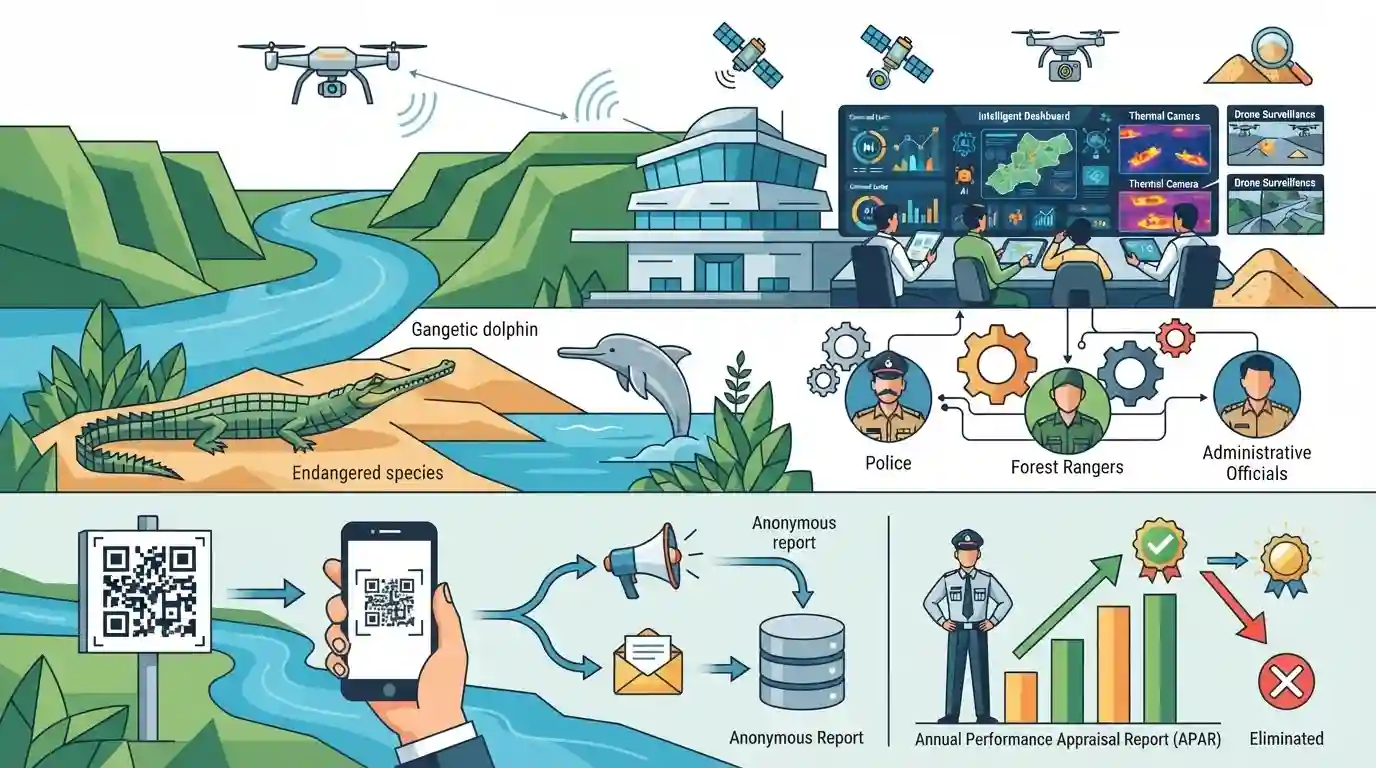
To combat rampant illegal sand mining in the ecologically sensitive National Chambal Sanctuary, the Rajasthan government has announced the deployment of an AI-powered intelligent dashboard, monthly drone surveys, and thermal cameras. Acting on Supreme Court directives, the state aims to protect the riverine habitat crucial for endangered species such as the gharial and the Gangetic dolphin. The strategy emphasizes both inter-departmental enforcement and public participation, introducing a QR-based anonymous grievance redressal platform for locals to report illegal activities. Furthermore, officials' effectiveness in curbing these crimes will now directly impact their Annual Performance Appraisal Reports (APARs), ensuring stricter administrative accountability.
Key Points
- Rajasthan is deploying an AI-powered dashboard, drones, high-resolution satellite imagery, and thermal cameras to combat illegal sand mining in the National Chambal Sanctuary.
- The initiative follows directives from the Supreme Court and recommendations from the Central Empowered Committee (CEC) to protect fragile riverine ecosystems.
- The National Chambal Sanctuary spans the districts of Kota, Sawai Madhopur, Karauli, Bundi, and Dholpur, providing critical habitat for endangered species like the gharial and Gangetic dolphin.
- A QR-code based digital complaint platform will be set up to enable anonymous public reporting of illegal mining, complete with geo-tagged media.
- To ensure accountability, enforcement officials will use body-worn cameras, and their performance in curbing illegal mining will be reflected in their Annual Performance Appraisal Reports (APARs).
Important Terms
National Chambal Sanctuary

A tri-state protected area across Rajasthan, Madhya Pradesh, and Uttar Pradesh along the Chambal River. It is managed to conserve the critically endangered gharial, red-crowned roof turtle, and endangered Gangetic dolphin.
UPSC context
GS-III (Environment). Highly tested in Prelims for protected areas, river ecosystems, and habitats of specific endangered aquatic species.
Central Empowered Committee (CEC)
Originally constituted by the Supreme Court in 2002 to monitor environmental compliance, the CEC is now a permanent statutory body under the MoEFCC, overseeing forest, wildlife, and environmental violations.
UPSC context
GS-II/GS-III. Tests knowledge of statutory bodies, environmental jurisprudence, and mechanisms enforcing Supreme Court environmental directives.
National Green Tribunal (NGT)
A specialized statutory judicial body established under the NGT Act of 2010 to expedite the disposal of cases related to environmental protection, forest conservation, and ecological rights.
UPSC context
Core GS-II/GS-III topic. Frequently tested in Prelims/Mains regarding statutory frameworks, alternative dispute resolution, and environmental governance.
Gharial
A unique, fish-eating crocodilian native to the Indian subcontinent, easily identified by its long, narrow snout. It is listed as Critically Endangered on the IUCN Red List.
UPSC context
Crucial for Prelims (Environment). Tests species conservation status (Critically Endangered), WPA Schedule I protection, and primary habitats (Chambal River).
Gangetic Dolphin
A nearly blind, freshwater dolphin endemic to the Ganges-Brahmaputra basin that navigates via echolocation. It is India's National Aquatic Animal and classified as Endangered by the IUCN.
UPSC context
High-yield Prelims topic (Environment). Questions often target its IUCN status (Endangered), role as an ecological indicator, and Project Dolphin.
Prelims Trap
"The National Chambal Sanctuary is located exclusively in the state of Rajasthan."
Despite Rajasthan launching these tech initiatives, the sanctuary is India's only tri-state protected area, spread across Rajasthan, Madhya Pradesh, and Uttar Pradesh.
Static Concepts Connected
What makes the National Chambal Sanctuary ecologically unique?
- Tri-state Protected Area: It is India's only sanctuary co-administered by three states: Rajasthan, Madhya Pradesh, and Uttar Pradesh, covering a 600-km stretch of the river.
- Indicator Species: It provides critical habitat for the Critically Endangered Gharial, the Endangered Gangetic Dolphin, and the Indian Skimmer.
- Vulnerable Riverine Habitat: Sand mining destroys the delicate sandy banks and ravine topography required for the nesting and basking of these freshwater species.
Who holds the regulatory authority over sand mining in India?
- Minor Mineral Status: Sand is classified as a 'minor mineral' under the Mines and Minerals (Development and Regulation) Act, 1957.
- State Jurisdiction: State governments possess the absolute power to frame rules, regulate, and grant administrative concessions for minor mineral mining.
- Environmental Clearance: Despite state control, sand mining requires prior environmental clearance (EC) as mandated by the Supreme Court and MoEFCC guidelines.
Cross-Topic Patterns
E-Governance in Green Policing
Linking AI dashboards and QR grievances to sand mining enforcement bridges GS2 E-governance and GS3 Conservation, compensating for low field-staff capacity in remote regions.
APARs for Administrative Accountability
Tying ecological enforcement directly to officers' Annual Performance Appraisal Reports (APARs) provides a tangible GS4 public administration case study on fixing institutional accountability.

Expect a Prelims pair-matching question on Chambal's species, or a GS3 Mains on using AI/drones to overcome green policing limitations.
Linked PYQs · 5
Linked PYQs · 5
- 2023RPSC_PRELIMSGS1
The National Tiger Conservation Authority has conferred the status of the fifth tiger sanctuary in Rajasthan, to which of the following sanctuaries?
- 2025RPSC_PRELIMSGS1
The Rajasthan government has announced the M-Sand Policy in the year 2024. It will remain effective
- 2018RPSC_PRELIMSGS1
Which of the following statements are true? (a) Marble Development and Conservation Rules – 2002 (b) Rajasthan Mineral Policy – 2015 (c) District Mineral Foundation Trust Rules – 2016 (d) Rajasthan Minor Mineral Concession Rules (amended up to May 2016) Code:
- 2025RPSC_PRELIMSGS1
Identify the correct statements with respect to Artificial Intelligence (AI) with the help of the codes given below: A. Machine learning is a subset of AI. B. In supervised learning, computer systems are trained without marked input data. C. Machines learn through trial and error, and are rewarded during reinforcement learning. Code:
- 2025RPSC_PRELIMSGS1
What is not the objective of the Citizen Charter?
