Rajasthan Tiger Count Reaches 149 Across Five Reserves
Source:gktoday ↗
Why It Matters
Wildlife conservation, specifically tiger reserves and their locations, is a recurring theme in RPSC RAS Prelims. The expansion to five tiger reserves in Rajasthan and the associated carrying capacity issues at Ranthambore are critical contemporary environmental topics for the state exam.
Summary
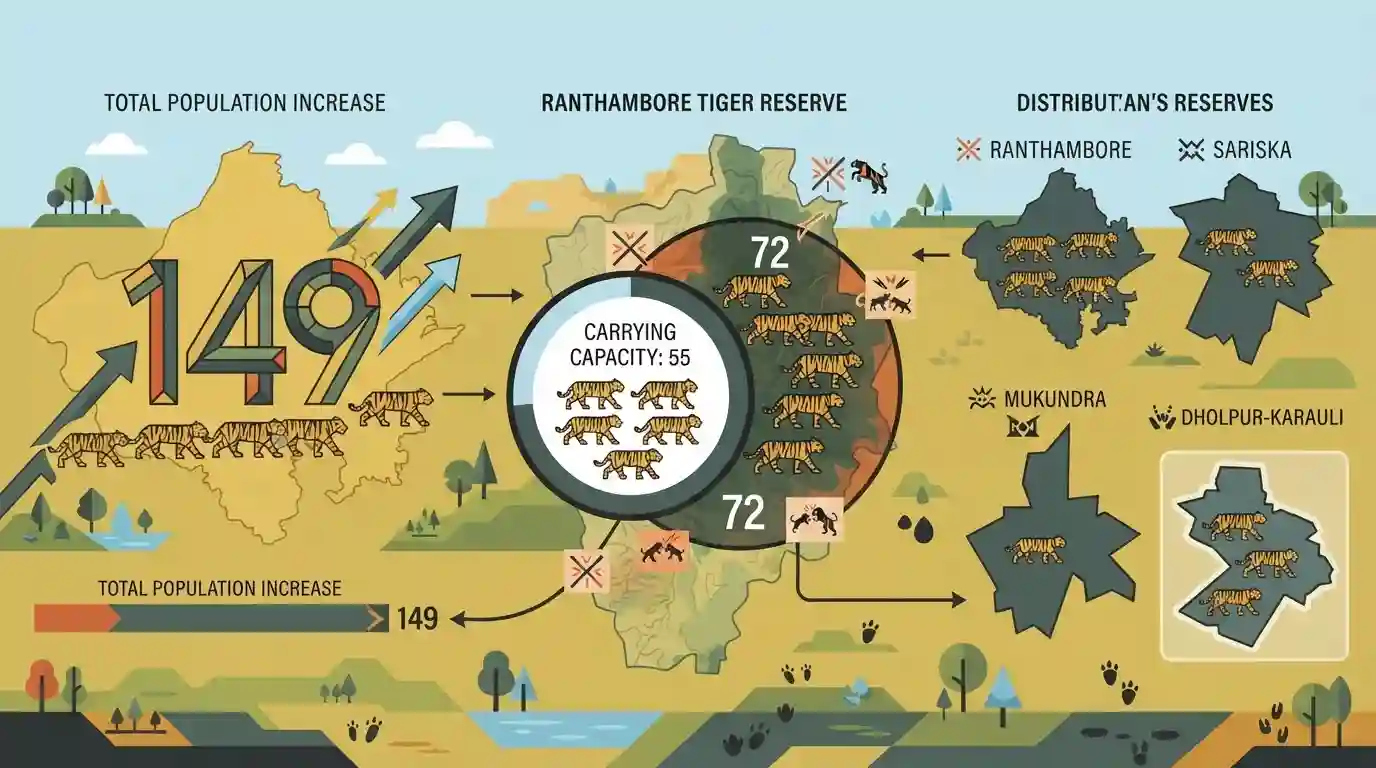
The tiger population in Rajasthan has increased to 149, underscoring significant conservation milestones in the state. However, the Ranthambore Tiger Reserve now houses 72 tigers, well beyond its carrying capacity of 55, raising concerns about territorial disputes and potential human-wildlife conflicts. The state manages this growing population across its five recognized tiger reserves, including the recently added Dholpur-Karauli reserve.
Key Points
- The tiger population in Rajasthan reached a total of 149 across the state's five reserves in 2024.
- Ranthambore Tiger Reserve has 72 tigers, significantly exceeding its carrying capacity of roughly 55 tigers, leading to increased territorial disputes and human-wildlife conflicts.
- Rajasthan currently has five established tiger reserves: Ranthambore, Sariska, Mukundara Hills, Ramgarh Vishdhari, and Dholpur-Karauli.
- Dholpur-Karauli was notified as Rajasthan's fifth tiger reserve by the NTCA in 2023, expanding the protected habitat and facilitating wildlife corridors.
Important Terms
National Tiger Conservation Authority (NTCA)

A statutory body established in 2005 under the Wildlife (Protection) Act, 1972, functioning under MoEFCC. It oversees Project Tiger, approves tiger conservation plans, and regulates tiger reserves across India.
UPSC context
GS-3 (Environment). Tests knowledge of statutory bodies, their functions, and legislative frameworks governing wildlife conservation.
Project Tiger
A Centrally Sponsored Scheme launched in 1973 by the Indian government. Implemented by the NTCA, it aims to conserve Bengal tigers by establishing core-buffer structured tiger reserves in their natural habitats.
UPSC context
GS-3 (Biodiversity). Frequently tested regarding flagship species protection, its funding structure, and conservation achievements.
Ranthambore Tiger Reserve
A prominent tiger reserve and national park situated in eastern Rajasthan at the junction of the Aravalli and Vindhya ranges. Known for its dry deciduous forests, historic fort, and dense tiger population.
UPSC context
GS-1/GS-3. Tests mapping skills, flora/fauna distribution, and protected areas within India's geography and ecology framework.
Carrying Capacity
The maximum population size of a species that a specific ecosystem can sustainably support over the long term without causing resource depletion or irreversible environmental degradation.
UPSC context
GS-3 (Environment/Ecology). Key concept for questions on sustainable development, urban planning, and human-wildlife conflict mechanisms.
Dholpur-Karauli Tiger Reserve
India's 54th tiger reserve and Rajasthan's fifth, approved in 2023. Spanning the Dholpur and Karauli districts near the Chambal and Banas rivers, it forms a crucial habitat corridor for tiger conservation.
UPSC context
GS-3 (Current Affairs). Important for Prelims regarding the latest additions to India's protected areas network.
Prelims Trap
The Central Government or NTCA holds the sole authority to notify and alter boundaries of Tiger Reserves under the WPA, 1972.
Aspirants often believe the Central Govt or NTCA can unilaterally notify or alter tiger reserve boundaries. In reality, the State Govt notifies them, and boundary changes require both NTCA and NBWL approval.
Static Concepts Connected
Statutory Framework of Tiger Reserves under WPA, 1972
- Notification authority: Reserves are notified by State Governments under Section 38V of the Wildlife (Protection) Act, 1972, based on the recommendation of the NTCA.
- Alteration of boundaries: Section 38W mandates that no boundary alteration or de-notification can occur without joint approval of the NTCA and the National Board for Wild Life (NBWL).
- Zonal classification: Under Section 38V, reserves must have a core Critical Tiger Habitat (inviolate) and a peripheral Buffer Zone (ecologically compatible coexistence).
Critical Tiger Habitat (CTH) vs. Critical Wildlife Habitat (CWH)
- Legal basis: CTHs are notified under the Wildlife (Protection) Act, 1972, whereas CWHs are designated under the Forest Rights Act (FRA), 2006.
- Nodal authority: CTHs fall under the jurisdiction of the NTCA/MoEFCC, while CWHs involve the Ministry of Tribal Affairs due to tribal forest rights intersections.
- Consent requirements: CWH notification requires absolute completion of forest rights settlement and Gram Sabha consent, making its process more socio-legally complex than CTH.
Cross-Topic Patterns
Ecological corridors vs. Linear infrastructure
The connectivity of corridors like Ramgarh Vishdhari highlights the conflict between infrastructure development (e.g., greenfield expressways) and maintaining genetic flow for endangered megafauna.
Carrying capacity vs. Tourism revenue
Overpopulation in Ranthambore showcases how commercial eco-tourism pressure clashes with the scientific ecological carrying capacity of Protected Areas.

Expect questions on statutory steps for Tiger Reserve notification, specifically the joint NTCA-NBWL approval required for boundary changes.
Linked PYQs · 1
Linked PYQs · 1
- 2023RPSC_PRELIMSGS1
The National Tiger Conservation Authority has conferred the status of the fifth tiger sanctuary in Rajasthan, to which of the following sanctuaries?
