Storm Dislodges Jaisalmer Solar Panels and Injures Civilians
Source:lokmat-times ↗
Why It Matters
The event highlights the intersection between green energy expansion and disaster resilience in arid, storm-prone western Rajasthan. It showcases how structural engineering standards for solar installations and robust hospital disaster preparedness are vital for public safety during monsoon-induced severe weather.
Summary
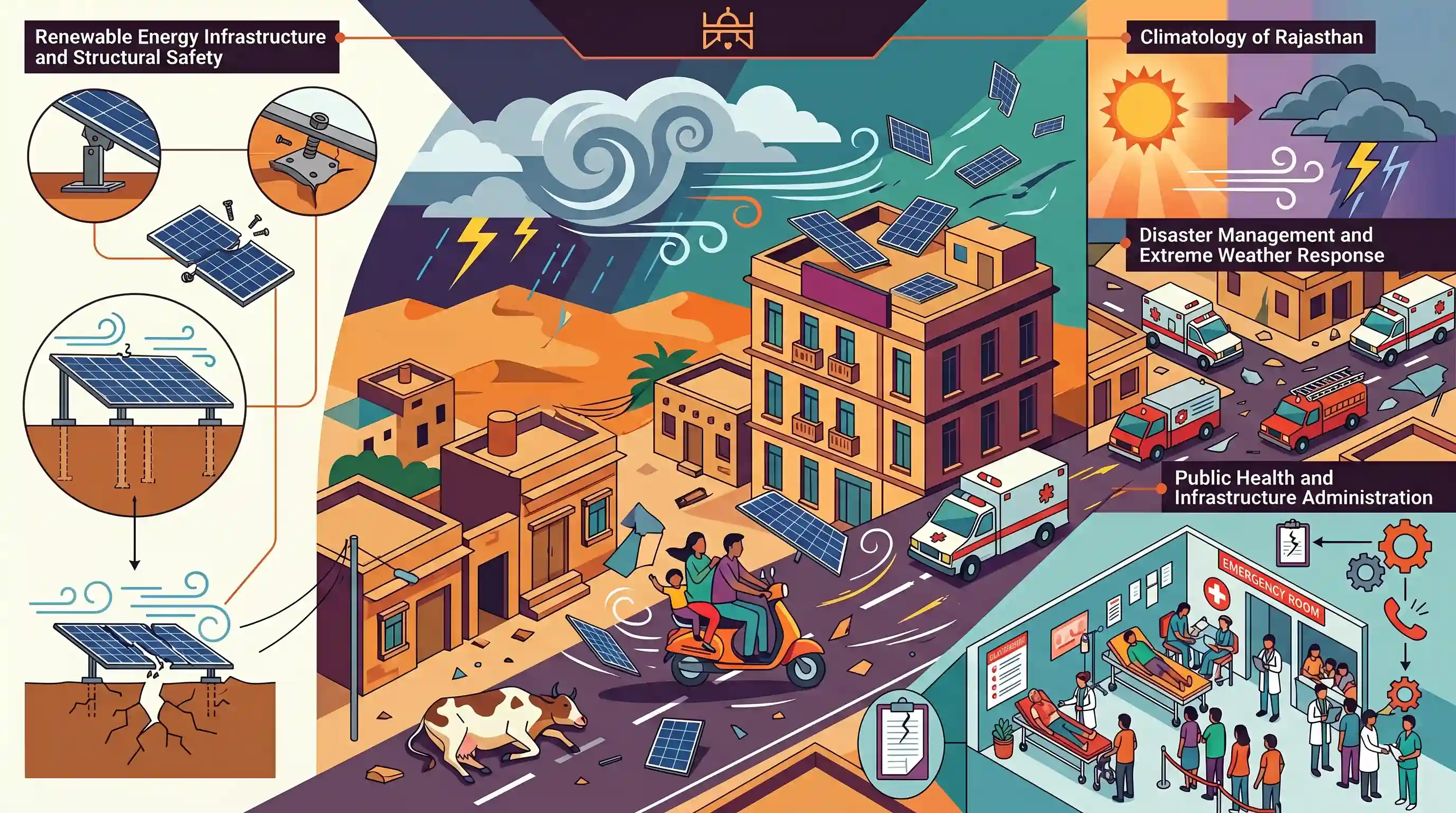
A severe storm accompanying the arrival of the southwest monsoon in Jaisalmer, Rajasthan, dislodged hotel rooftop solar panels in Gandhi Colony. The falling panels seriously injured three people on a scooter and killed a cow. The incident highlights the vulnerability of rooftop renewable energy structures to wind loads in the Thar desert region and exposes administrative gaps in local district hospital trauma centers and emergency services during natural calamities.
Key Points
- Monsoon Onset in Jaisalmer: The severe storm marked the first southwest monsoon spell in Jaisalmer and nearby areas (Pokaran, Ramdevra), dropping the local maximum temperature from a scorching 42.9°C.
- Rooftop Solar Structural Hazards: High-velocity winds dislodged rooftop solar panels from a hotel in Gandhi Colony, showing that renewable energy infrastructure in high-wind desert zones requires strict compliance with structural and wind-load standards.
- Casualties & Public Impact: Three members of a family (a 60-year-old grandfather and his two young grandsons) on a scooter were seriously injured by the falling debris and referred to Jodhpur for advanced treatment. A cow was also killed.
- Disaster & Medical Infrastructure Challenges: Local leaders and family members raised concerns over power outages at the district hospital's trauma center and the availability of immediate emergency services, indicating public administration gaps in emergency response.
Important Terms
National Solar Mission

A key initiative under the National Action Plan on Climate Change (NAPCC) launched to establish India as a global leader in solar energy, targeting 100 GW of capacity.
UPSC context
GS Paper III (Energy/Environment); tests renewable target structures, NAPCC missions, and global climate commitments.
PM-KUSUM Scheme
A welfare scheme launched in 2019 by the Ministry of New and Renewable Energy to provide water and energy security to farmers by solarizing agricultural pumps.
UPSC context
GS Paper III (Agriculture & Infrastructure); tests understanding of rural energy transition, agricultural subsidies, and decentralized generation.
Rajasthan Renewable Energy Corporation Limited (RRECL)
The state nodal agency in Rajasthan formed to promote, develop, and implement non-conventional energy sources and manage the state's energy conservation programs.
UPSC context
GS Paper III (Infrastructure/Governance); tests knowledge of state-level executing agencies for green energy transition.
Rajasthan Solar Energy Policy 2019
A subnational policy framework designed to target 30,000 MW of solar power capacity in Rajasthan by 2024-25, emphasizing solar parks and rooftop installations.
UPSC context
GS Paper III (Energy Policy) & RAS; tests regional energy target-setting, grid integration, and localized renewable investment frameworks.
Prelims Trap
Monsoonal rainfall in Rajasthan progressively increases from the Southeast humid zones to the Northwest hyper-arid zones during the Southwest Monsoon.
The spatial gradient of monsoon rainfall in Rajasthan is often reversed in questions. Rainfall actually increases from the Northwest (hyper-arid) to the Southeast (humid).
Static Concepts Connected
How does the Southwest Monsoon rainfall vary across Rajasthan's physiographic regions?
- Spatial Gradient: Rainfall increases progressively from the Northwest hyper-arid plains (Jaisalmer) to the Southeast humid plateau (Jhalawar/Banswara).
- Ascending Order: The correct ascending order of rainfall is Jalore (arid/semi-arid), followed by Jaipur (semi-arid), and Kota (humid southeastern plateau).
- Aravali Divide: The Aravali range runs Southwest to Northeast, acting as a major climatic divide, leaving the western side dry and rain-shadowed.
What are the structural safety standards for solar mounting installations in India?
- BIS Code IS 875: Design loads on structures, including wind loads, are regulated under the Bureau of Indian Standards (BIS) code IS 875 Part 3:2015.
- MNRE Wind Guidelines: Guidelines require solar mounting structures to withstand high wind velocities of up to 150–170 km/h, preventing uplift during storms.
- Nodal Agency Mandate: RRECL is the state nodal body coordinating renewable energy targets, policy compliance, and Central initiatives like PM-KUSUM Component A.
Cross-Topic Patterns
Green Transition vs Climate Resilience
Rapid decentralized solar deployment under schemes like PM-KUSUM creates localized civil hazards if safety standards are not updated for escalating extreme weather.
Disaster Response + Public Health Gaps
The interface of public health systems and local disaster management during seasonal extreme weather highlights gaps in Tier-II/III city emergency infrastructure.

Monsoon rainfall gradients in Rajasthan coupled with BIS wind-load safety standards for clean energy assets likely to form a 2026 GS Qn.
Linked PYQs · 4
Linked PYQs · 4
- 2021RPSC_PRELIMSGS1
In which year was the Rajasthan Solar Energy Policy announced?
- 2025RPSC_PRELIMSGS1
What is the correct ascending order of the following group of districts of Rajasthan based on average rainfall in the southwest monsoon?
- 2008RPSC_PRELIMSGS1
In which direction does the monsoon rainfall increase in Rajasthan?
- 2023RPSC_PRELIMSGS1
Which agency has been given the responsibility of implementing the PM-KUSUM scheme (Component A) in Rajasthan, which involves the establishment of solar power plants with a capacity of 0.5 MW to 2 MW?
