Rajasthan targets 125 GW renewable energy capacity by 2030
Source:the-tribune ↗
Why It Matters
Rajasthan is a frontline state for solar and wind energy in India. Understanding the state's renewable capacity targets (like the 125 GW goal) and its implementation of central solar schemes (PM-KUSUM, PM Surya Ghar) is highly relevant for RPSC Prelims questions related to state economy, policy frameworks, and energy infrastructure.
Summary
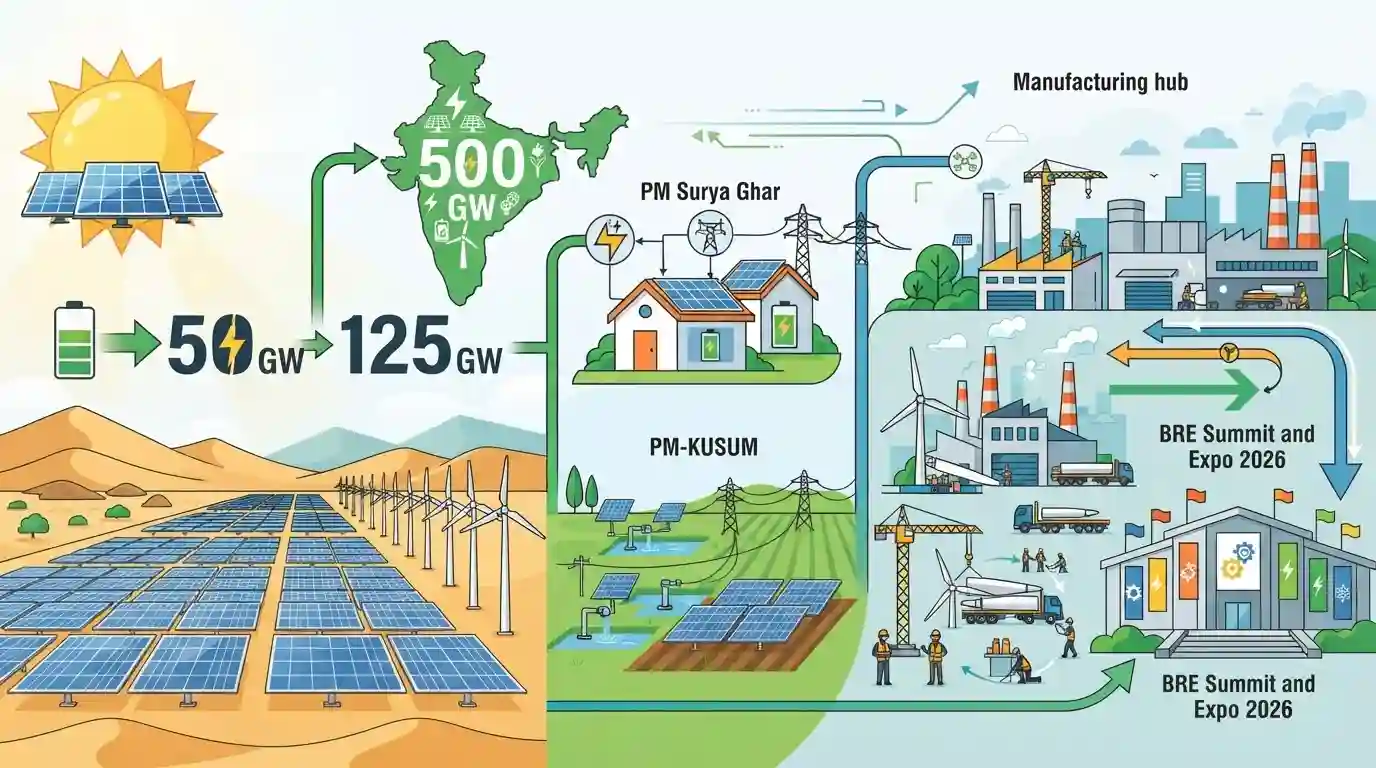
Rajasthan has set an ambitious target to install 125 GW of renewable energy capacity by 2030, stepping up its contribution to India's national goal of 500 GW of clean energy by the same year. The state currently has around 50 GW of installed capacity. The Union Ministry of New and Renewable Energy highlighted the role of schemes like PM Surya Ghar and PM-KUSUM in accelerating this transition. Additionally, Rajasthan is emerging as a manufacturing hub for renewable components, notably wind blades in Jaisalmer, as the state prepares to attract further investments ahead of the BRE Summit and Expo 2026.
Key Points
- Rajasthan aims to achieve 125 GW of renewable energy capacity by 2030, building on its currently installed capacity of roughly 50 GW.
- At the national level, India targets 500 GW of clean energy by 2030 and has already crossed the 300 GW milestone in non-fossil fuel capacity.
- Central schemes such as PM Surya Ghar and PM-KUSUM are playing a crucial role in promoting localized and agricultural solar power adoption.
- Jaisalmer has emerged as a key hub for wind blade manufacturing, with the government actively seeking more module manufacturing investments.
Important Terms
PM Surya Ghar: Muft Bijli Yojana

A central government scheme offering subsidies for residential rooftop solar installations. It aims to provide up to 300 units of free electricity per month to one crore households, promoting decentralized clean energy.
UPSC context
Important for RAS Pre and Mains (Economy/Government Schemes) as it tests knowledge of India's transition toward self-reliant renewable energy.
PM-KUSUM Scheme
A scheme subsidizing solar-powered irrigation pumps and decentralized solar power plants for farmers. It reduces agricultural reliance on diesel, ensures daytime power access, and enables farmers to sell surplus electricity.
UPSC context
Highly relevant for RAS Mains Paper 3 (Agriculture & Rural Economy), focusing on rural energy security and sustainable farming practices.
Ministry of New and Renewable Energy (MNRE)
The nodal central ministry responsible for policy formulation and project implementation across solar, wind, and emerging green technologies to achieve India's 500 GW non-fossil capacity target by 2030.
UPSC context
Tests awareness of the institutional frameworks driving climate action in RAS Prelims and Mains (General Science & Technology).
Rajasthan Integrated Clean Energy Policy, 2024
Rajasthan's overarching energy framework setting an ambitious target of 125 GW renewable capacity by 2030, heavily focused on expanding solar (90 GW) and wind/hybrid (25 GW) projects across the state.
UPSC context
Crucial for RAS Mains (Economy and Geography of Rajasthan) to evaluate state-level climate action and energy infrastructure planning.
BRE Summit and Expo 2026
A major upcoming B2B event aiming to attract global developers and clean energy investments to states like Rajasthan, boosting regional renewable manufacturing hubs (like Jaisalmer's wind blade industry).
UPSC context
Relevant for Current Affairs and RAS Mains (Economic Development) regarding green investments and ease of doing business in Rajasthan.
Prelims Trap
Under PM-KUSUM Component A, solar power plants can only be set up on barren or uncultivable lands.
Component A allows farmers to set up solar plants on both barren and cultivable lands (using stilt mounts) to ensure they can earn additional income without entirely losing agricultural productivity.
Static Concepts Connected
What are the three core components of the PM-KUSUM scheme?
- Component A: Setting up of 10,000 MW of decentralized ground-mounted grid-connected solar or other renewable energy power plants (up to 2 MW).
- Component B: Installation of standalone off-grid solar agriculture pumps to replace diesel pumps.
- Component C: Solarisation of existing grid-connected agriculture pumps to make them financially viable and energy-efficient.
Why is Rajasthan geographically favorable for renewable energy generation?
- High Insolation: Rajasthan receives the highest solar radiation in India, boasting over 300 clear sunny days annually.
- Wind Velocity: Western districts like Jaisalmer and Barmer possess optimal wind speeds suitable for maximizing wind turbine efficiency.
- Land Availability: The availability of vast tracts of flat, barren, and uncultivable desert land drastically reduces land acquisition hurdles.
Cross-Topic Patterns
RE transition boosting Marwar's industrial economy
Jaisalmer's emergence as a wind blade manufacturing hub links the renewable energy transition directly to industrialization, FDI, and job creation in Western Rajasthan's desert districts.
Rooftop solar and State Policy integration
Integration of PM Surya Ghar with the Rajasthan Solar Energy Policy 2023 creates a combined subsidy push for residential solar, a key governance theme for RAS Mains Paper 3.

Expect a multi-statement question combining Rajasthan's 125 GW target, Jaisalmer's wind manufacturing, and PM-KUSUM Component A details.
Linked PYQs · 4
Linked PYQs · 4
- 2021RPSC_PRELIMSGS1
In which year was the Rajasthan Solar Energy Policy announced?
- 2023RPSC_PRELIMSGS1
Which agency has been given the responsibility of implementing the PM-KUSUM scheme (Component A) in Rajasthan, which involves the establishment of solar power plants with a capacity of 0.5 MW to 2 MW?
- 2018RPSC_PRELIMSGS1
What is the target set by the Government of India to achieve by 2022 in terms of solar energy capacity?
- 2025RPSC_PRELIMSGS1
Which of the following statements are correct with respect to the PM Surya Ghar Free Electricity Scheme? (i) Under this scheme, solar plants will be installed on one crore houses to provide free electricity up to 300 units per month. (ii) Provision of 30% subsidy for installing rooftop solar plants (iii) 100% online system for registration, application, approval and grant (iv) Provision of lending to each applicant at a bank interest rate of 4%
