One State One Election Initiative for Rajasthan Local Bodies
Source:the-print ↗
Why It Matters
The 'One State-One Election' initiative for local bodies is a critical electoral reform step, significantly reducing administrative costs and policy paralysis during election cycles. For RPSC RAS Prelims, understanding the mandate and constitutional provisions of the State Election Commission (Articles 243K and 243ZA) is highly important, as it governs the very institutions (PRIs and ULBs) that form the core of local governance in Rajasthan.
Summary
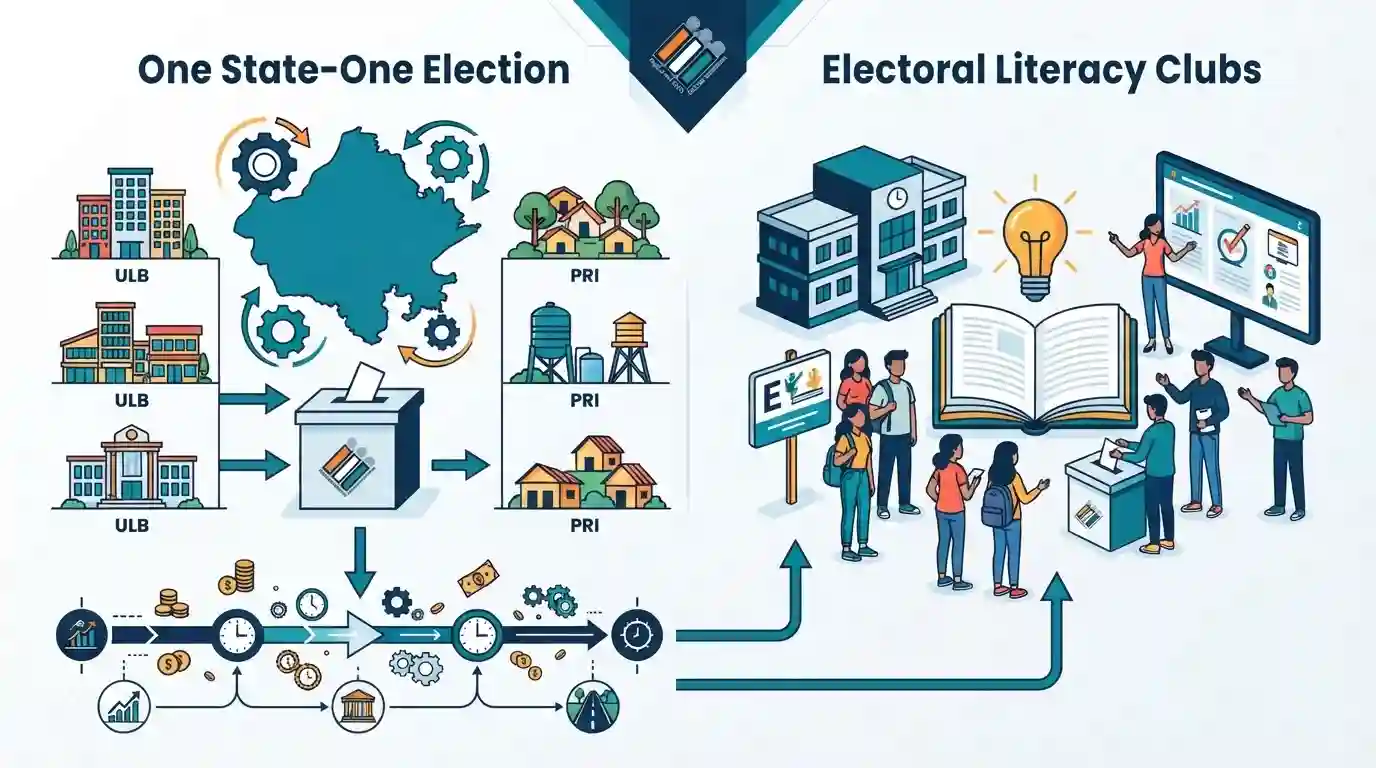
The Rajasthan State Election Commission is pushing for a 'One State-One Election' initiative, advocating for simultaneous polls for all Urban Local Bodies (ULBs) and Panchayati Raj Institutions (PRIs) in the state. State Election Commissioner Rajeshwar Singh highlighted that this move would bring transparency, optimize resources, save money, and ensure uninterrupted execution of developmental schemes. Additionally, the Commission is focusing on youth participation by establishing Electoral Literacy Clubs in colleges to educate and motivate new voters.
Key Points
- Rajasthan is advancing the 'One State-One Election' initiative by proposing simultaneous polls for all Urban Local Bodies (ULBs) and Panchayati Raj Institutions (PRIs).
- State Election Commissioner Rajeshwar Singh emphasized that conducting simultaneous elections will ensure transparency, reduce financial burdens, and lead to better utilization of resources.
- Simultaneous local body polls are expected to reduce disruptions in the implementation of development schemes and minimize voter fatigue.
- The State Election Commission is establishing Electoral Literacy Clubs (ELCs) in colleges to engage young voters aged 18 to 21 and improve the overall voting percentage.
- The article highlights Rajasthan's historical significance as the state where the Panchayati Raj system was first launched in India.
Important Terms
One State-One Election

A proposed electoral reform in Rajasthan aimed at holding simultaneous elections for all Urban Local Bodies and Panchayati Raj Institutions across the state to streamline administration and resource use.
UPSC context
Relevant to GS Paper 2 (Governance/Elections). It tests knowledge of electoral reforms, local governance, and simultaneous election feasibility.
State Election Commission (SEC)
An independent constitutional body established under Articles 243K and 243ZA, responsible for superintending, directing, and controlling the preparation of electoral rolls and conducting elections to local bodies.
UPSC context
Crucial for GS Paper 2 (Constitutional Bodies). Tests the distinction between the ECI and SECs and their respective mandates.
Urban Local Bodies (ULBs)
Constitutionalized through the 74th Amendment Act (Part IX-A), these are local self-governing institutions responsible for the administration, civic amenities, and development of urban areas across India.
UPSC context
Important for GS Paper 2 (Local Self-Government). Tests democratic decentralization, constitutional provisions, and urban governance challenges.
Panchayati Raj Institutions (PRIs)
A three-tier system of rural local self-government in India, granted constitutional status by the 73rd Amendment Act (Part IX), meant to build grassroots democracy and manage rural development.
UPSC context
Essential for GS Paper 2 (Panchayati Raj). Evaluates understanding of decentralized governance, the 11th Schedule, and rural administration.
Electoral Literacy Clubs (ELCs)
Forums established by the Election Commission of India in educational institutions to educate and engage first-time and future voters regarding their electoral rights and the voting process.
UPSC context
Relevant to GS Paper 2 (Statutory/Executive Initiatives). Tests awareness of voter education, SVEEP, and initiatives promoting democratic participation.
Prelims Trap
"The State Election Commissioner is appointed by the Governor and holds office during the pleasure of the Governor."
While appointed by the Governor, the SEC can only be removed in the same manner as a High Court judge (Article 243K). They do not hold office during the Governor's pleasure.
Static Concepts Connected
What is the constitutional mandate and independence of the State Election Commission?
- Exclusive Mandate: The SEC conducts elections exclusively for Panchayats (Art 243K) and Municipalities (Art 243ZA). It does not conduct State Assembly elections.
- Independent Removal: Appointed by the Governor, but functionally independent. Removal requires a process identical to the impeachment of a High Court Judge.
- Distinct from ECI: The SEC operates independently of the Election Commission of India (ECI), which handles Parliament and State Legislature elections under Art 324.
How does the Kovind Panel envision integrating local bodies into 'One Nation, One Election'?
- 100-Day Window: The panel recommended holding local body (ULB and PRI) elections within 100 days of the synchronized Lok Sabha and State Assembly elections.
- Constitutional Amendment: Requires the introduction of a new Article 324A to authorize Parliament to make laws ensuring simultaneous elections for Municipalities and Panchayats.
Cross-Topic Patterns
Simultaneous Polls + Constitutional Amendments
Synchronizing local polls with national/state elections requires amending Art 243E & 243U and ratification by 50% of states, directly linking electoral reforms to federalism and Article 368.
Panchayati Raj Origins + Modern Reforms
Rajasthan (Nagaur, 1959) pioneered the PRI system based on the Balwant Rai Mehta Committee. By pushing for simultaneous local polls, it remains a central case study for democratic decentralization.

Expect a tricky 2026 prelims statement mixing ECI and SEC mandates in the context of the Kovind panel's simultaneous elections report.
Linked PYQs · 2
Linked PYQs · 2
- 2016RPSC_PRELIMSGS1
The State Election Commission of Rajasthan is
- 2023RPSC_PRELIMSGS1
Consider the following statements regarding the State Election Commission of Rajasthan: (i) It was constituted in July 1994 under Article 243 T of the Constitution of India. (ii) It is a one-member commission headed by the State Election Commissioner.
