Rajasthan State Water Plan 2047 Launched to Ensure LongTerm Security
Source:gktoday ↗
Why It Matters
Water scarcity is a defining geographical and economic challenge for Rajasthan. The Rajasthan State Water Plan 2047 represents a massive policy shift toward long-term water security, combining river linking, interstate agreements (Yamuna), and local conservation. It is highly relevant for RPSC RAS Prelims questions targeting state irrigation projects, geography (Shekhawati, Udaipur lakes), and flagship schemes (Atal Bhujal Yojana, Jal Jeevan Mission).
Summary
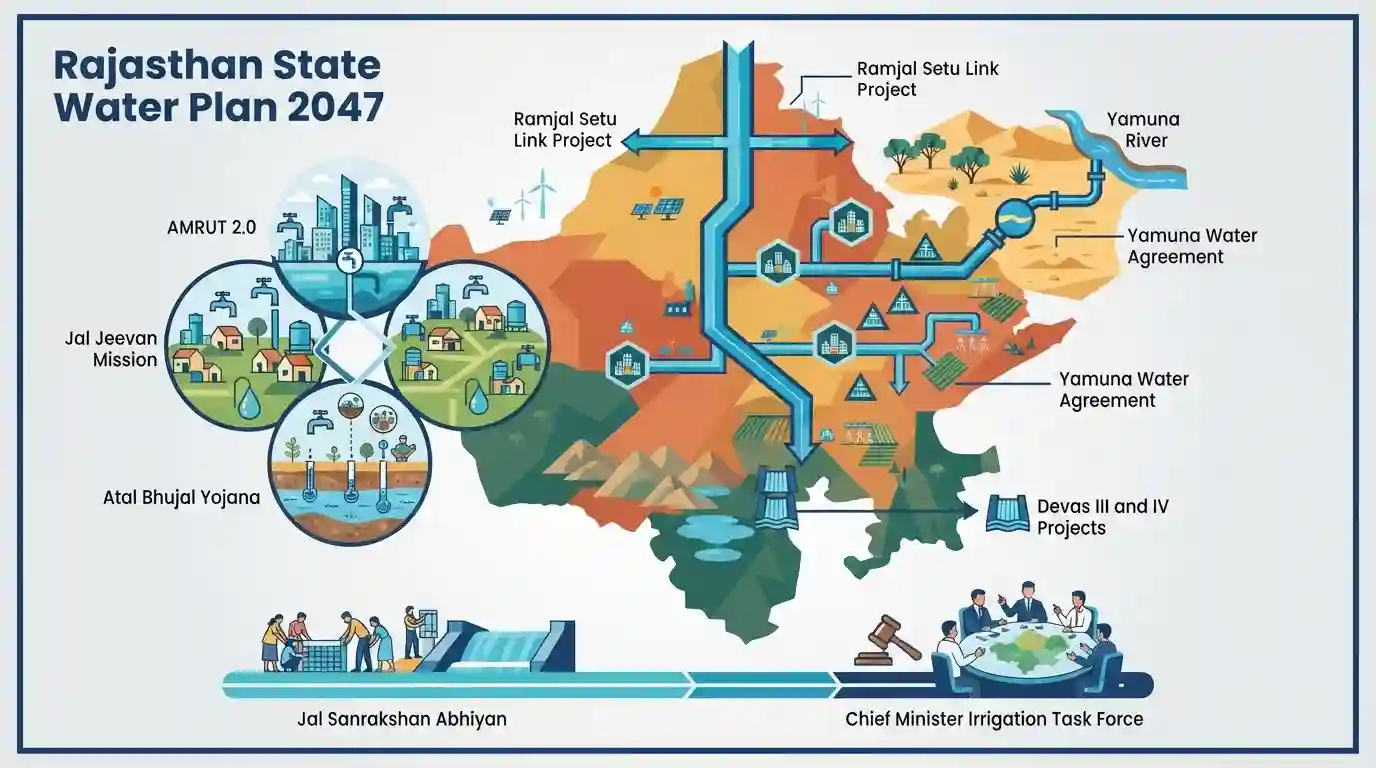
The Government of Rajasthan has launched the 'Rajasthan State Water Plan 2047', a comprehensive long-term strategy to address the state's chronic water scarcity. The plan integrates major infrastructure initiatives like the Ramjal Setu Link Project, which aims to supply drinking water to 17 districts and irrigate 4.84 lakh hectares. It also implements the historic Yamuna Water Agreement to provide water to the arid Shekhawati region. Furthermore, the plan encompasses the Devas III and IV projects for Udaipur, alongside urban and rural water schemes such as AMRUT 2.0, Jal Jeevan Mission, and Atal Bhujal Yojana. A dedicated Jal Sanrakshan Abhiyan and a Chief Minister Irrigation Task Force have been established to monitor and execute these massive conservation and distribution efforts.
Key Points
- Rajasthan launched the 'State Water Plan 2047' to ensure sustainable water availability for drinking and irrigation over the next two decades.
- The Ramjal Setu Link Project will provide drinking water to 17 districts and irrigation to 4.84 lakh hectares of land.
- The Yamuna Water Agreement signed on June 23, 2026, secures 1,917 cusecs of water for the Shekhawati region (Sikar, Jhunjhunu, Churu) via a 295 km pipeline.
- Devas III and Devas IV drinking water projects, costing ₹1,691 crore, have been approved to resolve the drinking water crisis in Udaipur.
- Key rural and urban schemes integrated include AMRUT 2.0 (₹5,100 crore for 178 ULBs), Jal Jeevan Mission, and Atal Bhujal Yojana (₹485 crore completed).
- The Jal Sanrakshan Abhiyan, launched on January 2, 2026, focuses on water conservation with a dedicated budget of ₹500 crore.
Important Terms
Rajasthan State Water Plan 2047

A long-term policy framework launched by Rajasthan in July 2026, aimed at securing future water availability through river-linking, groundwater recharge, and community participation.
UPSC context
GS I (Geography of India) & GS III (Water Resources); tests regional water management strategies and federal planning.
Ramjal Setu Link Project
Previously known as the PKC-ERCP, this interstate river-linking project between Rajasthan and Madhya Pradesh diverts Chambal’s surplus monsoon water to supply drinking water to 17 districts and irrigate 4.84 lakh hectares.
UPSC context
GS I (Geography) & GS III (Infrastructure); tests river interlinking, interstate water disputes, and regional irrigation projects.
Yamuna Water Agreement
A water-sharing arrangement under which 1,917 cusecs of Yamuna water will be supplied through a 295 km pipeline from Haryana to the arid Shekhawati region of Rajasthan.
UPSC context
GS II (Federalism & Interstate Relations) & GS III (Water Security); tests cooperative federalism and river-water sharing.
Devas III drinking water project
Part of the larger Devas water-transfer scheme in Rajasthan, utilizing a tunnel network and dams to divert surface water and address chronic drinking water shortages in Udaipur.
UPSC context
GS I (Resources) & GS III (Water Management); tests local water-supply architecture and river basin diversion projects.
Devas IV drinking water project
An infrastructure initiative paired with Devas III, aimed at constructing dams and transferring surface water to secure long-term drinking water supply and rejuvenate lakes in Udaipur.
UPSC context
GS I (Geography) & GS III (Environmental Conservation); tests urban water-rejuvenation schemes and micro-watershed infrastructure.
AMRUT 2.0
The second phase of the central urban transformation mission targeting universal water supply in statutory towns and promoting the circular economy of water through sewage recycling.
UPSC context
GS II (Government Schemes) & GS III (Urban Infrastructure); tests urban sanitation, water security, and sustainable city planning.
Jal Jeevan Mission
A flagship centrally sponsored scheme under the Ministry of Jal Shakti, aiming to provide functional household tap connections (FHTCs) to all rural households in India, extended to 2028.
UPSC context
GS II (Welfare Schemes & Social Justice) & GS III (Resources); tests rural development, governance, and decentralised water supply.
Atal Bhujal Yojana
A World Bank-assisted Central Sector Scheme focused on improving community-led groundwater management and promoting sustainable water budgeting across identified water-stressed states, including Rajasthan.
UPSC context
GS III (Groundwater Conservation & Agriculture); tests community-led resource management, water budgeting, and sustainable agrarian practices.
Prelims Trap
"Ramjal Setu Link Project transfers surplus Himalayan river water to the arid districts of Rajasthan."
It transfers surplus monsoon water from Vindhyan/Peninsular rivers (Kalisindh, Parbati, Chambal) to water-deficit basins, not from Himalayan rivers.
Static Concepts Connected
What are the core features of the Atal Bhujal Yojana?
- Funding Structure: It is a Central Sector Scheme, but the financial outlay is split 50:50 between the Government of India and the World Bank.
- Demand-Side Focus: It shifts focus from supply-side infrastructure to community-led groundwater management, emphasizing behavioral change and water budgeting.
- Target States: It targets water-stressed areas in 7 states: Gujarat, Haryana, Karnataka, MP, Maharashtra, Rajasthan, and UP.
How is inter-state river water managed constitutionally in India?
- Constitutional Division: Water is under the State List (Entry 17), but regulation of inter-state rivers is under the Union List (Entry 56).
- Article 262: Article 262 empowers Parliament to adjudicate disputes regarding the use, distribution, or control of inter-state river waters.
- ISWD Act 1956: Enacted under Article 262, barring the Supreme Court and other courts from exercising jurisdiction over such water disputes.
Cross-Topic Patterns
Cooperative Federalism in Water Sharing
The Yamuna Water Agreement between Haryana and Rajasthan contrasts with prolonged disputes like Cauvery or SYL, highlighting successful cooperative federalism under Inter-State river sharing frameworks.
Urban Water Security & Climate Adaptation
Udaipur's Devas projects paired with AMRUT 2.0 reflect a broader national policy shift toward climate-proofing Tier-2 city water infrastructure against imminent 'Day Zero' scenarios.

Expect a Prelims question pairing Peninsular river tributaries (Parbati, Kalisindh) with the renamed Ramjal Setu (ERCP) project.
Linked PYQs · 5
Linked PYQs · 5
- 2023RPSC_PRELIMSGS1
Which of the following statements is/are correct regarding the Atal Bhujal Yojana in Rajasthan? (a) The Atal Bhujal Yojana is being run by the Government of Rajasthan with financial assistance from the Government of India. (b) The focus of this scheme is to improve groundwater management and prevent its declining levels.
- 2018RPSC_PRELIMSGS1
In Rajasthan, for the first time, which of the following projects has made sprinkler irrigation mandatory?
- 2012RPSC_PRELIMSGS1
Which of the following is not a correct statement?
- 2021RPSC_PRELIMSGS1
The 'Parwan' multipurpose irrigation project of Rajasthan will provide irrigation facilities to which districts?
- 2023RPSC_PRELIMSGS1
Which of the following is not a part of the Rajasthan Urban Drinking Water, Sewage and Infrastructure Corporation Limited?
