Rajasthan Signs Clean Energy Accord With International Solar Alliance
Source:powerline ↗
Why It Matters
Rajasthan holds the highest solar energy potential and generation capacity in India. This landmark agreement makes Rajasthan the first state to collaborate directly with the ISA under this framework. Features like a digital twin-based pilot project in Ajmer DISCOM and the 2030-35 Energy Transition Plan highlight the integration of emerging technologies (AI, digital twins) into public utilities, which is a major area of focus for RPSC RAS GS/Science & Tech and Economy papers.
Summary
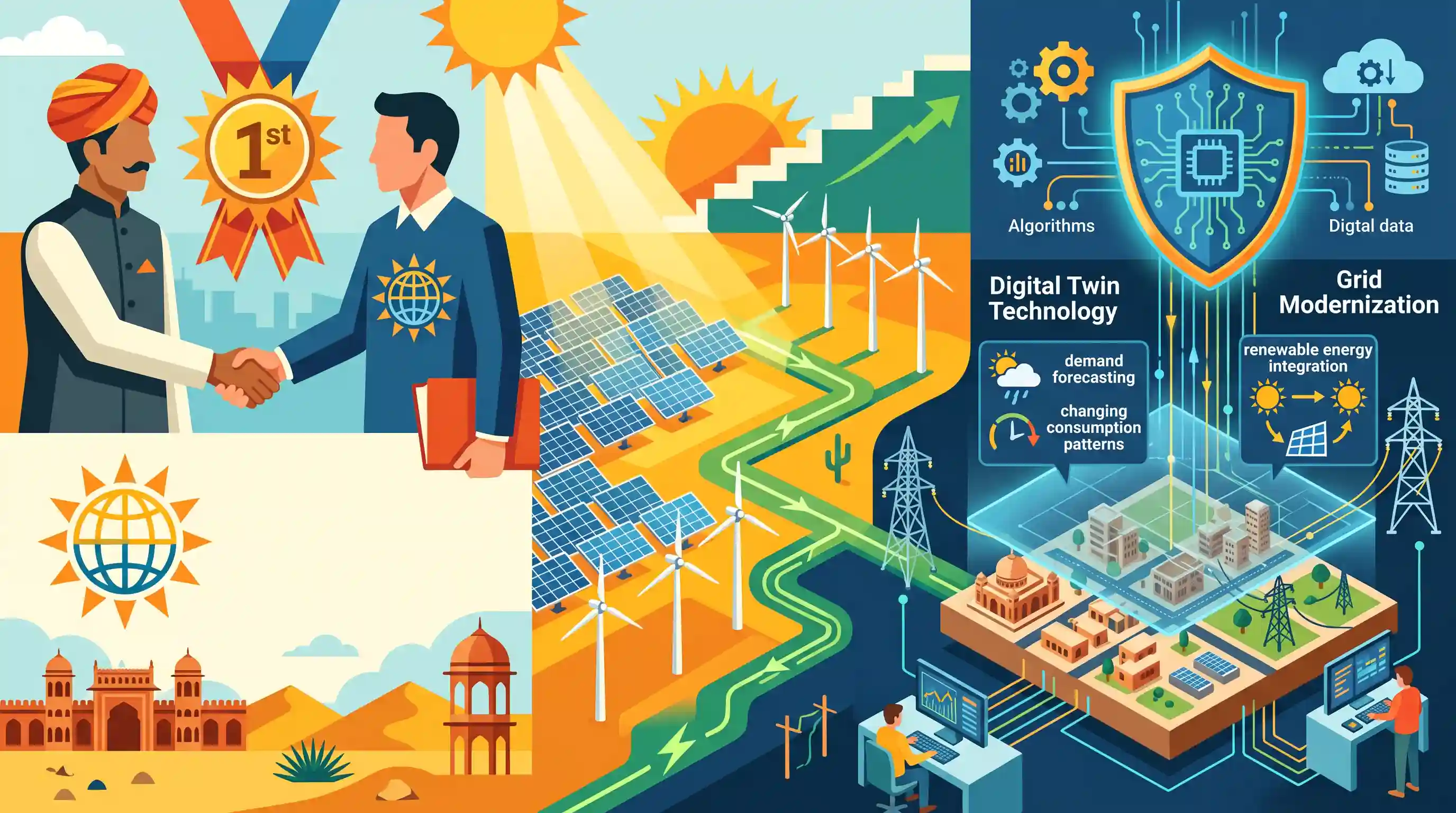
Rajasthan has made history as the first state in India to sign the 'Framework for Action – Advancing Clean Energy, Driven Sustainable Development' with the International Solar Alliance (ISA). The clean energy partnership aims to transition the state toward a cleaner, modern, and future-ready energy system. It outlines the preparation of Rajasthan's Energy Transition Plan for 2030-35, the implementation of AI and digital technologies, and a pioneering digital twin-based pilot project in the Ajmer DISCOM to optimize electricity demand forecasting and renewable energy integration.
Key Points
- First State to Sign: Rajasthan has become the first state in India to sign the 'Framework for Action – Advancing Clean Energy, Driven Sustainable Development' with the International Solar Alliance (ISA).
- Energy Transition Plan 2030-35: Under the framework, Rajasthan will prepare an Energy Transition Plan for the years 2030-35, focusing on renewable energy expansion, transmission and distribution strengthening, grid modernization, energy storage, energy efficiency, demand-side management, investment planning, and policy reforms.
- Digital Twin Pilot: A cutting-edge digital twin-based pilot project will be launched in the Ajmer distribution utility (Ajmer DISCOM) to improve electricity demand forecasting, network planning, and renewable energy integration.
- Capacity Building: The partnership will leverage artificial intelligence (AI) and digital technologies for power planning, alongside facilitating training and capacity building for state engineers and power sector officials.
Important Terms
International Solar Alliance (ISA)

An India-led treaty-based intergovernmental coalition of solar-resource-rich countries, launched at COP21, aimed at accelerating solar energy deployment to combat climate change and ensure global energy security.
UPSC context
Crucial for GS Paper II (Global Groupings) and GS Paper III (Renewable Energy and Climate Change).
Framework for Action – Advancing Clean Energy, Driven Sustainable Development
A landmark clean energy agreement signed between Rajasthan and the ISA to accelerate grid modernization, prepare a 2030-35 transition plan, and implement AI-enabled technologies.
UPSC context
Relevant for GS Paper III (Renewable Energy transition, infrastructure planning, and environment).
Digital Twin Technology
A virtual, real-time replica of a physical system or process that uses data from sensors, AI, and IoT to simulate, monitor, and optimize physical counterparts.
UPSC context
Relevant for GS Paper III (Science & Technology applications, infrastructure development, and Smart Grids).
PM-KUSUM Scheme
A flagship Central scheme launched in 2019 to solarize India's agricultural sector, reduce diesel dependence, and provide farmers with reliable daytime power and additional income.
UPSC context
Important for GS Paper III (Agriculture, Government Schemes, and Renewable Energy).
Ajmer Vidyut Vitran Nigam Limited (AVVNL)
A state government-owned power distribution company (DISCOM) in Rajasthan, established in 2000, responsible for electricity supply across eleven districts and piloting power grid digitization.
UPSC context
Relevant for GS Paper III (Infrastructure: Energy, and Power Sector Reforms).
Prelims Trap
The International Solar Alliance can only sign bilateral agreements and frameworks with sovereign member nations, not sub-national state governments.
Rajasthan has become the first Indian state to sign a bilateral framework with ISA, proving that sub-national entities can directly partner for transition planning.
Static Concepts Connected
What is the International Solar Alliance (ISA) and its 'Towards 1000' strategy?
- Genesis and HQ: Launched jointly by India and France at COP21 (2015); headquartered in Gurugram, India, as an intergovernmental treaty-based organization.
- Towards 1000 Strategy: Targets mobilizing USD 1,000 billion in investments, providing energy access to 1,000 million people, and installing 1,000 GW of solar capacity by 2030.
- Membership Scope: Membership is open to all member states of the United Nations, extending beyond the tropical zones originally targeted.
What are the three components of the PM-KUSUM scheme?
- Component A: Focuses on setting up 10,000 MW of decentralized, grid-connected solar or other renewable power plants (0.5 to 2 MW) on barren/fallow land.
- Component B: Aims at installing 17.50 lakh standalone solar-powered agriculture pumps to replace diesel pumps in off-grid areas.
- Component C: Envisages solarization of 15 lakh grid-connected agriculture pumps, including feeder-level solarization, allowing farmers to sell surplus power to DISCOMs.
Cross-Topic Patterns
Para-diplomacy in global climate action
Indian states directly partnering with international treaty bodies like ISA showcases 'para-diplomacy', allowing sub-national actors to drive localized climate adaptation and green funding.
Digital twins and DISCOM viability
Integrating AI and digital twin tech directly tackles technical bottlenecks of DISCOMs, improving demand forecasting and smoothing intermittent renewable power injection to reduce losses.

Sub-national climate governance and ISA's direct framework partnerships with Indian states are highly likely UPSC 2026 Prelims targets.
Linked PYQs · 3
Linked PYQs · 3
- 2021RPSC_PRELIMSGS1
In which year was the Rajasthan Solar Energy Policy announced?
- 2023RPSC_PRELIMSGS1
Which agency has been given the responsibility of implementing the PM-KUSUM scheme (Component A) in Rajasthan, which involves the establishment of solar power plants with a capacity of 0.5 MW to 2 MW?
- 2012RPSC_PRELIMSGS1
The first solar energy policy was announced by the Government of Rajasthan in -
