Rajasthan Sets 2027 Target for Power Self Reliance
Source:punjabkesari ↗
Why It Matters
Rajasthan's transition to a self-reliant energy producer and its leadership in solar and agricultural solarisation are critical focus areas for RPSC RAS examinations. Past papers highlight a strong focus on solar energy policies, implementing agencies (like RRECL), flagship projects (such as the first KUSUM plant in Bhaloji), and state-level discom reforms. Factual parameters such as the 2027 self-reliance deadline, daytime power supply coverage (26 districts), and thermal peak statistics are highly testable in RPSC Prelims.
Summary
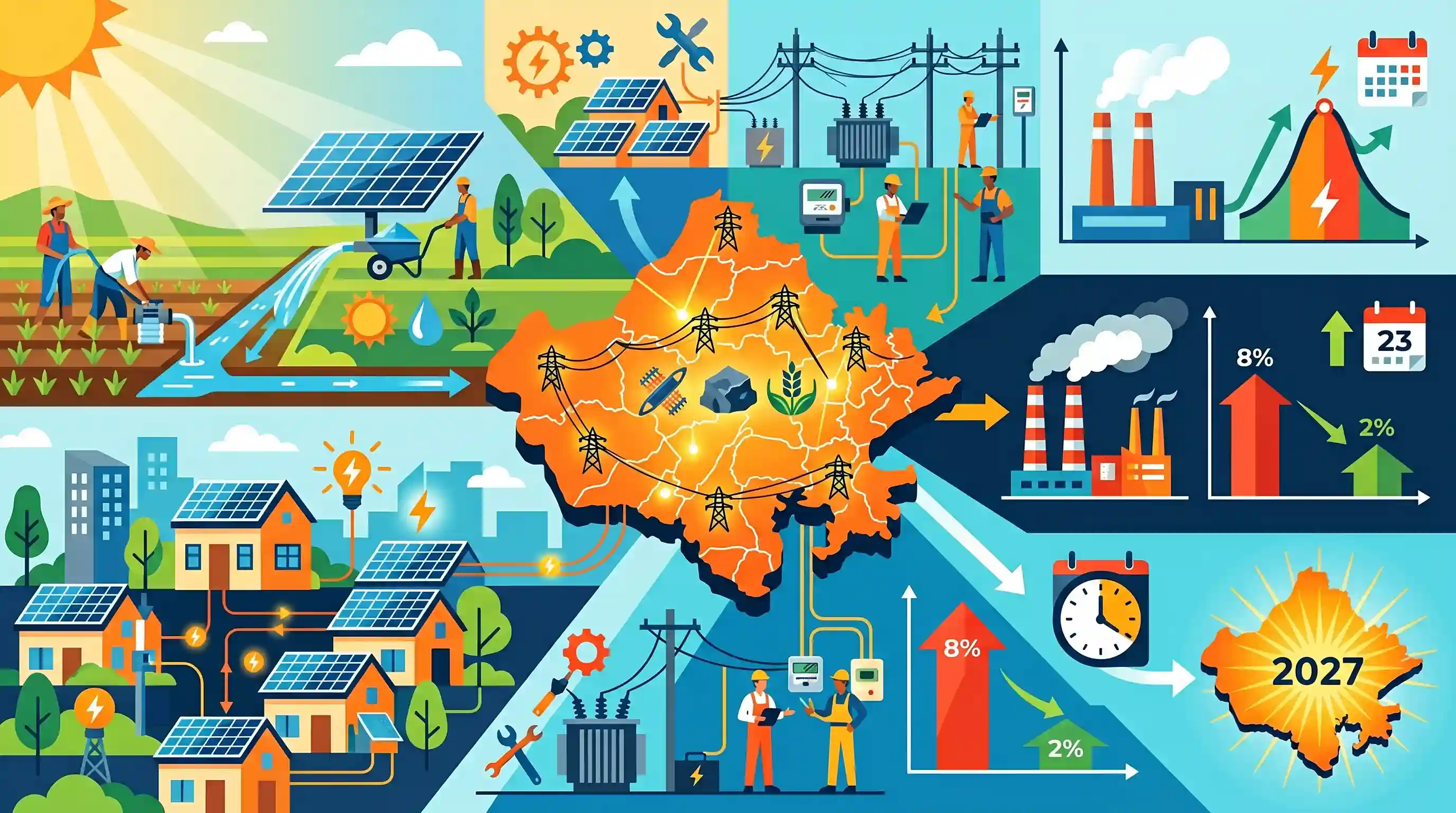
Rajasthan Chief Minister Bhajan Lal Sharma has urged the state's Energy Department to formulate a robust strategy to achieve power self-reliance by 2027. Key directives focus on extending daytime electricity to farmers across all districts (currently operational in 26 districts), leveraging the potential of PM-KUSUM and PM Surya Ghar schemes, and completing infrastructural works under the Revamped Distribution Sector Scheme (RDSS) in Jodhpur DISCOM. Additionally, the state achieved a peak thermal power generation of 7,171 MW on June 2, 2026, and significantly lowered external electricity purchases from 8% in May 2025 to 2% in May 2026.
Key Points
- Rajasthan Chief Minister Bhajan Lal Sharma has set a strict target to make the state self-reliant in the power sector by 2027.
- Daytime power supply for agricultural consumers has been implemented in 26 districts of Rajasthan, with directives to expand it to the remaining districts.
- The state is prioritizing the execution of central solar programs like the PM-KUSUM Scheme and the PM Surya Ghar Scheme to facilitate decentralised power generation.
- Infrastructural improvements under the Revamped Distribution Sector Scheme (RDSS) within Jodhpur DISCOM, including line strengthening and meter installations, are being expedited.
- On June 2, 2026, Rajasthan's thermal power stations achieved a record-high electricity generation of 7,171 MW.
- The reliance on buying electricity from external sources was drastically reduced from 8% in May 2025 to just 2% in May 2026.
Important Terms
PM-KUSUM Scheme

A central government scheme launched in 2019 to provide solar energy and water security to farmers, featuring standalone solar pumps, solarized agricultural feeders, and grid-connected solar plants.
UPSC context
GS Paper III (Agriculture & Infrastructure); tests understanding of rural de-dieselization and decentralized renewable energy transition policies.
PM Surya Ghar: Muft Bijli Yojana
A central rooftop solar scheme launched in February 2024 to provide up to 300 units of free monthly electricity to one crore households via subsidies for installing rooftop solar panels.
UPSC context
GS Paper III (Infrastructure & Renewable Energy); tests knowledge of household clean energy adoption and subsidy systems in governance.
Revamped Distribution Sector Scheme (RDSS)
A reforms-based, results-linked central scheme launched in 2021 to improve the operational efficiency and financial sustainability of distribution companies (DISCOMs) through smart metering and grid upgrades.
UPSC context
GS Paper III (Infrastructure & Energy); tests understanding of structural reforms, smart grid transition, and financial health of state DISCOMs.
Rajasthan Renewable Energy Corporation Limited (RRECL)
The state-level nodal agency in Rajasthan tasked with promoting, formulating, and facilitating renewable energy projects, energy conservation, and non-conventional energy initiatives.
UPSC context
GS Paper III (Energy Transitions); tests knowledge of state-level institutional frameworks implementing green power and solar-wind hybrid projects.
Prelims Trap
Component-A of the PM-KUSUM scheme provides direct capital subsidies to farmers for installing standalone solar agricultural pumps.
Standalone pumps are covered under Component-B. Component-A is strictly for grid-connected, ground-mounted renewable power plants (0.5–2 MW) set up on fallow land.
Static Concepts Connected
What is PM-KUSUM and how are its three operational components divided?
- Component-A: Decentralized, grid-connected solar power plants (0.5 to 2 MW) set up by farmers on barren/fallow land.
- Component-B: Installation of standalone solar agriculture pumps to replace diesel-powered pumps in off-grid areas.
- Component-C: Solarisation of existing grid-connected agriculture pumps, allowing farmers to sell surplus power to DISCOMs.
What are the core metrics and objectives under the Revamped Distribution Sector Scheme (RDSS)?
- AT&C Losses: Targeting a reduction in Aggregate Technical & Commercial losses to 12–15% at the pan-India level.
- ACS-ARR Gap: Aiming to eliminate the gap between the Average Cost of Supply and Average Revenue Realised.
- Smart Metering: Mandating prepaid smart metering for consumers and system-level metering at feeders to check power theft.
Cross-Topic Patterns
Federal Subsidies + DISCOM Fiscal Health
Merging state-level free electricity schemes with central rooftop programs (PM Surya Ghar) acts as a fiscal stabilizer, lowering the financial burden on state-owned DISCOMs.
Solar Energy + Ground Water Conservation
Solarizing agricultural feeders (PM-KUSUM Component-C) discourages excessive nighttime pumping, aligning renewable targets with sustainable water table management in arid regions.

Comparative assessments of RDSS efficiency targets and PM-KUSUM component designs will likely feature as a multi-statement MCQ in 2026.
Linked PYQs · 4
Linked PYQs · 4
- 2023RPSC_PRELIMSGS1
Which agency has been given the responsibility of implementing the PM-KUSUM scheme (Component A) in Rajasthan, which involves the establishment of solar power plants with a capacity of 0.5 MW to 2 MW?
- 2021RPSC_PRELIMSGS1
In which village of Rajasthan was India's first agriculture-based “KUSUM” solar energy plant project launched?
- 2025RPSC_PRELIMSGS1
Which of the following statements are correct with respect to the PM Surya Ghar Free Electricity Scheme? (i) Under this scheme, solar plants will be installed on one crore houses to provide free electricity up to 300 units per month. (ii) Provision of 30% subsidy for installing rooftop solar plants (iii) 100% online system for registration, application, approval and grant (iv) Provision of lending to each applicant at a bank interest rate of 4%
- 2024RPSC_PRELIMSGS1
Which of the following statements about Rajasthan Multi Bijli Yojana is/are correct? A. Provide plants on one side to provide 100 solar plants. B. Subsidy for setting up rooftop solar panels. C. Provision of loan at book interest.
