Rajasthan Targets Export Growth Through Dedicated Textile Cell
Source:the-buckstopper ↗
Why It Matters
Understanding sectoral contributions to Rajasthan's exports and regional production capabilities (like wool and cotton rankings) is highly relevant for RPSC RAS Prelims and Mains. Specific policies like RIPS, RIPS thrust sectors, and government initiatives targeting exporters (similar to 'Mission Niryatak Bano') are frequent topics of examination.
Summary
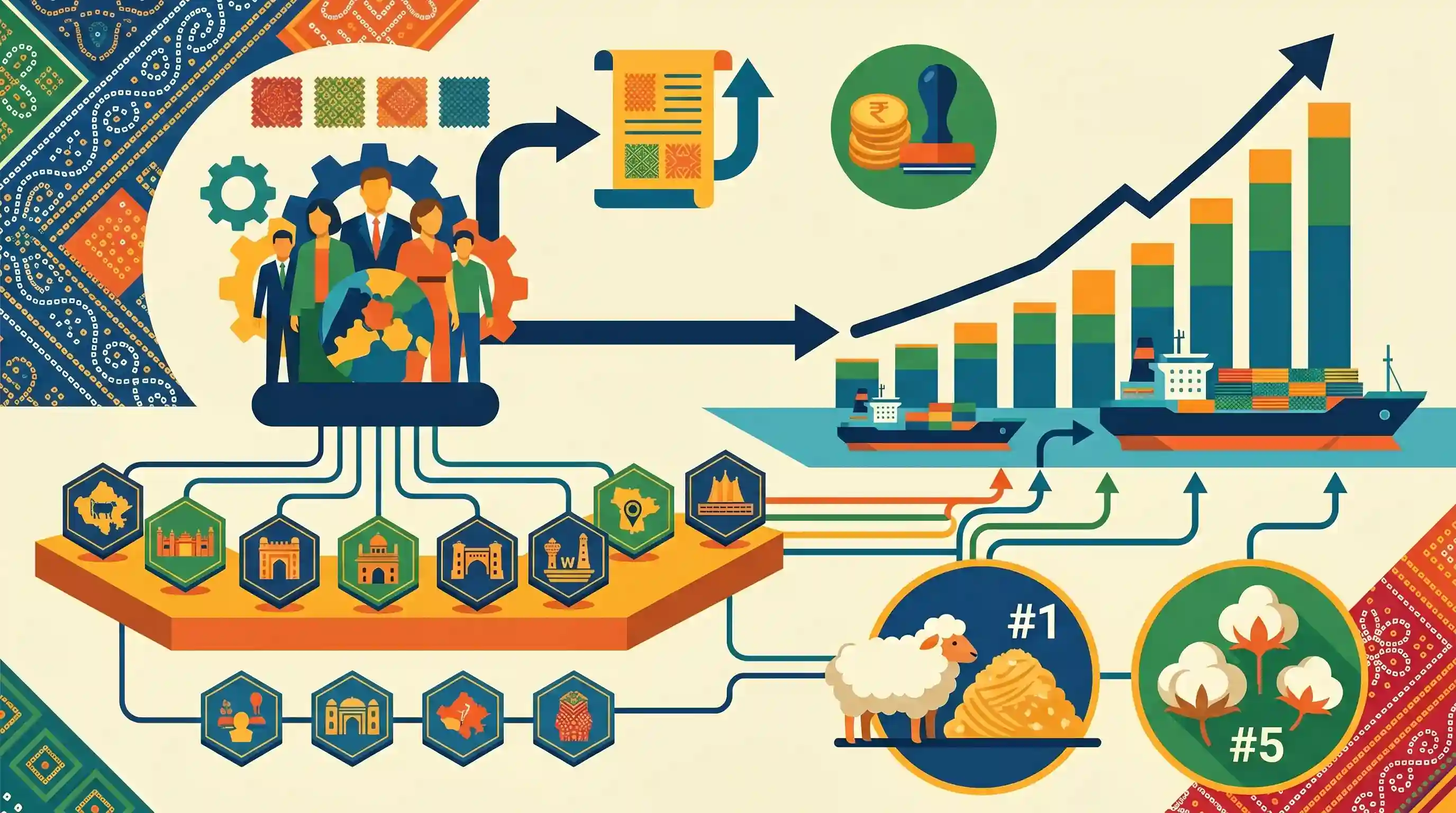
The Rajasthan government has created a state-level Textile Cell to drive industrial growth and boost textile exports. Working under the Industry and Commerce Department, the cell will execute the 'Rajasthan Textile and Apparel Policy-2025', capitalize on the 'thrust area' incentives under the Rajasthan Investment Promotion Scheme (RIPS), and target a 3-to-4-fold increase in the state's textile exports (which currently stand at Rs 13,500 crore, making up over 13% of total state exports). Strategic export plans have been customized for 11 districts—classified into 7 Champion and 4 Aspirational districts—to fully leverage Rajasthan's top ranking in wool production (47% national share) and 5th ranking in cotton production.
Key Points
- Rajasthan government has established a dedicated state-level Textile Cell to promote the textile industry and scale up its exports.
- The primary objective of the Textile Cell is the effective implementation of the 'Rajasthan Textile and Apparel Policy-2025'. Under the Rajasthan Investment Promotion Scheme (RIPS), textiles have been declared a 'thrust area' to extend additional incentives.
- Rajasthan's total exports stood at over Rs 97,171 crore in 2024-25, with textiles and apparel accounting for around Rs 13,500 crore (more than 13% of total exports). The state aims to boost textile exports by 3 to 4 times.
- The state is a critical source of raw materials: Rajasthan tops India in wool production (contributing about 47% of national output) and ranks 5th nationally in cotton production. It currently has over 1,800 textile and apparel units.
- Textile export plans have been crafted for 11 targeted districts. This includes 7 'Champion Districts' (Ajmer, Bhilwara, Jaipur, Banswara, Chittorgarh, Jodhpur, Kota) and 4 'Aspirational Districts' (SriGanganagar, Hanumangarh, Nagaur, Churu).
- The state plans to host a major two-day Textile Summit in October 2026 to showcase its potential to national and international trade stakeholders.
Important Terms
Rajasthan Textile and Apparel Policy-2025

A state policy to establish Rajasthan as a modern manufacturing hub by offering asset creation incentives, promoting eco-friendly operations, and expanding coverage to the garment and technical textile sectors.
UPSC context
GS Paper III (Industrial Policy, Manufacturing). Tests state-level sectoral interventions, export promotion, and regional manufacturing policies.
Rajasthan Investment Promotion Scheme (RIPS)
Rajasthan's flagship investment promotion program providing fiscal benefits, tax/duty exemptions, interest subvention, and capital subsidies to attract global and domestic enterprises across focus sectors.
UPSC context
GS Paper III (Investment Models, Industrial Growth). Tests mechanisms for attracting capital, ease of doing business, and state-led economic growth.
District Export Plans
Comprehensive local action plans under the Central 'Districts as Export Hubs' initiative designed to identify specific local products, improve supply chains, resolve bottlenecks, and integrate grassroots manufacturing into global markets.
UPSC context
GS Paper III (Economic Growth, Resource Mobilization). Tests decentralized economic planning, MSME integration, and geographically balanced trade development.
Mission Become an Exporter
Also known as 'Mission Niryatak Bano,' this campaign provides local traders and homemakers a six-step process of training, documentation, and handholding to register and participate in international trade from Rajasthan.
UPSC context
GS Paper III (Industrial Policy, Employment). Tests grassroots trade enablement, state-led entrepreneurship initiatives, and capacity building for MSMEs.
Department of Industries and Commerce (Government of Rajasthan)
The state government's nodal administrative body responsible for industrial growth, enforcing MSME and sector policies, facilitating investments, and boosting the overall ease of doing business.
UPSC context
GS Paper III (Economic Development, Infrastructure). Tests the institutional framework, governance models, and administrative policies for regional industrialization.
Prelims Trap
Himalayan states like Jammu and Kashmir or Himachal Pradesh lead India's wool production due to their cold climates and sheep-rearing traditions.
Rajasthan actually dominates national wool production, accounting for nearly 48% of India's total output, driven by its robust pastoralist economy in arid regions.
Static Concepts Connected
What is the 'Districts as Export Hubs' initiative?
- Institutional framework: Jointly run by DGFT and State/UT governments to identify and mobilize export-worthy products at the grassroots level.
- Decentralized planning: Formulates specific plans for each district to address infrastructure bottlenecks, support MSMEs, and scale local exports.
What are the core geographical requirements for cotton cultivation?
- Climatic conditions: Requires warm, dry weather, 21°C to 30°C temperatures, and at least 210 frost-free days during its growing period.
- Soil and water: Thrives in deep black clayey soil (Regur) of the Deccan, but also grows well in irrigated alluvial soils of North-West India.
Cross-Topic Patterns
Arid geography and cash crops
Rajasthan's high cotton yield demonstrates how canal irrigation networks like the Indira Gandhi Canal can transform desert soils into high-yield commercial crop zones.
Decentralized trade federalism
State investment policies aligning with the central 'Districts as Export Hubs' illustrate a shift where states compete and collaborate to drive India's external trade.

UPSC may combine agricultural geography of commercial crops with decentralized trade initiatives like 'Districts as Export Hubs' in 2026.
Linked PYQs · 3
Linked PYQs · 3
- 2021RPSC_PRELIMSGS1
’Mission Become an Exporter’ has been initiated for people aspiring to become exporters
- 2024RPSC_PRELIMSGS1
In Rajasthan's Gross Fixed Capital Formation of 2022-23, what is the order in which sectors are arranged from highest to lowest share? A. Construction B. Transport C. Agriculture D. Manufacturing
- 2025RPSC_PRELIMSGS1
The correct order of decreasing contribution of different sectors in Rajasthan’s Gross Fixed Capital Formation is
