Save Aravalli Hills Protests and Illegal Mining in Rajasthan
Source:Indian Express ↗
Why It Matters
The issue provides a real-world case study of the environmental and political consequences of illegal mining. It is highly relevant for GS-3 (Environmental Degradation and Mining Hazards) and GS-1 (Geography, specifically the role of natural barriers in preventing desertification).
Summary
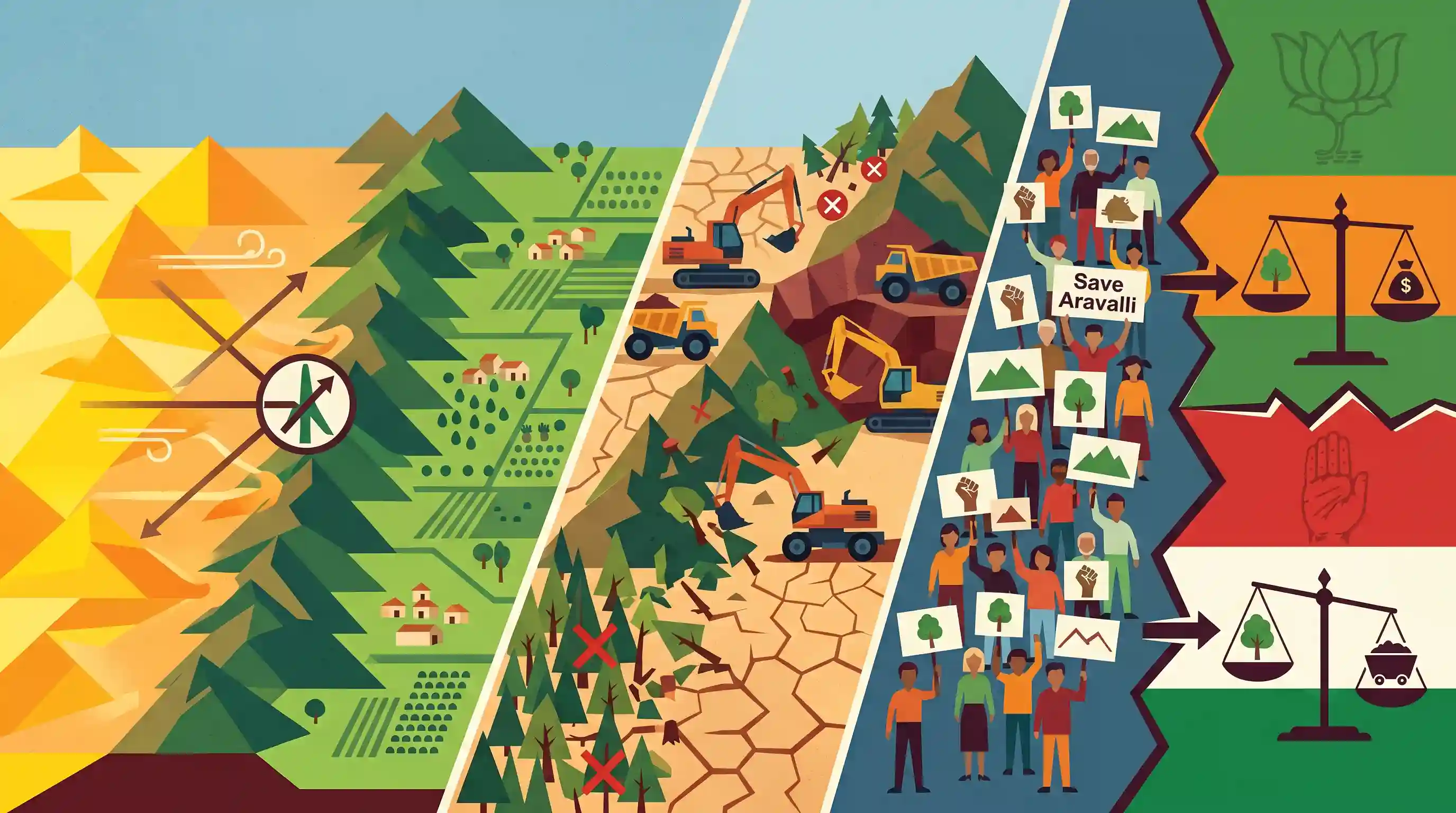
The 'Save Aravalli Hills' protests in Rajasthan have emerged as a significant environmental and political flashpoint, intensifying the rivalry between the BJP and the Congress. The agitation is driven by widespread concern over the ecological destruction of the Aravalli range—the oldest fold mountains in India—due to unchecked illegal mining and deforestation. Because the Aravallis serve as a crucial geographical barrier preventing the eastward expansion of the Thar Desert, their degradation poses severe risks of desertification and climate disruption. Politically, the mobilization is forcing both major parties to navigate complex governance challenges, pitting public demands for conservation against entrenched mining interests.
Key Points
- The 'Save Aravalli Hills' agitation has gained momentum in Rajasthan, highlighting the severe ecological degradation of one of India's oldest mountain ranges.
- Rampant illegal mining and deforestation are the primary threats to the Aravallis, compromising their role as a natural barrier against the eastward expansion of the Thar Desert.
- The environmental protests have evolved into a major political flashpoint, intensifying the blame game between the ruling BJP and the opposition Congress.
- The issue underscores the critical governance challenge of curbing powerful mining mafias while addressing civil society demands for ecological conservation.
Important Terms
Aravalli Range

India's oldest fold mountain system stretching from Gujarat to Delhi, acting as a natural ecological barrier against desertification and a primary source of groundwater recharge for North India.
UPSC context
GS Paper I (Geography) and GS III (Environment). Tests knowledge of Indian physiography and the ecological significance of natural barriers.
Fold Mountains
Landforms created by the buckling and folding of the Earth's crust due to tectonic plate collisions; categorized as 'young' (Himalayas) or 'old' (Aravallis) based on geological age.
UPSC context
GS Paper I (Physical Geography). Essential for understanding geomorphic processes, plate tectonics, and the distinction between young and old ranges.
Desertification
A process of land degradation in arid and semi-arid areas, resulting from climatic variations and human activities like deforestation, causing fertile land to lose its productivity.
UPSC context
GS Paper I and GS III. Relevant to topics on land degradation, UNCCD commitments, and sustainable land management.
Thar Desert
A vast arid region in northwestern India and eastern Pakistan, characterized by shifting sand dunes and extreme temperatures, bounded on the southeast by the Aravalli Range.
UPSC context
GS Paper I (Geography). Key for studying Indian climatic zones, desert formation, and the impact of topography on monsoon patterns.
Illegal Mining
Mineral extraction conducted without legal authorization, which in the Aravallis has led to the disappearance of hillocks, groundwater depletion, and severe ecological degradation.
UPSC context
GS Paper III (Environment & Governance). Tests understanding of resource governance, judicial interventions (Supreme Court), and environmental impact assessments.
Aravalli Green Wall Project
A multi-state initiative to create a 5-km wide green buffer zone around the Aravalli range to restore degraded land and check the eastward expansion of the Thar Desert.
UPSC context
GS Paper III (Environment). Important for initiatives to combat climate change and fulfill India's land degradation neutrality targets by 2030.
Prelims Trap
"The Aravalli Range is a young fold mountain system confined entirely to the state of Rajasthan."
Aravallis are highly eroded relict (old) fold mountains, not young, and they span four states/UTs—Gujarat, Rajasthan, Haryana, and Delhi.
Static Concepts Connected
What is the geological nature and geographical extent of the Aravalli Range?
- Relict Mountains: They are one of the world's oldest fold mountains, formed in the Precambrian era, now heavily eroded and classified as relict or residual mountains.
- Geographical Extent: The range runs approximately 692 km diagonally from Palanpur (Gujarat) through Rajasthan and Haryana to Raisina Hill (Delhi).
- Highest Peak: Guru Shikhar (1,722m) in Mount Abu, Rajasthan, is the highest peak of this mountain system.
What is the Aravalli Green Wall Project?
- Core Objective: A nature-based policy initiative creating a 5-km wide continuous afforestation buffer along the Aravalli range to halt the eastward expansion of the Thar Desert.
- African Inspiration: It is directly modeled after the 'Great Green Wall' of Africa in the Sahel region, which aims to combat land degradation and desertification.
- Coverage and Scope: It involves ecological restoration of degraded wastelands across Gujarat, Rajasthan, Haryana, and Delhi, focusing on native tree species and groundwater recharge.
Cross-Topic Patterns
Aravalli degradation and NCR air quality
The destruction of the Aravalli barrier accelerates wind-blown sand transport, directly worsening winter dust pollution and particulate matter (PM10/PM2.5) concentrations in the National Capital Region (NCR).
Judicial intervention in mining regulation
The Supreme Court's mandate defining Aravalli landforms and pausing mining leases mirrors its earlier environmental interventions in Goa and Karnataka to curb rampant illegal iron ore mining.

Expect a multi-statement Prelims question linking the Aravalli Green Wall Project's geographical coverage to UNCCD targets.
Linked PYQs · 3
Linked PYQs · 3
- 2025MainsGS3
Mineral resources are fundamental to the country's economy and these are exploited by mining. Why is mining considered an environmental hazard? Explain the remedial measures required to reduce the environmental hazard due to mining.
- 2013MainsGS3
What are the consequences of Illegal mining ? Discuss the Ministry of Environment and Forests' concept of GO AND NO GO zones for coal mining sector.
- 2020MainsGS1
The process of desertification does not have climatic boundaries. Justify with examples.
