Sanitation Workers Strike Disrupts Municipal Services in Rajasthan
Source:outlook-india ↗
Why It Matters
The strike underscores key challenges in urban governance, solid waste management, and the welfare of marginalized communities traditionally employed in sanitation. This aligns with RPSC syllabus topics on local self-government, administrative reforms, and state-specific municipal legislation such as the Rajasthan Municipal Act.
Summary
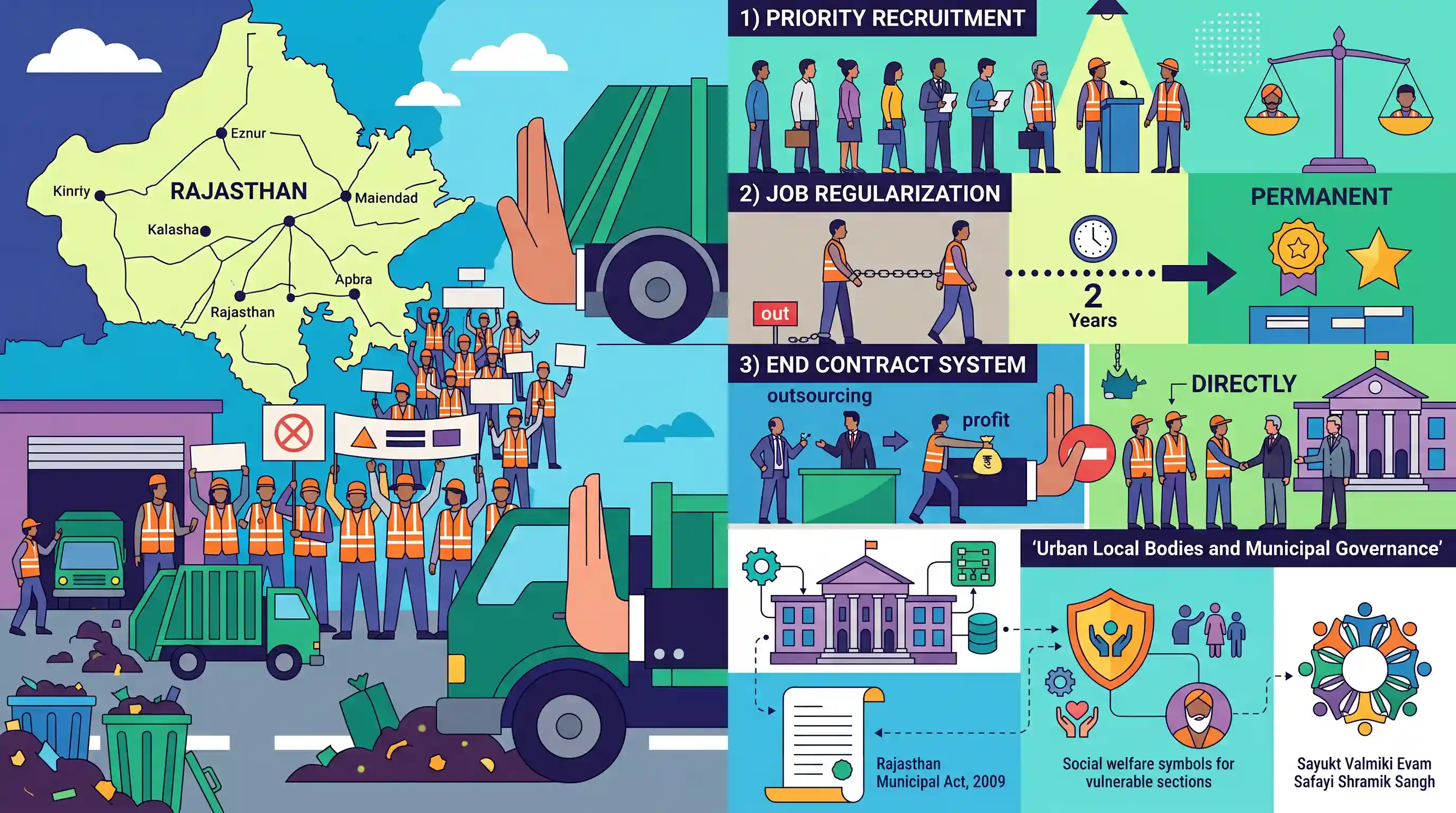
A statewide strike by Valmiki sanitation workers in Rajasthan disrupted solid waste collection in major cities, including Jaipur. Organized by the Sayukt Valmiki Evam Safayi Shramik Sangh, the workers are demanding priority recruitment for the Valmiki community, regularization after two years, and the elimination of contract/outsourcing systems in municipal sanitation.
Key Points
- Valmiki sanitation workers launched a statewide strike in Rajasthan, disrupting municipal waste collection and leading to garbage accumulation in major cities including Jaipur.
- The strike is spearheaded by the Sayukt Valmiki Evam Safayi Shramik Sangh, led by Nandkishore Dandoriya, demanding regularization of workers, the abolition of the contract/outsourcing system, and priority recruitment for traditional Valmiki community members.
- There is a division within the community; worker leader Pawan Choudhary opposed the work boycott, advocating for continued cooperation with the administration while pushing the government to complete recruitment via legal procedures.
- Director of Local Bodies Juikar Pratik Chandrashekhar confirmed that dialogue is underway to resolve the issues and that the formal recruitment process has already been initiated.
Important Terms
Rajasthan Municipal Act, 2009

The primary state legislation governing the establishment, composition, powers, and administrative procedures of Urban Local Bodies (such as Municipal Corporations, Councils, and Boards) across Rajasthan.
UPSC context
GS Paper II: Local self-government. Tests knowledge of statutory frameworks for decentralized urban administration.
Sayukt Valmiki Evam Safayi Shramik Sangh
An influential labor union in Rajasthan representing traditional Valmiki community sanitation workers, advocating for direct recruitment priority, regularization, and the elimination of contract-based outsourcing systems.
UPSC context
GS Paper II: Pressure groups and vulnerable sections. Tests collective bargaining and caste-associated labor issues.
Directorate of Local Bodies, Rajasthan
The executive arm of Rajasthan's Department of Local Self Government, responsible for monitoring, administering, and coordinating day-to-day operations and welfare programs across the state's 309 urban local bodies.
UPSC context
GS Paper II: Urban administration. Tests the administrative dynamics between state authorities and decentralized local governments.
Prelims Trap
The PEMSR Act, 2013 completely outlaws all forms of manual municipal solid waste handling and sweeping.
The Act specifically targets manual scavenging (handling human excreta) and hazardous, unprotected sewer/septic tank cleaning. It does not outlaw regular municipal sweepers or manual dry-waste collection.
Static Concepts Connected
What is the constitutional and statutory framework protecting sanitation workers in India?
- Constitutional backing: Article 17 (Abolition of Untouchability) and Article 21 (Right to Life with Dignity) form the bedrock of judicial protection.
- Statutory ban: The PEMSR Act, 2013 prohibits manual scavenging and hazardous, unprotected sewer/septic tank cleaning, making violations cognizable and non-bailable.
- Judicial precedent: In Safai Karamchari Andolan v. Union of India (2014), the court ordered complete eradication of manual scavenging and mandatory compensation for sewer deaths.
How does the 74th Amendment handle municipal sanitation?
- Twelfth Schedule devolution: Public health, sanitation, conservancy, and solid waste management are devolved to ULBs under Entry 6 of the Twelfth Schedule.
- Administrative bottlenecks: Despite legislative devolution, ULBs struggle with a lack of independent revenue-raising powers, resulting in high rates of contractual labor outsourcing.
Cross-Topic Patterns
ULB fiscal deficit & sanitation contract traps
The trend of outsourcing sanitation highlights the structural underfunding of Urban Local Bodies (ULBs) under the 74th Amendment, forcing a reliance on precarious contractual labor.
Caste-based labor vs. mechanized sanitation
Linking the rehabilitation of traditional sanitation communities to schemes like the NAMASTE scheme, transforming hazardous manual work into dignified, mechanized municipal jobs.

Mains 2026 may link municipal fiscal stress with the rising labor protests and socio-economic rights of contractual sanitation workers.
Linked PYQs · 2
Linked PYQs · 2
- 2021RPSC_PRELIMSGS1
According to the provisions of the Rajasthan Municipal Act, 2009, what is the maximum number of persons that the State Government can nominate in a Municipal Council?
- 2023RPSC_PRELIMSGS1
Which of the following is not a part of the Rajasthan Urban Drinking Water, Sewage and Infrastructure Corporation Limited?
