Pali Girl Breaks Tradition to Become First Female Royal Lineage Heir
Source:indiatoday ↗
Why It Matters
This event is a landmark example of social reform within traditional Rajput communities in Rajasthan, demonstrating the modernization of age-old customs to incorporate gender equality. For RPSC RAS, understanding local cultural customs (like Paag Ka Dastoor), historical forts (such as Kherwa Fort in Pali), and regional textile colors is highly relevant as these frequently feature in the Art and Culture syllabus of the State Services Examination.
Summary
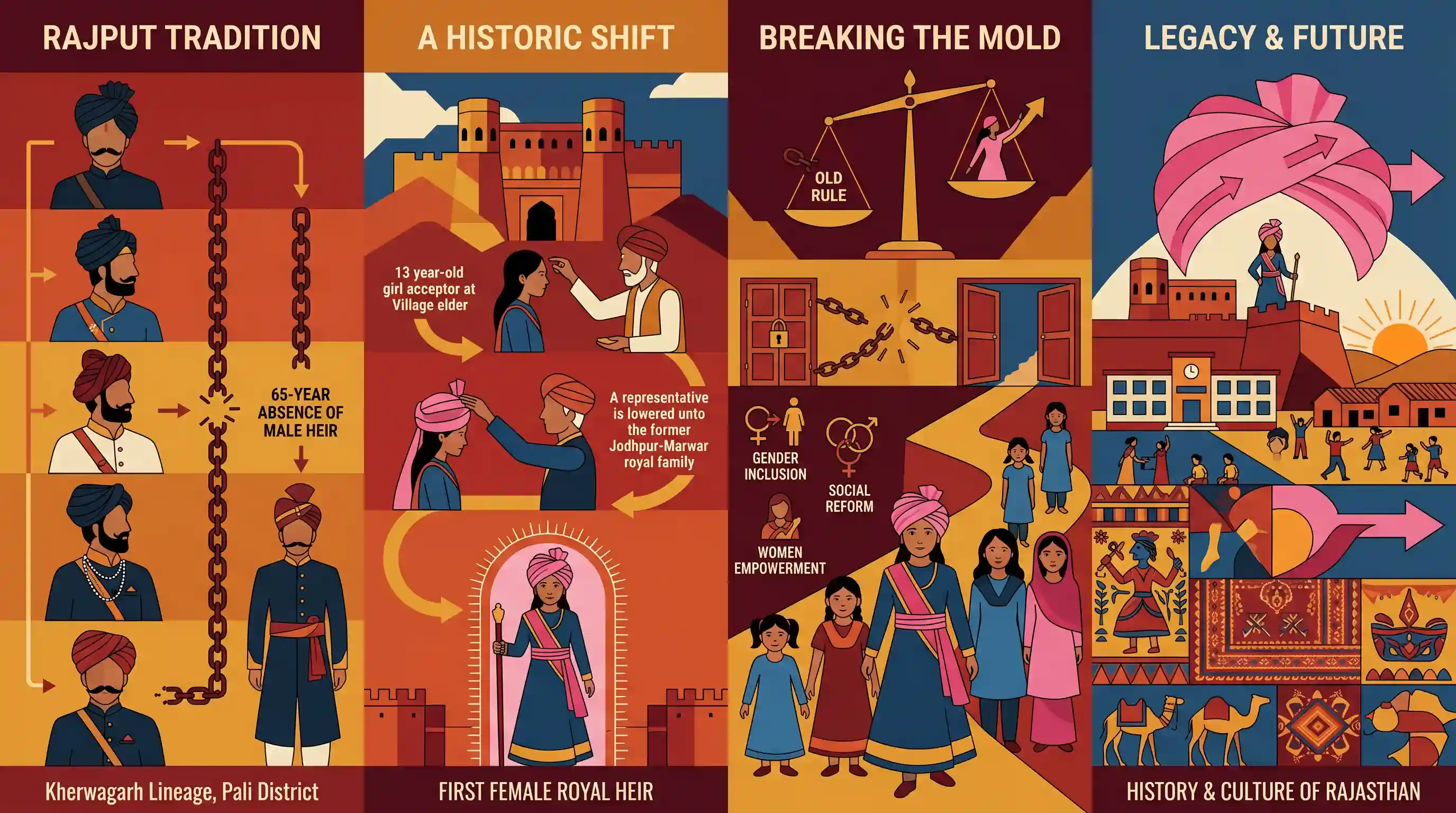
A 13-year-old girl, Tejaswi Kumari Jodha, has broken historical Rajput tradition by being named the first-ever female royal heir of the Kherwagarh lineage in Pali district, Rajasthan. Following the death of her father, Harish Chandra Jodha, she was anointed through the traditional 'Paag Ka Dastoor' ceremony at the 17th-century Kherwa Fort. Under the custom, a ceremonial pink turban sent by the former Jodhpur-Marwar royal family was placed on her head, marking the transfer of responsibility and leadership. The family had not performed the ceremony for 65 years due to the absence of a male heir, making this event a significant step forward for gender inclusion and social reform within traditional Rajasthani communities.
Key Points
- Tejaswi Kumari Jodha, a 13-year-old girl, broke centuries-old patriarchal tradition by becoming the first female heir to be anointed in the Kherwagarh lineage in Kherwa village, Pali district, Rajasthan.
- She succeeded her late father, Harish Chandra Jodha, through the traditional 'Paag Ka Dastoor' (turban succession ceremony).
- The ceremony had not been performed by the family for 65 years due to the rigid custom requiring a male heir, making this modern adaptation a major progressive milestone.
- A ceremonial pink turban, symbolizing the assumption of leadership and the end of mourning, was sent by the former royal family of Jodhpur-Marwar and placed on her head during the ritual.
- The ceremony took place at the historic 17th-century Kherwa Fort, with the local community collectively supporting the transition to promote gender equality.
Important Terms
Paag Ka Dastoor

A traditional Rajput turban-tying ceremony that marks the formal transfer of family leadership, moral responsibility, and inheritance from a deceased head of the family to their successor.
UPSC context
GS Paper I: Indian Heritage and Culture (customs); GS Paper II: Social Justice (women empowerment and gender reform).
Kherwagarh lineage
A historic Rajput ruling lineage based in the Pali district of Rajasthan, historically occupying the 17th-century Kherwa Fort and bound by customary regional succession practices.
UPSC context
GS Paper I: Art & Culture and History of Rajasthan; useful for studying regional feudal clans and socio-cultural inheritance structures.
Former royal family of Jodhpur-Marwar
The erstwhile ruling Rathore dynasty of the princely state of Jodhpur (Marwar) in Rajasthan, which historically holds customary suzerainty over several local Rajput estates.
UPSC context
GS Paper I: Modern Indian History and regional princely history; illustrates post-independence cultural roles of former royalty.
Kherwa Fort
A 17th-century historic fort in the Pali district of Rajasthan, showcasing traditional Rajput architecture and serving as the ancestral seat of the Kherwagarh lineage.
UPSC context
GS Paper I: Art and Culture (heritage and fort architecture of Rajasthan), reflecting regional military and cultural history.
Prelims Trap
A traditional Rajasthani Pagri is structurally shorter and broader than a Safa, allowing for casual and voluminous styling.
A Pagri is actually much longer (18-30m) and narrower (20cm) for tight formal folds, whereas a Safa is shorter (6-10m) and broader (1m) for a voluminous wrap.
Static Concepts Connected
What was the territorial and capital trajectory of the Rathore Dynasty of Marwar?
- Founding Seat: Established by Rao Siha in 1243 CE in the Pali region.
- Mandore Transition: Capital shifted to Mandore in 1395 CE by Rao Chunda, consolidating Rathore power.
- Jodhpur Era: Rao Jodha founded Jodhpur and built the Mehrangarh Fort in 1459 CE.
- Thikana System: Administered as semi-autonomous fiefdoms/baronies under the sovereign ruler of Jodhpur-Marwar.
How do traditional Rajasthani headgears and colors distinguish social status?
- Pagri Dimensions: Typically 18 to 30 meters long and 20 cm wide, wound into tight, formal lineage-associated folds.
- Safa Dimensions: Typically 6 to 10 meters long and 1 meter wide, offering a casual and voluminous wrap.
- Kasumal Dye: A deep red or crimson color derived specifically from the Kusum (safflower) flower, symbolizing joy and auspiciousness.
Cross-Topic Patterns
Feudal Customs vs Article 14
Adapting customary succession rites like Paag Ka Dastoor for women aligns centuries-old regional feudal identities with constitutional mandates of gender equality and dignity.
Natural Dyes and Material Culture
The use of Kasumal (safflower-derived crimson dye) in traditional textiles links historical trade routes, botany, and geographic indicators in Western India.

Medieval Marwar lineage shifts and material culture distinctions like Pagri vs Safa are highly viable for 2026 match-the-following.
Linked PYQs · 3
Linked PYQs · 3
- 2024RPSC_PRELIMSGS1
Which of the following colours is 'Kasumal', which is used in the costumes of Rajasthan?
- 2025RPSC_PRELIMSGS1
What color is ‘Kamal’ used in the attire of Rajasthan?
- 2023RPSC_PRELIMSGS1
Which of the following is not a hill fort of Rajasthan?
