Rajasthan Target for Daytime Agricultural Power Supply
Source:lokmattimes ↗
Why It Matters
Solar energy, rural power supply, and state utility reforms are highly testable areas in the RPSC RAS Prelims exam, which regularly features questions on scheme targets, specific village installations, and energy policies.
Summary
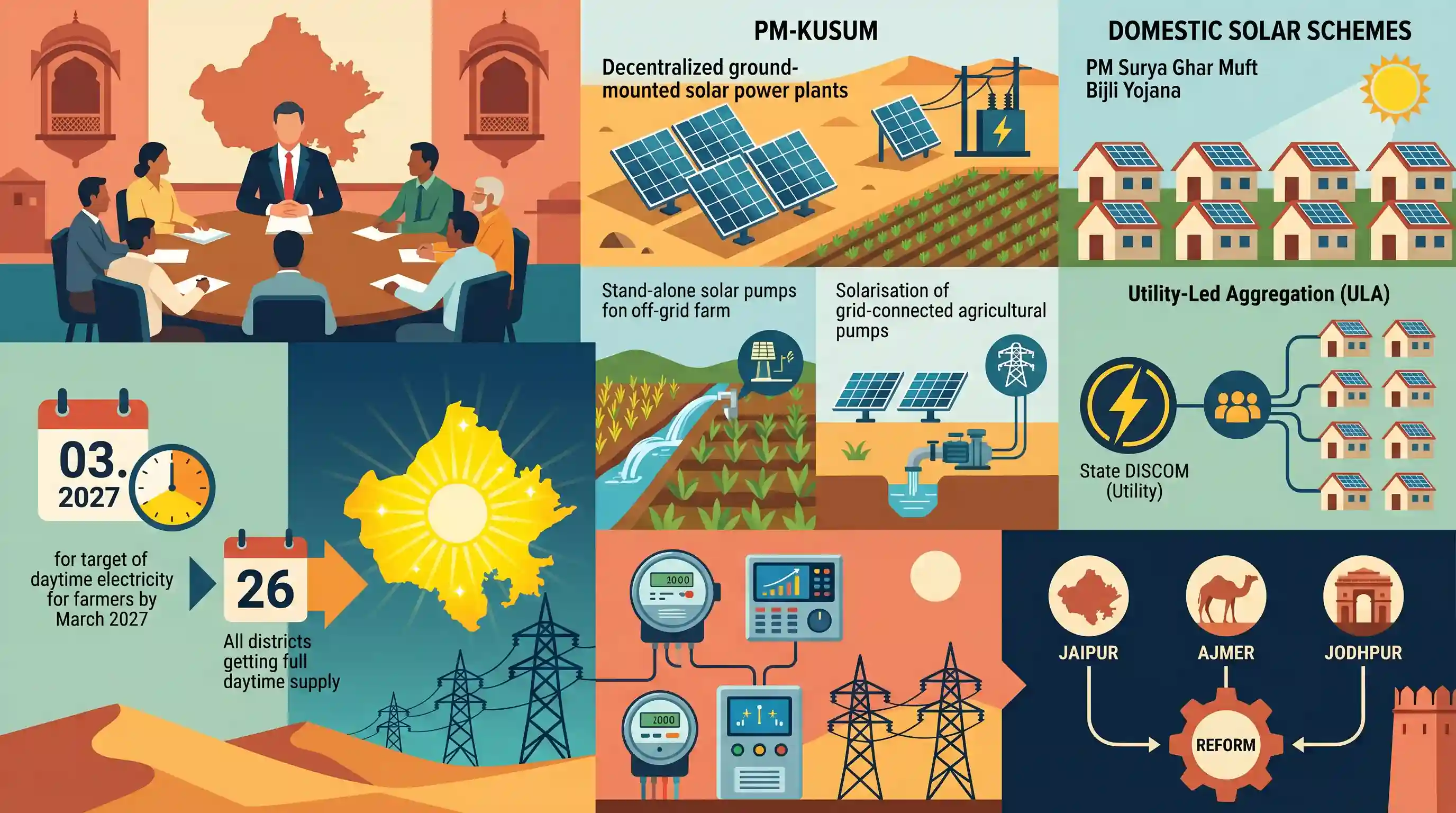
Rajasthan Chief Secretary V. Srinivas reviewed key energy and power initiatives across the state's three DISCOMs. The state has set a deadline of March 2027 to extend daytime electricity supply to farmers across all districts (currently available in 26 districts). The review highlighted progress in key solar schemes like PM-KUSUM, PM Surya Ghar Muft Bijli Yojana, and the Utility-Led Aggregation (ULA) model to boost domestic solar infrastructure.
Key Points
- March 2027 Target: The government of Rajasthan has established March 2027 as the target to provide daytime electricity supply to all farmers across the state.
- District Progress: Currently, agricultural daytime power supply is already functional in 26 districts of Rajasthan, with fast-tracked work underway in the remaining districts.
- PM-KUSUM Leadership: Rajasthan continues to rank among the top-performing states nationally in implementing the decentralized solar PM-KUSUM scheme.
- Rooftop Solar & ULA: Implementation of the PM Surya Ghar Muft Bijli Yojana and the Utility-Led Aggregation (ULA) model is being strictly monitored to accelerate rooftop solar adoption.
Important Terms
PM-KUSUM Scheme

A central scheme promoting agricultural solar energy through decentralized plants, standalone solar pumps, and grid-connected pump solarization to enhance farmers' income and de-dieselize the farm sector.
UPSC context
GS Paper III: Energy and Agriculture. Tests understanding of sustainable irrigation, farm-income boosting, and clean energy transition.
Pradhan Mantri Surya Ghar Muft Bijli Yojana
A central scheme aiming to provide up to 300 units of free monthly electricity to one crore Indian households by offering subsidies for residential rooftop solar installations.
UPSC context
GS Paper III: Renewable Energy and Infrastructure. Focuses on decentralized clean energy targets and residential solar adoption.
Utility-Led Aggregation (ULA) model
An implementation model under PM Surya Ghar where power distribution companies aggregate households and install rooftop solar systems on their behalf, easing barriers for economically weaker sections.
UPSC context
GS Paper III: Infrastructure and Energy Reforms. Tests understanding of structural interventions in utility-scale rooftop solar adoption.
Jaipur DISCOM
A state-owned power distribution company in Rajasthan responsible for supplying electricity in the Jaipur region and executing state energy reforms and agricultural solarization projects.
UPSC context
GS Paper III: Infrastructure and DISCOM Reforms. Tests understanding of state-level operational challenges and solar scheme execution.
Jodhpur DISCOM
A state-owned power distribution utility in western Rajasthan managing electricity supply across extensive arid zones and implementing agricultural feeder solarization under PM-KUSUM.
UPSC context
GS Paper III: Energy and Infrastructure. Analyzes geographic disparities, agricultural subsidy burdens, and regional solar implementation challenges.
Ajmer DISCOM
A state-owned electricity distribution company in central and southern Rajasthan, managing power supply, billing efficiency, and regional deployment of rooftop solar schemes.
UPSC context
GS Paper III: Infrastructure and Energy. Focuses on comparative state-level utility performance, efficiency, and debt management.
Prelims Trap
PM-KUSUM Component-A focuses on solarizing existing individual agricultural pumps.
Component-A targets setting up 0.5-2 MW grid-connected solar plants on barren land. Solarization of individual pumps falls under Component-B (off-grid) and Component-C (grid-connected pumps).
Static Concepts Connected
What are the three core components of the PM-KUSUM scheme?
- Component-A: Setting up 10,000 MW of grid-connected solar or other renewable energy plants (0.5 to 2 MW capacity) on barren/fallow land.
- Component-B: Installation of 20 lakh standalone solar-powered agricultural pumps to replace diesel pumps in non-grid areas.
- Component-C: Solarization of 15 lakh grid-connected agricultural pumps through both individual pump solarization and feeder-level solarization.
What is the Utility-Led Aggregation (ULA) model in solar deployment?
- Demand Bundling: DISCOMs aggregate demand from multiple low-income residential consumers to bypass individual upfront capital constraints.
- Financing & Execution: DISCOMs or designated developers fund and manage installation, recovering costs through energy tariffs or central subsidies.
- System Integration: Enhances grid stability by standardizing equipment quality and ensuring smooth net-metering integration directly managed by the utility.
Cross-Topic Patterns
Daytime Solar Power vs Groundwater Depletion
Providing reliable daytime power eases farmers' schedules but can trigger unchecked groundwater extraction unless paired with micro-irrigation and strict water budgeting.
Agricultural Solarization & DISCOM Debt
Feeder-level solarization directly addresses the structural cause of DISCOM losses—unmetered agricultural subsidies—by replacing high-cost grid supply with cheap, localized solar power.

UPSC may contrast PM-KUSUM components with PM Surya Ghar ULA model, focusing on grid integration vs decentralized solar ownership in 2026.
Linked PYQs · 4
Linked PYQs · 4
- 2023RPSC_PRELIMSGS1
Which agency has been given the responsibility of implementing the PM-KUSUM scheme (Component A) in Rajasthan, which involves the establishment of solar power plants with a capacity of 0.5 MW to 2 MW?
- 2021RPSC_PRELIMSGS1
In which village of Rajasthan was India's first agriculture-based “KUSUM” solar energy plant project launched?
- 2024RPSC_PRELIMSGS1
Which of the following statements about Rajasthan Multi Bijli Yojana is/are correct? A. Provide plants on one side to provide 100 solar plants. B. Subsidy for setting up rooftop solar panels. C. Provision of loan at book interest.
- 2021RPSC_PRELIMSGS1
In which year was the Rajasthan Solar Energy Policy announced?
