Rajasthan Reports Decline in SC ST Atrocity Cases via Fast Justice
Source:the-hans-india ↗
Why It Matters
The article is relevant for understanding state-level administrative frameworks (like the State-Level Vigilance and Monitoring Committee) designed to implement the SC/ST (Prevention of Atrocities) Act. It showcases the governance mechanisms required for protecting vulnerable groups, an important sub-topic under Polity and Social Justice for civil services exams.
Summary
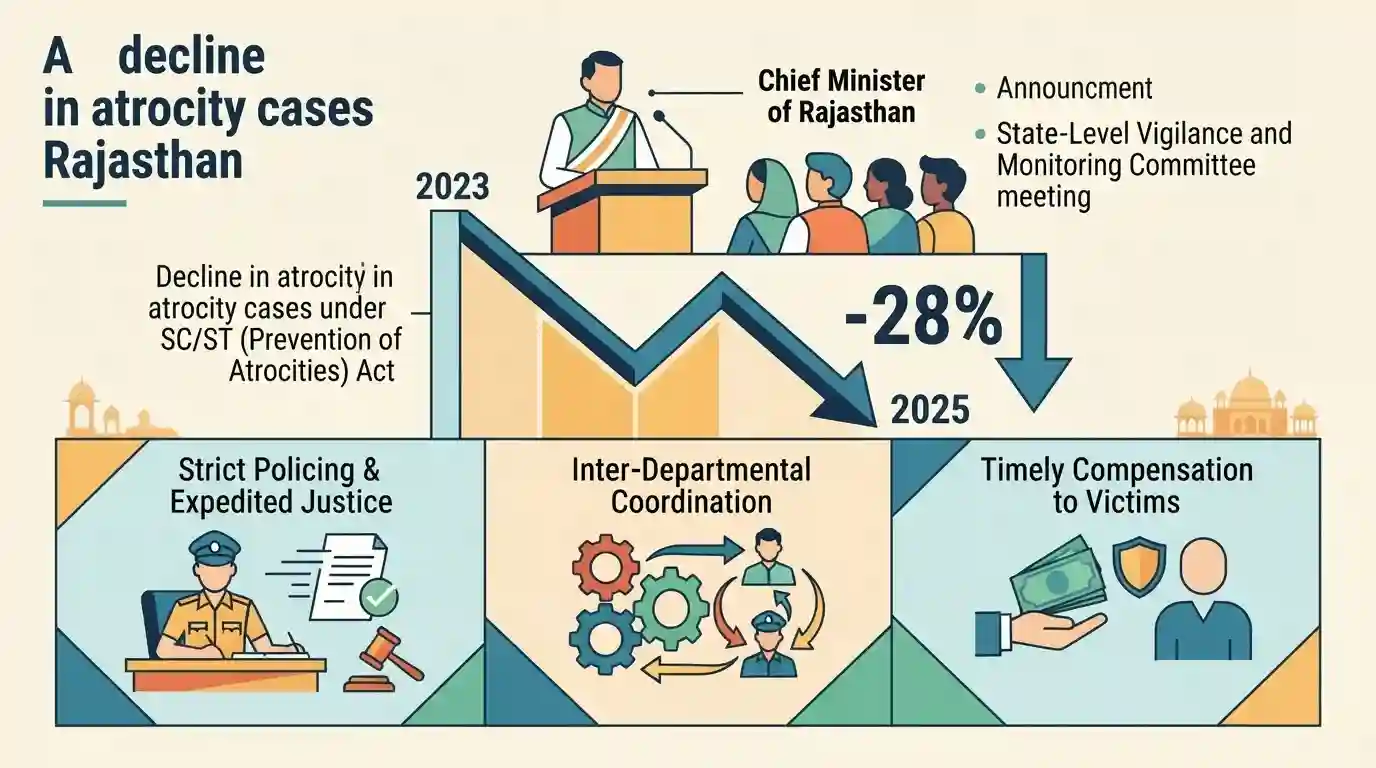
Rajasthan Chief Minister Bhajanlal Sharma announced a 28% decline in atrocity cases registered under the SC/ST (Prevention of Atrocities) Act between 2023 and 2025. During a State-Level Vigilance and Monitoring Committee meeting, he attributed this positive trend to strict policing and expedited justice delivery. The CM instructed police and administrative bodies to enhance inter-departmental coordination, ensure timely filing of chargesheets, and guarantee prompt financial compensation to victims in order to further strengthen the protection of vulnerable communities.
Key Points
- Rajasthan has reported a 28% decrease in cases under the SC/ST (Prevention of Atrocities) Act from 2023 to 2025.
- Chief Minister Bhajanlal Sharma emphasized the government's commitment to speedy justice and strict law enforcement against those committing atrocities.
- During a State-Level Vigilance and Monitoring Committee meeting, the CM directed proactive policing and intelligence-gathering to prevent caste-based conflicts.
- Inter-departmental coordination among Police, Social Justice, and Prosecution departments was stressed to ensure timely investigation, filing of challans, and disbursement of compensation.
Important Terms
SC/ST (Prevention of Atrocities) Act

A 1989 legislation penalizing crimes, discrimination, and humiliation against Scheduled Castes and Scheduled Tribes. It establishes special courts, denies anticipatory bail for offenders, and mandates comprehensive victim rehabilitation mechanisms.
UPSC context
Core topic in GS Paper II (Social Justice/Vulnerable Sections) for analyzing statutory protections and human rights safeguards.
State-Level Vigilance and Monitoring Committee
A statutory body chaired by the Chief Minister under the SC/ST (Prevention of Atrocities) Rules. It oversees the Act’s implementation, reviews prosecution efforts, and ensures prompt relief for victims.
UPSC context
Vital for GS Paper II (Statutory Bodies) to understand institutional mechanisms ensuring accountability and prompt justice delivery.
Social Justice and Empowerment Department
The nodal state-level agency overseeing welfare schemes, backward class empowerment, and the execution of the SC/ST Act, including providing timely financial compensation to victims of social atrocities.
UPSC context
Important for GS Paper II (Government Policies) evaluating the state machinery's effectiveness in protecting and uplifting vulnerable sections.
Prelims Trap
An absolute bar exists on anticipatory bail under the SC/ST Act, preventing courts from granting it under any circumstances.
In Prathvi Raj Chouhan (2020), the SC ruled that if the complaint does not prima facie disclose an offence under the Act, the bar under Section 18/18A does not apply, and anticipatory bail can be granted.
Static Concepts Connected
What is the constitution and mandate of the State-Level Vigilance and Monitoring Committee (SLVMC)?
- Chairmanship: Chaired by the Chief Minister of the respective State.
- Meeting Frequency: Mandated under Rule 16 of the 1995 Rules to meet at least twice a year, specifically in January and July.
- Core Mandate: Reviews the implementation of the Act, prosecution of cases, and the relief and rehabilitation facilities provided to victims.
How did the Supreme Court clarify the "place within public view" requirement under the SC/ST Act?
- Judicial Clarification: In Hitesh Verma v. State of Uttarakhand (2020), the Court ruled that an offence must occur in a place visible to the public.
- Private vs Public: An offence committed inside a private house with no public onlookers present does not satisfy the "public view" criteria.
- Caste Intent: The insult or intimidation must be specifically intended to humiliate the victim on account of their caste identity.
Cross-Topic Patterns
Judicial Review vs Legislative Sovereignty
The repetitive cycle of Supreme Court rulings diluting the SC/ST Act followed by Parliament enacting amendments (like Section 18A) highlights the delicate balance between judicial review and legislative intent.
Police Capacity and Social Justice
Delays in filing chargesheets (violating the 60-day Rule 7 limit) showcase how police understaffing and administrative bottlenecks directly compromise statutory social justice safeguards.

Prelims 2026 may test statutory exceptions to anticipatory bail and the 'public view' criteria under the SC/ST Act to assess legal literacy.
Linked PYQs · 2
Linked PYQs · 2
- 2025RPSC_PRELIMSGS1
Under Section 7 of the Rajasthan Lokayukta and Upa-Lokayukta Act, 1973, the Lokayukta has the power to investigate charges against ministers and public servants in certain cases. Which of the following is not part of those investigations?
- 2024RPSC_PRELIMSGS1
According to the Rajasthan Lokayukta and Deputy Lokayukta Act, 1973, the Lokayukta in Rajasthan can investigate allegations against ministers and public servants in certain cases. Which of the following subject is included in such cases? (i) Involves grievance/any suffering caused by public servant. (ii) Used his position as a public servant to obtain, for himself or for any other person, any valuable thing or financial benefit. (iii) Sexual harassment of woman, cause injury to any person. (iv) Can be related to being guilty of corruption of the trust reposed in him as a public servant.
