Rajasthan Receives Central Funds Under Jal Jeevan Mission
Source:rasonly ↗
Why It Matters
Water scarcity and rural infrastructure are critical issues in Rajasthan's semi-arid geography. Questions on central and state government schemes (like Jal Jeevan Mission and Atal Bhujal Yojana) and their financial allocations are repeatedly asked in the RPSC RAS Prelims under Rajasthan Economy and Governance sections.
Summary
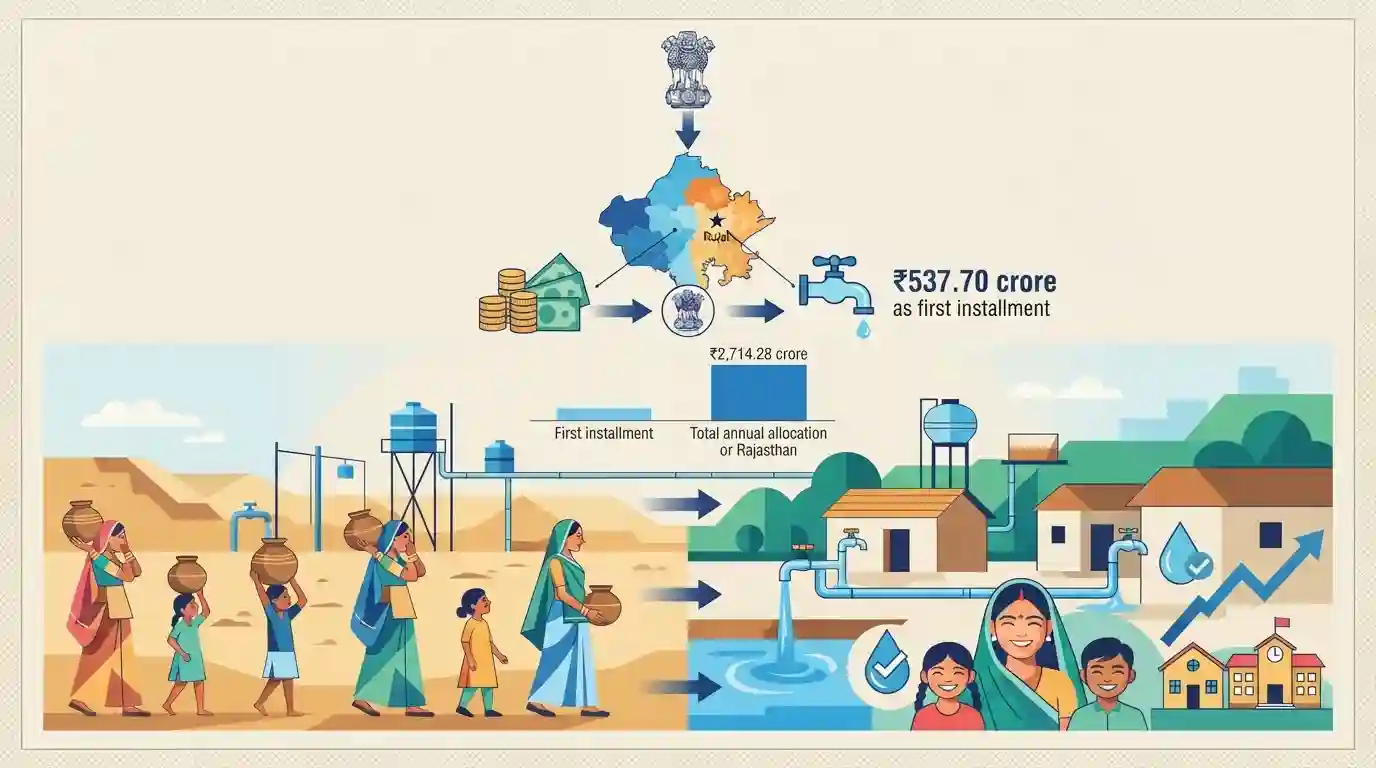
The Government of India has approved and released ₹537.70 crore as the first installment of central assistance to Rajasthan under the Jal Jeevan Mission (JJM) for the financial year 2026-27. Out of the total annual allocation of ₹2,714.28 crore for the state, these funds will expedite the provision of clean tap water to rural households. The initiative, part of the broader 'Har Ghar Jal' program spearheaded by the Ministry of Jal Shakti, aims to ensure equitable access to safe drinking water, thereby improving public health and socio-economic indicators in rural Rajasthan.
Key Points
- The Central Government has released ₹537.70 crore as the first tranche of central assistance to Rajasthan under the Jal Jeevan Mission (JJM) for the financial year 2026-27.
- The total allocation for Rajasthan under JJM for the 2026-27 fiscal year is ₹2,714.28 crore.
- The release of funds aims to accelerate the 'Har Ghar Jal' objective, which seeks to provide functional tap water connections to every rural household.
- This initiative underscores the government's focus on equitable distribution of water resources and improving rural health and living standards.
Important Terms
Jal Jeevan Mission (JJM)

A flagship Government of India initiative designed to provide safe and adequate drinking water through individual Functional Household Tap Connections to rural households. The 2.0 phase extends these targets for long-term water security.
UPSC context
GS-2 (Government Policies), GS-3 (Infrastructure). Tests knowledge of welfare schemes, rural development, and center-state fund allocation dynamics.
Har Ghar Jal
A core mandate of the Jal Jeevan Mission aiming to supply 55 liters of safe, potable tap water per capita per day to every rural household on a regular and long-term basis.
UPSC context
GS-2 (Welfare Schemes). Critical for analyzing socio-economic indicators, public health outcomes, and rural community empowerment.
Ministry of Jal Shakti
A nodal ministry formed in 2019 to consolidate water administration. It oversees water resources management, drinking water supply, rural sanitation, groundwater regulation, and major river rejuvenation programs.
UPSC context
GS-2 (Governance). Essential for understanding institutional frameworks managing India's water stress, sustainable resources, and national sanitation programs.
Prelims Trap
"Jal Jeevan Mission is a Central Sector Scheme providing 100% central funding to all Indian states."
JJM is a Centrally Sponsored Scheme, not Central Sector. Funding is shared 50:50 for general category states like Rajasthan, and 90:10 for Himalayan/NE states.
Static Concepts Connected
What are the core design features and service benchmarks of the Jal Jeevan Mission?
- Service Benchmark: Assures a regular, long-term supply of 55 litres per capita per day (LPCD) of potable tap water to every rural household.
- Decentralized Model: Relies on Village Water and Sanitation Committees (VWSCs/Pani Samitis) to manage infrastructure. At least 50% of members must be women.
- Funding Pattern: As a Centrally Sponsored Scheme, general states fund 50%, NE/Himalayan states fund 10%, while UTs receive 100% central funding.
Cross-Topic Patterns
Water Scarcity & Fiscal Federalism
Rajasthan has >10% of India's land but only 1.16% of surface water, increasing state dependence on Centre-funded water infrastructure for demographic survival.
Decentralized Governance & Gender
Mandating 50% female representation in Pani Samitis integrates natural resource management with grassroots political empowerment, echoing the goals of the 73rd Amendment.

A 2026 prelims question will likely test JJM 2.0's new 2028 deadline, 55 LPCD benchmark, and the 50% women quota in Pani Samitis.
Linked PYQs · 2
Linked PYQs · 2
- 2023RPSC_PRELIMSGS1
Which of the following statements is/are correct regarding the Atal Bhujal Yojana in Rajasthan? (a) The Atal Bhujal Yojana is being run by the Government of Rajasthan with financial assistance from the Government of India. (b) The focus of this scheme is to improve groundwater management and prevent its declining levels.
- 2023RPSC_PRELIMSGS1
Which of the following is not a part of the Rajasthan Urban Drinking Water, Sewage and Infrastructure Corporation Limited?
