Rajasthan Ranks Fourth Nationally in Jan Dhan Scheme Deposits
Source:timesofindia ↗
Why It Matters
Demonstrates the on-ground impact and success of PMJDY in achieving financial inclusion and women empowerment in Rajasthan. It provides critical data points for GS papers regarding the penetration of banking services and DBT mechanisms among economically weaker sections.
Summary
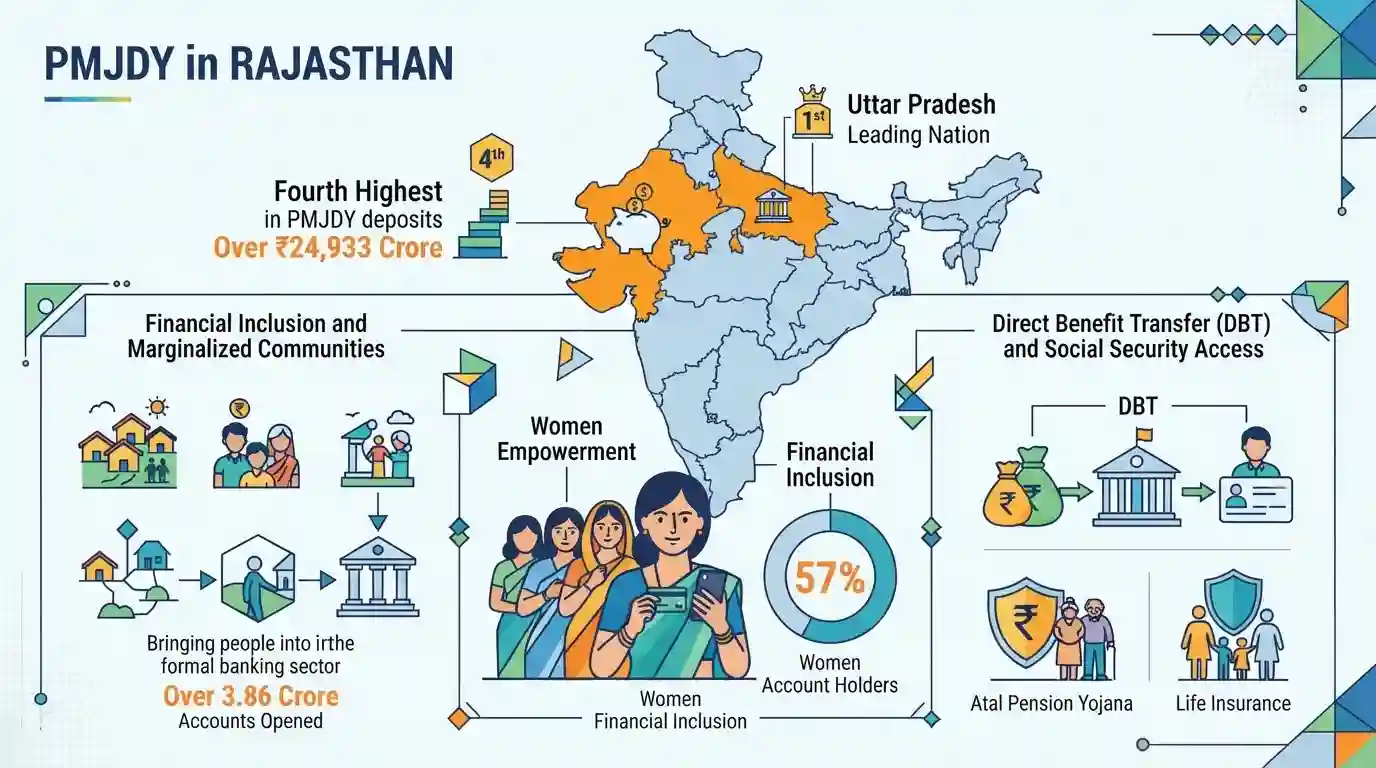
Rajasthan has emerged as the fourth highest state in the country in terms of deposits under the Pradhan Mantri Jan Dhan Yojana (PMJDY), accumulating over ₹24,933 crore. The scheme has successfully brought marginalized communities into the formal banking sector, with over 3.86 crore accounts opened in the state. Notably, 57% of these accounts belong to women, highlighting a strong push toward female financial inclusion. The initiative also forms the backbone for Direct Benefit Transfers (DBT) and enables access to social security programs like the Atal Pension Yojana and life insurance schemes. Uttar Pradesh currently leads the nation in total PMJDY deposits.
Key Points
- Rajasthan ranks fourth in the country in Pradhan Mantri Jan Dhan Yojana (PMJDY) deposits, holding over ₹24,933 crore.
- More than 3.86 crore PMJDY accounts have been opened in the state, bringing economically weaker sections into the formal banking system.
- Women hold 57% of these accounts (over 2.19 crore), which is slightly higher than the national average of 56%.
- Uttar Pradesh tops the national list with ₹67,206 crore in deposits, followed by Bihar, West Bengal, Rajasthan, and Maharashtra.
- Over 2.87 crore RuPay debit cards have been issued to account holders in Rajasthan, facilitating digital transactions, direct benefit transfers (DBT), and social security access.
Important Terms
Pradhan Mantri Jan Dhan Yojana (PMJDY)

A national mission for financial inclusion launched in 2014, offering unbanked citizens basic savings accounts with zero-balance requirements, indigenous RuPay debit cards, and access to credit, insurance, and pension services.
UPSC context
GS Paper III (Indian Economy & Issues relating to planning, mobilization of resources, growth, development); tests financial inclusion policies.
Atal Pension Yojana
A government-backed pension scheme launched in 2015 for unorganized sector workers, providing a guaranteed monthly pension (₹1,000–₹5,000) post-retirement at age 60, based on defined age-linked contributions.
UPSC context
GS Paper II (Social Justice/Welfare Schemes); tests social security nets and pension coverage for vulnerable, unorganized-sector workforces.
Pradhan Mantri Jeevan Jyoti Bima Yojana (PMJJBY)
A one-year government-backed term life insurance scheme renewable annually, offering ₹2 lakh cover for death due to any reason to individuals aged 18–50 with a bank account at an annual premium.
UPSC context
GS Paper II (Welfare Schemes) & GS Paper III (Indian Economy); tests financial safety nets and affordable insurance models.
Pradhan Mantri Suraksha Bima Yojana (PMSBY)
A one-year personal accident insurance scheme renewable annually, providing ₹2 lakh cover for accidental death/total disability and ₹1 lakh for partial disability to bank account holders aged 18–70 at an annual premium.
UPSC context
GS Paper II (Welfare Schemes) & GS Paper III (Indian Economy); tests financial vulnerability mitigation and affordable social insurance programs.
Direct Benefit Transfer (DBT)
A government mechanism to transfer subsidies and welfare benefits directly into beneficiaries' bank accounts, leveraging Aadhaar and the JAM trinity to minimize leakages, delays, and administrative intermediaries.
UPSC context
GS Paper III (Indian Economy/Subsidies/PDS); tests technological interventions in governance and efficiency in public spending.
Prelims Trap
PMJDY accounts do not earn interest and are automatically deactivated if a zero balance is maintained for six consecutive months.
Jan Dhan accounts earn normal savings bank interest. While keeping a zero balance is permitted indefinitely, active transactions are required only to keep the linked RuPay insurance cover active.
Static Concepts Connected
What are the core pillars of Pradhan Mantri Jan Dhan Yojana (PMJDY)?
- Zero Balance Savings: Accounts can be opened with zero balance; they are interest-bearing and have no minimum balance requirements or penalties.
- Insurance & Overdraft: Provides built-in accidental insurance cover of Rs 2 lakh through linked RuPay cards and an overdraft facility up to Rs 10,000.
How does the JAM Trinity enable Direct Benefit Transfer (DBT)?
- Targeted Identification: Aadhaar biometric data uniquely identifies beneficiaries, eliminating ghost accounts and leakages in welfare distribution.
- Direct Financial Delivery: Jan Dhan accounts linked to mobile numbers ensure funds flow directly from government treasuries into individual citizen accounts.
Cross-Topic Patterns
Financial inclusion + Federal demographics
Concentration of high deposits in UP, Bihar, and West Bengal highlights how regional population density and historic unbanking drive the scale of financial inclusion.
Gendered banking + Micro-social security
With women owning 57% of accounts, zero-balance banking serves as a key fiscal channel for gender-responsive budgeting and targeted welfare transfers.

Expect a GS-3 question analyzing PMJDY's evolution from a basic savings tool to a structural pillar for social security and DBT delivery.
Linked PYQs · 2
Linked PYQs · 2
- 2013RPSC_PRELIMSGS1
When was the Pradhan Mantri Jan Dhan Yojana launched?
- 2016RPSC_PRELIMSGS1
In the context of the PAHAL (PAHAL) scheme, choose the correct answer
