Rajasthan Ranks Among Top States in Higher Education Enrolment Growth
Source:social-news ↗
Why It Matters
Understanding the impact of the National Education Policy 2020 and specific central and state initiatives is crucial for assessing human development and social sector progress, which are heavily emphasized in RPSC and UPSC syllabi.
Summary
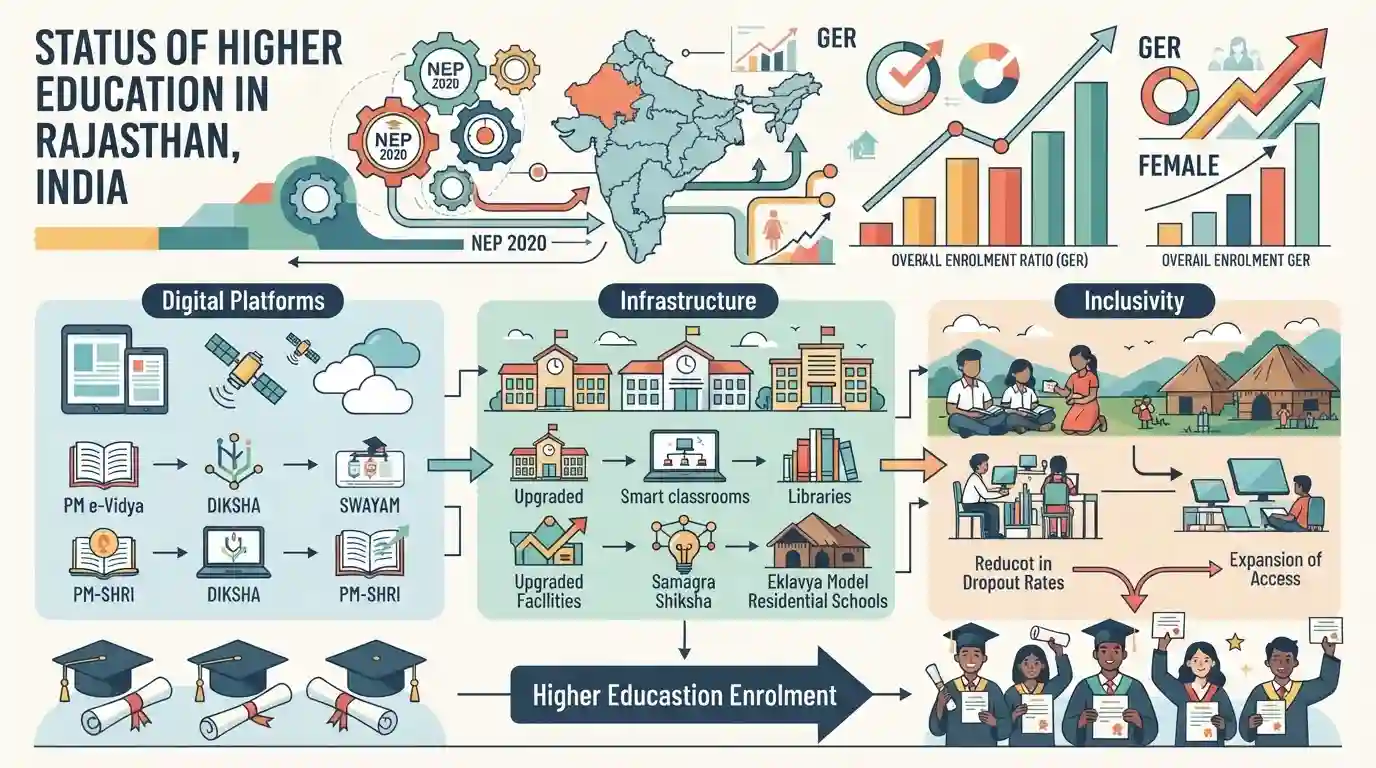
Rajasthan has emerged as one of the top seven states in India for higher education enrolment, largely due to the successful implementation of the National Education Policy (NEP) 2020 and various Central Government initiatives. The state has recorded a notable increase in the overall Gross Enrolment Ratio (GER) to 28.4%, with female GER surpassing the average at 28.5%. A combination of digital education platforms like PM e-Vidya, DIKSHA, and SWAYAM, along with infrastructure and inclusivity programs such as PM-SHRI, Samagra Shiksha, and Eklavya Model Residential Schools, has been instrumental in reducing dropout rates and enhancing educational access in rural and tribal areas.
Key Points
- Rajasthan has ranked among the top seven states in India for higher education enrolment.
- The overall Gross Enrolment Ratio (GER) in higher education has increased from 23.7% to 28.4%.
- Female GER in higher education has shown significant improvement, rising from 22.9% to 28.5%.
- Success is attributed to the National Education Policy (NEP) 2020 and digital initiatives like PM e-Vidya, DIKSHA, and SWAYAM.
- Infrastructure and inclusivity schemes such as PM-SHRI, PM-USHA, and Eklavya Model Residential Schools have reduced dropout rates and expanded access.
Important Terms
National Education Policy (NEP) 2020

A comprehensive framework launched to reform school and higher education in India. Built on five pillars—Access, Equity, Quality, Affordability, and Accountability—it replaces the 1986 policy and introduces a 5+3+3+4 school structure.
UPSC context
GS Paper II: Social Justice/Education; tests understanding of national policy reforms, governance, and human resource development.
Samagra Shiksha
A centrally sponsored scheme for school education from pre-school to Class 12. It integrates Sarva Shiksha Abhiyan, Rashtriya Madhyamik Shiksha Abhiyan, and Teacher Education to ensure universal access, equity, and quality.
UPSC context
GS Paper II: Social Justice/Education; tests knowledge of centrally sponsored schemes, child education rights, and learning outcome initiatives.
PM-SHRI
A centrally sponsored scheme (Pradhan Mantri Schools for Rising India) launched in 2022 to upgrade and develop over 14,500 government schools. It aims to showcase NEP 2020's vision as model exemplar schools.
UPSC context
GS Paper II: Social Justice/Education; tests understanding of model school infrastructure, cooperative federalism, and implementation of NEP 2020.
PM-USHA
A centrally sponsored scheme (Pradhan Mantri Uchchatar Shiksha Abhiyan) launched in June 2023. It provides strategic funding to upgrade state-run universities and colleges, ensuring equity, quality, and alignment with NEP 2020.
UPSC context
GS Paper II: Governance/Education; tests knowledge of higher education funding, institutional quality improvement, and regional equity.
Eklavya Model Residential Schools
A flagship Ministry of Tribal Affairs initiative launched in 1997-98 to provide completely free, quality CBSE-pattern residential secondary education (classes VI to XII) to Scheduled Tribe students in remote and tribal areas.
UPSC context
GS Paper II: Welfare of Vulnerable Sections; tests knowledge of tribal development schemes, constitutional rights, and educational inclusion.
DIKSHA
Digital Infrastructure for Knowledge Sharing is a national digital portal launched in 2017. Led by NCERT, it provides curriculum-linked e-content, energized textbooks, and teaching aids for school education across India.
UPSC context
GS Paper II: E-governance/Education; tests understanding of digital public infrastructure in school education and national learning platforms.
SWAYAM
Study Webs of Active-Learning for Young Aspiring Minds is an indigenous Massive Open Online Courses platform launched in 2017. It provides free, interactive, high-quality classes from Class 9 to post-graduation.
UPSC context
GS Paper II: Social Justice/Education; tests knowledge of digital education platforms, online learning policy, and bridging the digital divide.
PM e-Vidya
A comprehensive digital initiative launched in May 2020 under the Atmanirbhar Bharat Abhiyaan. It unifies digital, online, and on-air education to enable multi-mode learning access and bridge the digital divide.
UPSC context
GS Paper II: Social Sector/Education; tests knowledge of digital public infrastructure, crisis-response education models, and remote-learning accessibility.
Prelims Trap
The National Education Policy 2020 aims to achieve a 100% Gross Enrolment Ratio (GER) in higher education by 2030.
NEP 2020 differentiates its timelines: 100% GER is targeted for school education by 2030, whereas the target for higher education is 50% GER by 2035.
Static Concepts Connected
What is the Gross Enrolment Ratio (GER) and how is it calculated in Higher Education?
- Definition: It is the ratio of total enrolment in a specific level of education to the population of the corresponding official age group.
- Age Cohort: In India, the standard age cohort used for calculating higher education GER is 18–23 years.
- AISHE Survey: The data is monitored and published annually via the All India Survey on Higher Education (AISHE) by the Ministry of Education.
What is the PM-USHA scheme and its core mandate?
- Nomenclature: Formerly RUSA, Pradhan Mantri Uchchatar Shiksha Abhiyan (PM-USHA) is a Centrally Sponsored Scheme supporting state-level higher education institutions.
- Key Focus: It is designed to implement NEP 2020 reforms by strategically funding state universities to improve access, equity, and quality.
Cross-Topic Patterns
DPI in education and social equity
Platforms like DIKSHA and SWAYAM leverage India's open-source digital architecture to democratize learning, illustrating how digital public infrastructure directly bridges rural-urban social divides.
Demographic dividend and GER targets
Achieving high-quality higher education GER is critical for India to transform its youth population into skilled human capital, avoiding the demographic trap of high youth underemployment.

UPSC may couple NEP 2020 milestone targets (2030 vs 2035) with digital initiatives like SWAYAM/DIKSHA in a multi-statement Prelims question.
Linked PYQs · 3
Linked PYQs · 3
- 2023RPSC_PRELIMSGS1
Which scheme aims to improve the health and nutritional status of pregnant women and lactating mothers and their infants (0 to 6 months) by promoting the use of appropriate practices, care, and services during pregnancy, safe delivery, and breastfeeding?
- 2023RPSC_PRELIMSGS1
Which of the following options describes a key objective of the Indira Mahila Shakti Udan Yojana?
- 2024RPSC_PRELIMSGS1
Who among the following are eligible for Aastha Scheme in Rajasthan? (i) Persons with specially abled category. (ii) Specially abled category with more than 40 percent disability. (iii) If people are specially abled 2 or more people are specially abled. (iv) Families with 2 or more specially abled persons.
