Rajasthan Police Cyber Advisory Against Overseas Job Cyber Slavery
Source:the-print ↗
Why It Matters
Highlights the evolving nature of transnational cyber crimes and human trafficking. Relevant for questions on cyber security challenges, MEA initiatives (eMigrate), and state police measures to protect citizens from organized transnational crime.
Summary
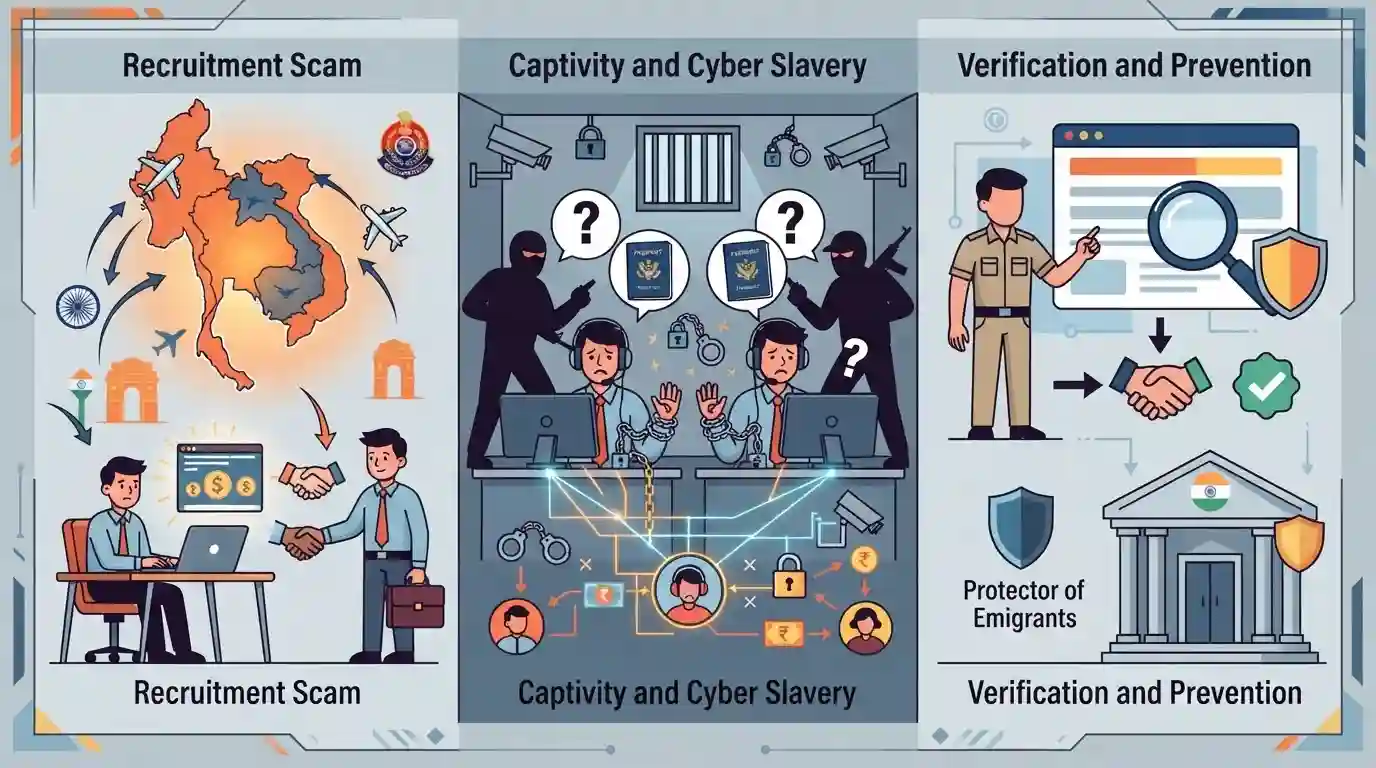
The Rajasthan Police's Cyber Crime Branch has issued an advisory warning unemployed youth, especially IT professionals, about fraudulent overseas job scams leading to 'cyber slavery'. Criminal syndicates lure youths with promises of high-paying jobs in Southeast Asian countries (Cambodia, Myanmar, Laos, and Thailand). Once there, victims are held captive, their passports are confiscated, and they are forced to carry out cyber frauds against Indians. Authorities advise verifying recruitment agents via the MEA's eMigrate portal and the Protector of Emigrants.
Key Points
- The Rajasthan Police Cyber Crime Branch has issued a public advisory warning educated youth against falling for fraudulent overseas job offers.
- Scammers primarily target youth with IT skills, promising lucrative jobs in data entry and customer support in Southeast Asian countries like Cambodia, Laos, Myanmar, and Thailand.
- Upon arrival, victims' passports are confiscated, and they are forced into 'cyber slavery', being coerced to execute online financial frauds and scams targeting Indian citizens.
- The advisory urges job seekers to verify the credentials of recruitment agents through the Ministry of External Affairs' eMigrate portal and the Protector of Emigrants.
Important Terms
Cyber Slavery

A modern form of human trafficking where individuals are lured by fake overseas job offers, physically confined, and coerced by criminal syndicates into committing cybercrimes like financial fraud and phishing.
UPSC context
GS Paper 3 (Internal Security). Tests knowledge of the dangerous convergence between human trafficking, transnational organized crime, and digital fraud.
eMigrate Portal
An MEA digital platform designed to automate and regulate the emigration process. It registers authorized recruiting agents and foreign employers, ensuring safe and legal overseas mobility for Indian workers.
UPSC context
GS Paper 2 (e-Governance, Indian Diaspora). Highlights digital diplomacy and state interventions safeguarding migrant workers from exploitation and illegal recruitment.
Protector of Emigrants
A statutory authority established under the Emigration Act, 1983. Operating under the MEA, it issues emigration clearances, regulates recruiting agencies, and safeguards intending emigrants from fraudulent overseas job scams.
UPSC context
GS Paper 2 (Statutory Bodies). Crucial for understanding the legal and institutional frameworks designed to prevent human trafficking and labor exploitation.
Ministry of External Affairs
The nodal government ministry managing India's foreign relations, diplomatic missions, and the welfare of the Indian diaspora. It oversees the Emigration Act and coordinates international rescues of trafficked citizens.
UPSC context
GS Paper 2 (International Relations). Focuses on the Ministry's role in protecting Indian citizens abroad and coordinating bilateral responses to transnational crime.
Rajasthan Police Cyber Crime Branch
A specialized state law enforcement unit dedicated to investigating digital offenses, tracking transnational cyber fraud networks, and issuing public advisories to prevent citizens from falling victim to online scams.
UPSC context
GS Paper 3 (Cyber Security, Internal Security). Demonstrates the critical role of state-level police forces in mitigating advanced transnational cyber threats.
Prelims Trap
The NIA cannot investigate human trafficking or cyber-terrorism if the offence is committed outside Indian territory.
The NIA (Amendment) Act, 2019 granted the agency extraterritorial jurisdiction to investigate scheduled offences like human trafficking and cyber-terrorism committed against Indians abroad.
Static Concepts Connected
What are the key extraterritorial provisions of the NIA (Amendment) Act, 2019?
- Extraterritorial reach: Empowers the NIA to investigate scheduled offences committed outside India against Indian citizens or interests, subject to international treaties.
- Expanded offences: Added human trafficking, cyber-terrorism, counterfeit currency, and explosive substances to the list of Scheduled Offences.
How does the Emigration Act 1983 protect Indian workers going abroad?
- Statutory Authority: The Protector General of Emigrants (under MEA) serves as the statutory authority to protect the interests of Indian workers abroad and register recruiting agents.
- ECR Category: Passports without matriculation fall under the ECR category, legally requiring Emigration Clearance from the Protector of Emigrants before traveling to 18 designated countries.
- eMigrate Portal: A centralized digital platform by the MEA that integrates with DigiLocker and Passport Seva to register certified agents and prevent fraudulent hiring.
Cross-Topic Patterns
Golden Triangle to Cyber Crime hubs
The 'Golden Triangle' (Myanmar, Laos, Thailand) is evolving from traditional narcotics trafficking to operating transnational cyber-scam compounds, complicating regional security matrices.
Trafficking shifts to white-collar skills
Human trafficking is no longer confined to unskilled labor; criminal syndicates now actively target educated IT professionals for 'cyber slavery' and complex financial frauds.

Expect a multi-statement prelims question interlinking NIA's extraterritorial jurisdiction, cyber-terrorism, and MEA's eMigrate portal.
