Rajasthan Police Signs Training MoU with University of Manchester
Source:careers360 ↗
Why It Matters
This MoU demonstrates innovative approaches in state governance and police reform by leveraging international institutional collaborations to address specialized administrative challenges, such as capacity building and mental health within the police force. This is highly relevant for state-specific administrative initiatives and human resource development topics in the RPSC RAS syllabus.
Summary
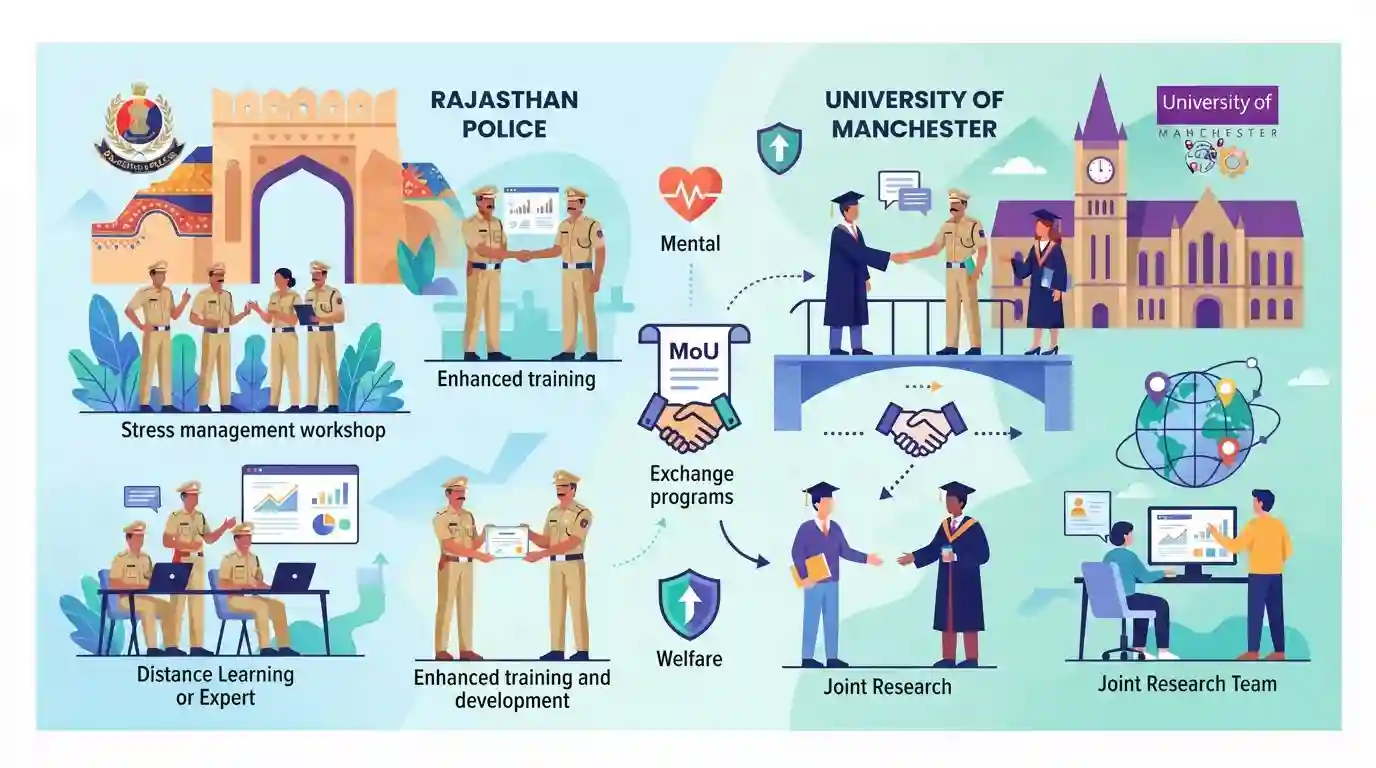
The Rajasthan Police has signed a five-year Memorandum of Understanding (MoU) with the University of Manchester to enhance police training, welfare, and mental health support. The collaboration, initiated through the Rajasthan Police Academy and the university's School of Health Sciences, aims to address critical issues such as stress management and the concerning rate of suicides among police personnel. The agreement facilitates international exchange programs, joint research, distance learning, and expert interactions to integrate global research expertise with Rajasthan Police's field experience.
Key Points
- The Rajasthan Police Academy signed a 5-year Memorandum of Understanding (MoU) with the UK-based University of Manchester.
- The agreement focuses on cooperation in police welfare, mental health, professional training, and research.
- Initial collaboration will involve the university's School of Health Sciences to specifically address stress management and mental health support for police personnel.
- The partnership includes student and researcher exchange programs, distance learning, joint teaching initiatives, and PhD co-supervision.
- DGP Rajeev Kumar Sharma highlighted the urgent need for focused research and recommendations to curb the rising incidents of suicides among police personnel.
Important Terms
Rajasthan Police-University of Manchester MoU

A five-year bilateral agreement focusing on police welfare, mental health, and stress management. It facilitates joint research, distance learning, and international exchange programs to reduce police suicides.
UPSC context
Relevant for GS Paper II (Governance) & III (Internal Security) regarding police reforms, capacity building, and mental health of security personnel.
Rajasthan Police Academy
A premier police training institution located in Jaipur, Rajasthan. Under the new MoU, it serves as the nodal agency integrating global research with field experience for policing improvements.
UPSC context
Highlights institutional mechanisms for human resource development, training, and the modernization of police forces in GS Paper II and III.
School of Health Sciences
A department within the University of Manchester collaborating with Rajasthan Police. It provides specialized academic and research expertise focusing on mental health, social care, and law enforcement welfare.
UPSC context
Demonstrates the role of specialized academic institutions in providing evidence-based policy inputs for governance and internal security (GS Paper II).
Prelims Trap
Police and public order fall under the Concurrent List, enabling the Union to mandate training MoUs.
Police and Public Order are strictly State List subjects (List II, 7th Schedule). Consequently, state governments have independent jurisdiction over police administration and training.
Static Concepts Connected
Which key committees and directives frame the police reform discourse in India?
- NPC (1977-81): The first comprehensive review post-independence, which recommended structural changes to avoid political interference.
- Padmanabhaiah (2000): Focused extensively on lowering recruitment age, modernizing training, and addressing human resource challenges.
- Prakash Singh (2006): Supreme Court issued binding directives, including separating investigation from law and order duties.
What drives high attrition and suicide rates in India's uniformed forces?
- Operational stress: Prolonged deployment, routine denial of leave, and poor living conditions exacerbate psychological strain.
- Command toxicity: Humiliation by superiors and the lack of robust grievance redressal mechanisms are frequently cited by MHA task forces.
- Mental health stigma: The fear of being deemed 'unfit' prevents personnel from seeking timely psychological counseling or institutional help.
Cross-Topic Patterns
Sub-national diplomacy (Paradiplomacy)
States signing MoUs with foreign universities highlights 'paradiplomacy', where sub-national governments independently engage global actors for governance capacity building without relying entirely on Union channels.
Mental Health in Uniformed Services
Moves beyond physical modernization of police forces to viewing psychological welfare as vital internal security capital, aligning with the principles of the Mental Healthcare Act 2017.

Mains GS2/GS3 questions on police reforms are shifting from structural changes (Prakash Singh) to human-centric capacity and mental health.
Linked PYQs · 3
Linked PYQs · 3
- 2025RPSC_PRELIMSGS1
Under which article of the Constitution is there a mandatory consultation provision with the Rajasthan Public Service Commission in disciplinary cases affecting serving personnel under the Government of Rajasthan?
- 2025RPSC_PRELIMSGS1
What has been formed in place of the Chief Minister Rajasthan Economic Reforms Advisory Council (CMRETAC)?
- 2023RPSC_PRELIMSGS1
Which company was established by the Government of Rajasthan in the 21st century with the objective of developing information technology (IT) skills?
